Midrange
Axiom Paradox flight numbers
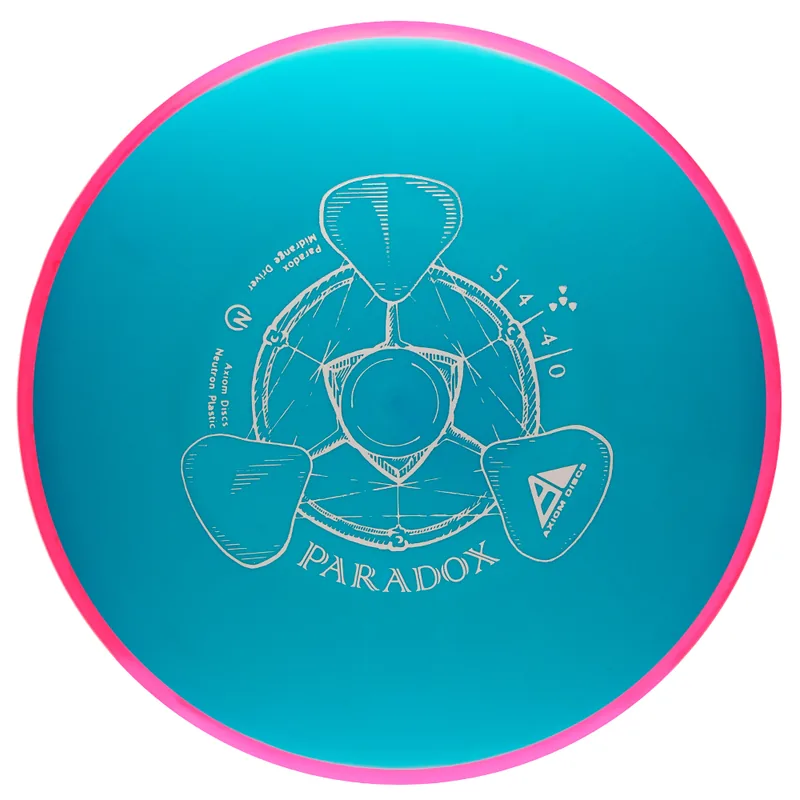
The Axiom Paradox is among the most understable midranges made, rated 5 / 4 / -4 / 0.
Manufacturer model-page ratings. Manufacturer ratings · How to read them
Choose it for
Rollers and turnover shots. Axiom says high-power players use it for rollers, low-speed flip-ups and big nose-up anhyzers, while low-power players get a first midrange for straight or hyzer-flip flights.
Choose something else if…
You need a midrange you can trust in wind. The Paradox will flip.
What the Paradox flight numbers mean
Turn -4 with no fade means a flat backhand keeps turning right. For a slow arm that can look straight; for a strong arm it rolls.
SEE THE SHAPE
Paradox flight path
Illustrative top view of the published ratings, not a measured flight. How the curve is drawn
Compare the Paradox flight shape with the Hex →
Which version are you buying?
The Paradox is in Axiom’s 13 mm midrange class with the Hex. Axiom also suggests it as a teaching disc, and weights run 165–179 g.
| Plastic or scope | Weight |
|---|---|
| Model-page range (not plastic-specific) | 165–179 g (about 5.8–6.3 oz) |
| Diameter | 21.5 cm (about 8.5 in) |
|---|---|
| Rim width | 1.3 cm (about 0.51 in) |
Source: Axiom Paradox, checked 2026-10-17. How to choose a disc weight
Discs with flight numbers like the Paradox
- Latitude 64° Pearl · 4 / 6 / -4 / 0 (-1 speed, +2 glide)
- Discraft Archer · 5 / 4 / -4 / 1 (+1 fade)
- Discraft Stratus · 5 / 4 / -4 / 1 (+1 fade)
- Divergent Discs Leviathan · 5 / 4 / -3 / 0 (+1 turn)
- Gateway Mystic · 5 / 5 / -3 / 0 (+1 glide, +1 turn)
Read about the Axiom Hex or compare the Paradox and Hex side by side.