DISCFIELD / Learn
Disc golf flight numbers, explained

The four numbers on a disc are a starting point for choosing what to try. They describe an intended flight, not a promise about the shot you will throw.
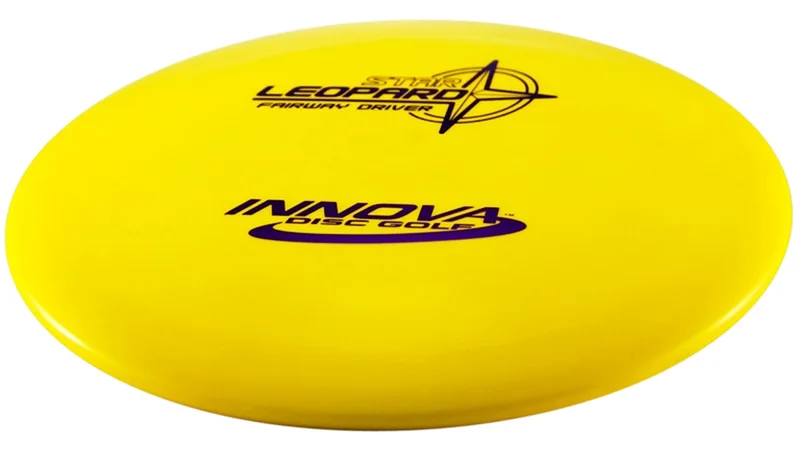
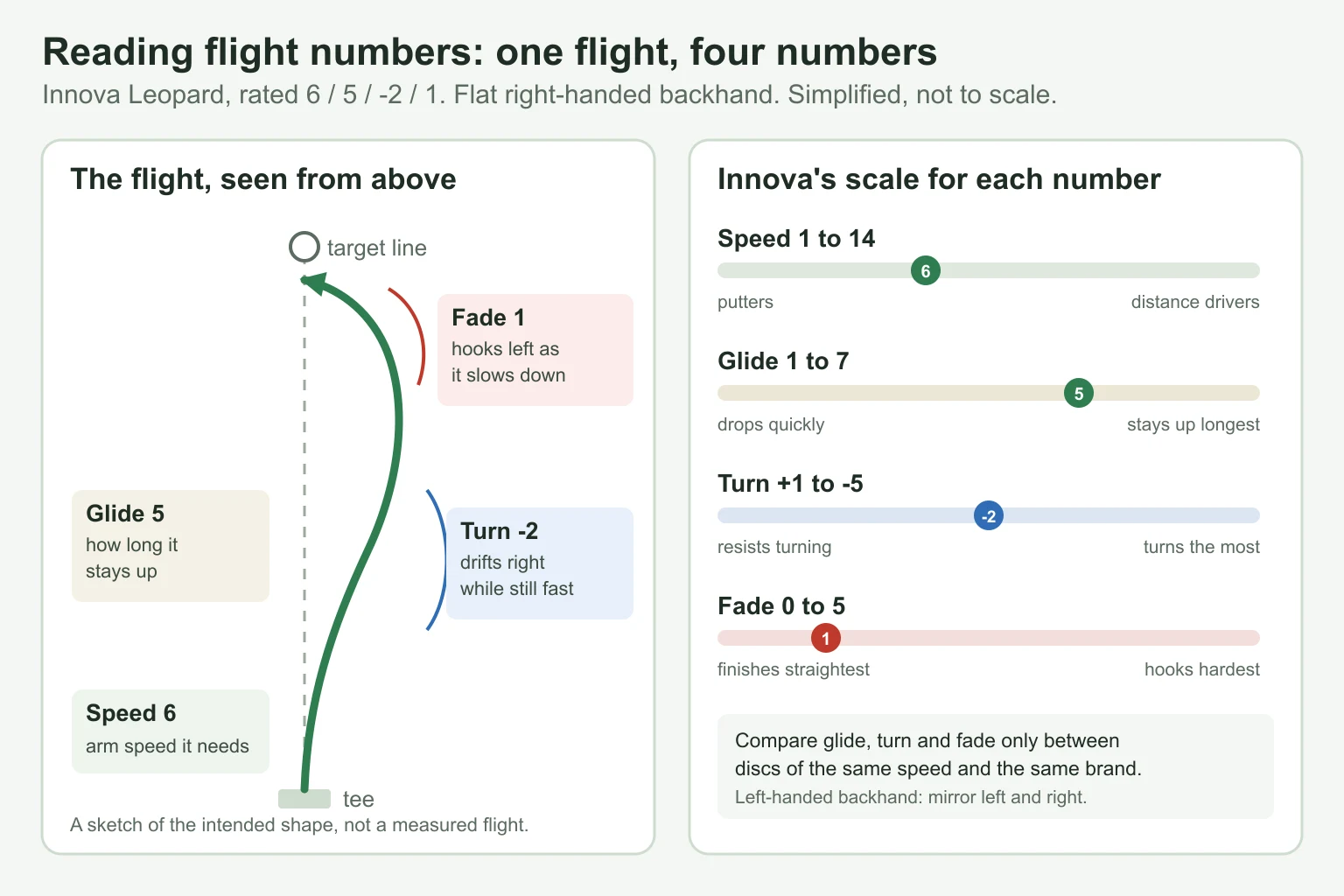
Disc golf flight numbers are speed, glide, turn and fade, printed in that order. Speed says how fast the disc is built to fly, glide says how well it stays up, turn describes the early drift to the right and fade the hook to the left at the end (for a right-handed backhand). A label such as 6 / 5 / -2 / 1 on an Innova Leopard describes a moderately fast disc with good glide, some early turn and a gentle finish. This guide goes through each number, the ranges by disc type and the common misreadings, then shows how to use the label when you pick your next disc.
Read the numbers in order
Innova uses speed, glide, turn, fade. Its ratings are comparative; they are not standardized measurements across manufacturers.
| Number | What it describes | What it does not tell you |
|---|---|---|
| Speed | The disc’s speed class; faster models need more throwing power to perform as intended. | How far you personally will throw it. |
| Glide | Its tendency to stay aloft. | A guaranteed extra distance. |
| Turn | Early-flight turning tendency, toward the right for a right-handed backhand. More negative means more tendency to turn. | Where the disc will land. |
| Fade | Finishing tendency, toward the left for a right-handed backhand. Higher means a stronger finish. | An angle measured in degrees. |
Innova cautions against comparing glide, turn and fade across different speed classes, or treating numbers across brands as equivalent. Plastic, wear and the thrower can change the result. See Innova’s flight-rating explanation (checked September 8, 2026, and again October 16, 2026).
On Innova's scale, speed runs from 1 to 14, glide from 1 to 7, turn from +1 to -5 and fade from 0 to 5. Innova designed the system around the right-handed backhand, and its co-founder Dave Dunipace developed it to describe how different discs fly (Innova's in-depth explanation, checked October 16, 2026). Other brands print the same four numbers, but each rates its own discs.
Speed: how fast the disc is built to fly
Speed is the rate a disc is designed to fly at. Higher-speed discs generally have a wider rim and need more arm speed to fly the way the label says. Our records follow that pattern. The Aviar has a 0.9 cm rim and speed 2, the Mako3 1.2 cm and speed 5, the Leopard 1.6 cm and speed 6, and the Boss 2.5 cm and speed 13.
Speed is the number that sorts discs into types. Across the 75 discs in our records the ranges look like this:
| Disc type | Speed in our records | Typical use |
|---|---|---|
| Putter and approach | 2 to 4 | Putting and short, controlled approaches |
| Midrange | 4 to 5 | Straight shots and approaches up to about 300 feet |
| Fairway driver | 6 to 9 | Controlled tee shots |
| Distance driver | 10 to 14 | Maximum distance for players with the arm speed for it |
Innova does not recommend high-speed discs for beginners, because they need more power to fly properly. A newer player who throws a speed 12 driver usually gets a disc that never reaches its intended speed, so it fades out early. Faster discs do cut into a headwind with less effort, which is why some newer players carry one as a headwind disc while throwing slower discs the rest of the time. Our distance driver guide covers when a faster disc starts to pay off.
Glide: how long the disc stays up
Glide describes a disc's ability to hold loft, from 1 to 7 on Innova's scale. A glide 1 or 2 disc drops out of the air quickly. The Animal (2 / 1 / 0 / 1) is an example, built as a short-range approach disc. A glide 5 or 6 disc stays up longer and is easier to throw far with no wind or a tailwind.
Innova recommends more glide for new players and for maximum distance, and less glide in strong wind, where a high-glide disc gets pushed around more and its distance is harder to control. Glide is a tendency, so a glide 6 disc does not add a fixed number of feet to your throw.
Turn: the early drift
Turn, also called high-speed turn, is the tendency of a disc to bank to the right early in the flight on a right-handed backhand. The scale runs from +1, most resistant to turning, to -5, the most turn. Innova's Mamba, rated 11 / 6 / -5 / 1, sits at that limit; Innova says it has more high-speed turn than any of its other long-range drivers. Innova notes that discs rated -3 to -5 make good roller discs; the Roadrunner at 9 / 5 / -4 / 1 is one of them in our records. See our roller guide for that shot.
Turn depends on speed. Innova's technical note says a disc thrown faster than its optimum speed turns more, and one thrown slower turns less, if at all. That explains why a disc with -2 turn can drift right for a strong player and fly fairly straight for a beginner. Turn also covers a disc rising out of a hyzer: a disc with lots of turn released on a strong hyzer angle may only flip up to flat and fly straight, which is the idea behind the hyzer flip.
Innova says discs with more turn are easier for beginners to throw, while discs with less turn are more accurate in the wind.
Fade: the finish
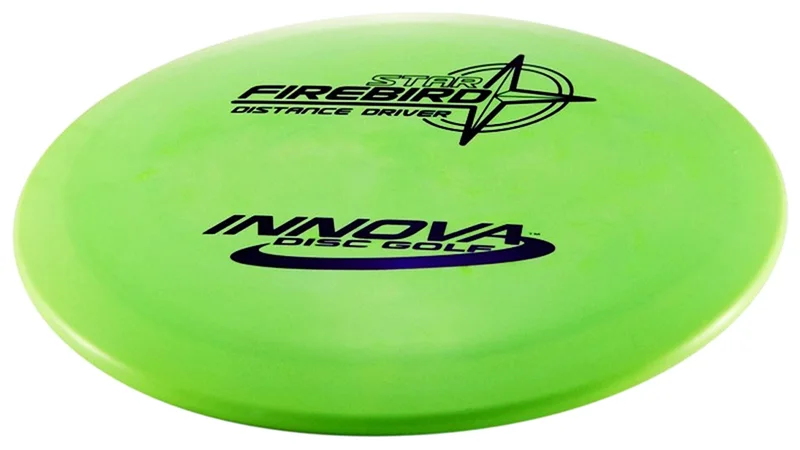
Fade, or low-speed fade, is the hook to the left at the end of a right-handed backhand flight, as the disc slows down. It runs from 0 to 5. A fade 0 disc finishes the straightest, and a fade 5 disc hooks hard. The Firebird, rated 9 / 3 / 0 / 4, is Innova's own example of a disc that stays reliably overstable in all wind conditions.
Almost every disc fades at least a little as it slows, so a 0 does not mean the disc never curves. A high fade is predictable in heavy wind and suits spike and skip shots, where you want the disc to finish hard. A low fade suits straight wooded holes where a hard finish would leave you off the fairway. Innova also says fade depends heavily on the nose angle at release: the more nose up, the sooner and harder the disc fades.
A worked example: 6 / 5 / -2 / 1
These are the published numbers for the Innova Leopard: speed 6, glide 5, turn -2, fade 1. The source is Innova’s comparison table, checked September 8, 2026.
A useful way to read the label is in two stages. First ask whether the speed class suits the disc you want to try. Then use the remaining numbers to ask about its intended shape. Do not add -2 and 1 to get a “net curve” of -1. Those ratings refer to different parts of the flight and are not distances.
For comparison, the Mako3 reference lists 5 / 5 / 0 / 0. That does not make it a straight-line machine. Think of the record as a description to investigate with your own throws, rather than a correction for your release.
Turn, fade and stability
Turn and fade together describe a disc's stability. Innova's glossary calls a flight that turns right (on a right-handed backhand) understable, one that holds its line stable, and one that goes left overstable. Discs with a lot of negative turn and little fade read as understable; discs with turn near 0 and high fade read as overstable.
Innova adds a detail that matters for newer players: understable discs are much more speed-sensitive than stable or overstable ones, and an understable disc often flies stable or even overstable when thrown slowly. So the disc that a strong player calls understable may be the straight disc for you. Our guide to understable vs overstable discs goes further into choosing between them.
Compare discs within one speed class
Innova's rule is that glide, turn and fade only compare discs of the same speed. Its example is the Wraith (11 / 5 / -1 / 3), which you can line up against other speed 11 discs but not against the speed 7 Eagle. Here are four speed 7 fairway drivers from Innova in our records, where the comparison does work:
| Disc | Flight numbers | What the turn and fade suggest |
|---|---|---|
| Innova Leopard3 | 7 / 5 / -2 / 1 | The most turn and the softest finish of the four |
| Innova Hawkeye | 7 / 5 / -1 / 1 | A little turn and a gentle finish |
| Innova Teebird | 7 / 5 / 0 / 2 | Holds its line, then a moderate finish |
| Innova Eagle | 7 / 4 / -1 / 3 | Less glide and the strongest finish |
Read across a row like this and you can see where each disc sits in the family. You can put them on the same chart with the Flight Chart, or open two side by side in the comparison tool.
Why the same disc flies differently
The rating describes the mold, so the actual disc in your hand can fly differently. Innova names most of the reasons:
- Plastic. Innova says its Champion and Glow Champion plastics generally produce discs with less high-speed turn than its other premium plastics, and that plastic affects the longer-range drivers the most. Our guide to DX, Star and Champion plastic compares the common options.
- Wear. As a disc hits trees and the ground, it tends to turn more and fade less. Base plastics such as DX change faster than premium plastics, which is why some players carry the same mold at different stages of wear.
- Your arm speed. A disc thrown below its intended speed turns less and fades sooner. This is the main reason a beginner's flights look more overstable than the label suggests.
- Release. A nose-up release adds fade, and off-axis torque (a wobble or flutter from rolling the wrist at release) tends to make the disc turn more.
- Elevation. Innova says that at 5,000 feet, discs glide less, turn less and fade more than at sea level.
- Wind. A headwind makes a disc act less stable and a tailwind more stable. Our wind guide explains how to choose a disc for each.
Weight changes how a disc feels and flies too; see our disc weight guide before buying a lighter or heavier copy of a disc you like.
Match the explanation to your throw
The directions above assume right-handed backhand. Left-handed backhand reverses them. Right-handed forehand also has the opposite usual turn/fade directions from right-handed backhand. See Innova’s backhand explanation and forehand explanation, checked September 8, 2026. When discussing a shot, name the throw as well as the direction; “this disc goes left” leaves too much unanswered.
In short, a right-handed backhand and a left-handed forehand both turn right and fade left. A left-handed backhand and a right-handed forehand both turn left and fade right. The numbers stay the same; only the direction changes. Our forehand guide has more on that throw.
Flight numbers across brands
Innova states that flight ratings should not be used to compare discs between brands, because each company rates its discs differently. Identical numbers from two makers are two separate opinions about two different molds, so the discs may fly quite differently.
Cross-brand numbers still tell you roughly where a disc sits. Our comparison tool uses them that way, and every disc record lists discs with similar flight numbers as a first filter. A match is a reason to try the disc; your own throws decide whether it can replace the one you have.
Common misreadings
- "Higher speed means more distance." Only if you can throw the disc fast enough. Below its intended speed, a fast driver fades early and often goes shorter than a slower disc.
- "Add turn and fade to get the curve." Turn and fade describe different parts of the flight. A -2 turn and a 1 fade do not cancel into -1.
- "Fade 0 means a straight finish." Nearly every disc fades a little as it slows; 0 means the least fade on the scale.
- "Negative turn is bad." Turn is useful. It helps a newer player hold a straight line, and it makes rollers and hyzer flips possible.
- "Same numbers, same disc." Only within one brand and speed class does a match say much, and even then plastic, weight and wear can separate two discs.
Use one familiar disc as your reference
Our suggestion is to write down what your current disc actually does before shopping. Try a simple note with four fields:
- Disc: full model name, plastic and marked weight.
- Situation: a familiar target line and the conditions.
- Result: where it started, where it finished and how repeatable it felt.
- Need: the specific result you wanted instead.
That gives you a better question for a shop or a more experienced player than “What is the best disc?” You can ask for a disc to solve a particular problem and explain what you already have.
If you are starting from nothing, use our first-bag guide. If two listings have the same model name, check the plastic choice before assuming they are interchangeable. If you already own a few discs, Bag Check lays them out by flight numbers so you can see overlaps and gaps.
The limit of the label
A flight rating cannot tell you whether a rim feels comfortable, whether you like the plastic, or whether the disc fills a missing role in your bag. Use the numbers to narrow a decision, then judge the disc by your own repeatable results. This guide is an explanation of published ratings, not a flight test.