DISCFIELD / Learn
How to clean disc golf discs and store them without warping

To clean disc golf discs, wash them by hand with a soft sponge, mild dish soap and lukewarm water, rinse them and dry them completely. That is enough for mud, sap residue and the gritty film that builds up after a few wet rounds. Skip the dishwasher, very hot water and solvents.
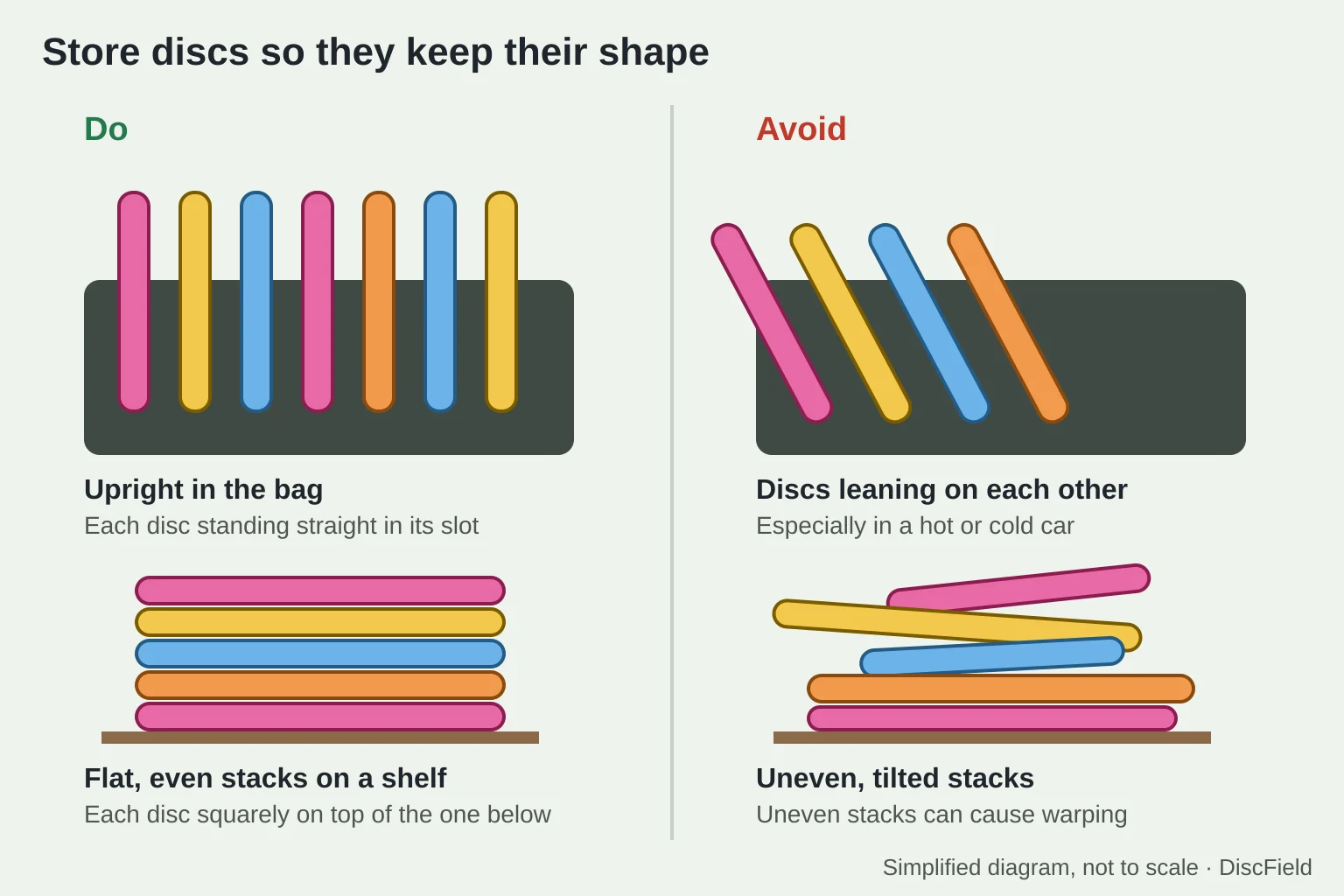
Cleaning will not change a disc's shape, but storage can. Keep discs upright in your bag, in flat even stacks at home, and away from the heat and cold of a parked car. This guide covers both, plus how to mark your discs and when a damaged disc should come out of the bag.
How to clean disc golf discs, step by step
- Knock off loose dirt first. Tap the disc against your palm or rinse it under the tap so grit does not scratch the plastic while you scrub.
- Wash with mild soap. Use a soft sponge or cloth, a drop of ordinary dish soap and lukewarm water. Clean both sides, and run the sponge around the inside of the rim, where dirt collects.
- Rinse. Soap left on the plastic can make it feel slick in your hand.
- Dry completely. Wipe with a towel and let the disc air-dry standing upright before it goes back in the bag.
Do this when a disc feels gritty or slippery, or after a muddy round. There is no need to wash a dry, clean disc after every round.
What to avoid when cleaning
- The dishwasher. The hot water and heated drying cycle are exactly the conditions you want to keep plastic away from.
- Very hot or boiling water. Heat can soften plastic, and a soft disc can bend out of shape.
- Solvents such as acetone, nail polish remover or paint thinner. Ordinary dirt does not need them, and they can damage the stamp or the plastic surface.
- Scouring pads and abrasive powders. They scratch the surface. Under PDGA rule 813.01, moderate sanding to deal with wear or small molding flaws is allowed, but excessive sanding makes a disc illegal for sanctioned play.
Keep your discs grippy during a round
Wet or dirty plastic is harder to hold, especially on drives. Carry a small towel and wipe each disc before you throw it, and dry your hand too. Innova's tips for playing in the heat suggest drying sweaty hands with a chalk bag before each throw, because sweat affects grip and control.
If one disc always feels slick even when it is clean, the plastic blend may be the reason rather than dirt. Our DX, Star and Champion guide compares how grippy the common Innova plastics feel, and the disc golf grips guide shows how to hold each throw.
How to store disc golf discs without warping
Dynamic Discs' care instructions give three simple storage rules:
- On shelves, keep discs in flat, even stacks. The company warns that uneven stacks can cause warping.
- In a bag, keep each disc upright in its compartment. Discs leaning on one another can warp in hot or cold temperatures.
- In disc sleeves, have the discs face the same direction and stand up straight, without leaning.
A storage bin, a shelf or a milk crate works. What matters is that no disc is bent, propped at an angle or crushed under something heavy for days.
Discs in a hot or cold car
A parked car can get much hotter or colder than your home. The Dynamic Discs instructions single out leaning discs in hot or cold temperatures as a warping risk, and Innova's winter disc golf guide says plastics are sensitive to temperature swings and that cold makes many of them brittle and hard.
In practice, bring your bag inside after the round instead of leaving it in the trunk. If the bag has to stay in the car for a while, keep the discs upright in their slots and the bag out of direct sun.
Brittle plastic also cracks more easily, so check your discs for cracks after cold-weather rounds, especially any that hit a tree or frozen ground.
Mark your discs so they come back
Write your name and a phone number on the underside of every disc with a permanent marker. PDGA rule 813.01 allows marking a disc with dye or permanent marker ink, so this does not affect whether the disc is legal. A bright color also helps: our guide to pink and other easy-to-find disc colors explains which colors stand out in grass and leaves.
When to retire a damaged disc
Inspect your discs now and then, the same way you would check a used disc before buying it:
| What you find | What it means | What to do |
|---|---|---|
| A crack or a hole | Illegal under PDGA rule 813.01, and a weak point in the plastic | Take it out of play |
| A wavy rim when you sight along the edge | The disc is warped | Expect an unpredictable flight; keep it for fieldwork or replace it |
| Deep gouges or sharp burrs on the rim | Damage from trees, rocks or pavement | Throw it only if it still feels comfortable to hold |
| Scuffs and a faded stamp | Normal wear | Keep throwing it; expect a little more turn and less fade over time |
Wear is not a problem in itself. As discs wear, they tend to turn more and fade less, according to Innova's flight-number guidance, so an old disc may simply have a new job. Our guide to understable and overstable discs explains how that shift changes the shots a disc is good for. When an old favorite has changed too much, Bag Check can help you decide whether to replace it or keep both copies for different shots.
Dynamic Discs' care instructions, Innova's heat, winter and flight-number pages and PDGA rule 813.01 were checked October 7, 2026. The cleaning steps are DiscField's practical suggestions, not manufacturer instructions or a tested cleaning method.