DISCFIELD / Buying guides
Used disc golf discs: what to check before you buy

Used disc golf discs are a cheap way to try a new mold, replace a lost disc or put a few practice discs in your bag. The catch is that you are buying one particular copy, not a model. Wear changes how a disc flies, and some damage makes a disc a bad buy at any price.
Before you pay, check five things: the stamp, the rim, how much wear there is, whether there are cracks or holes, and whether the disc is warped. Then expect a worn disc to turn more and fade less than its printed flight numbers. That can be a good thing, as long as you know it going in.
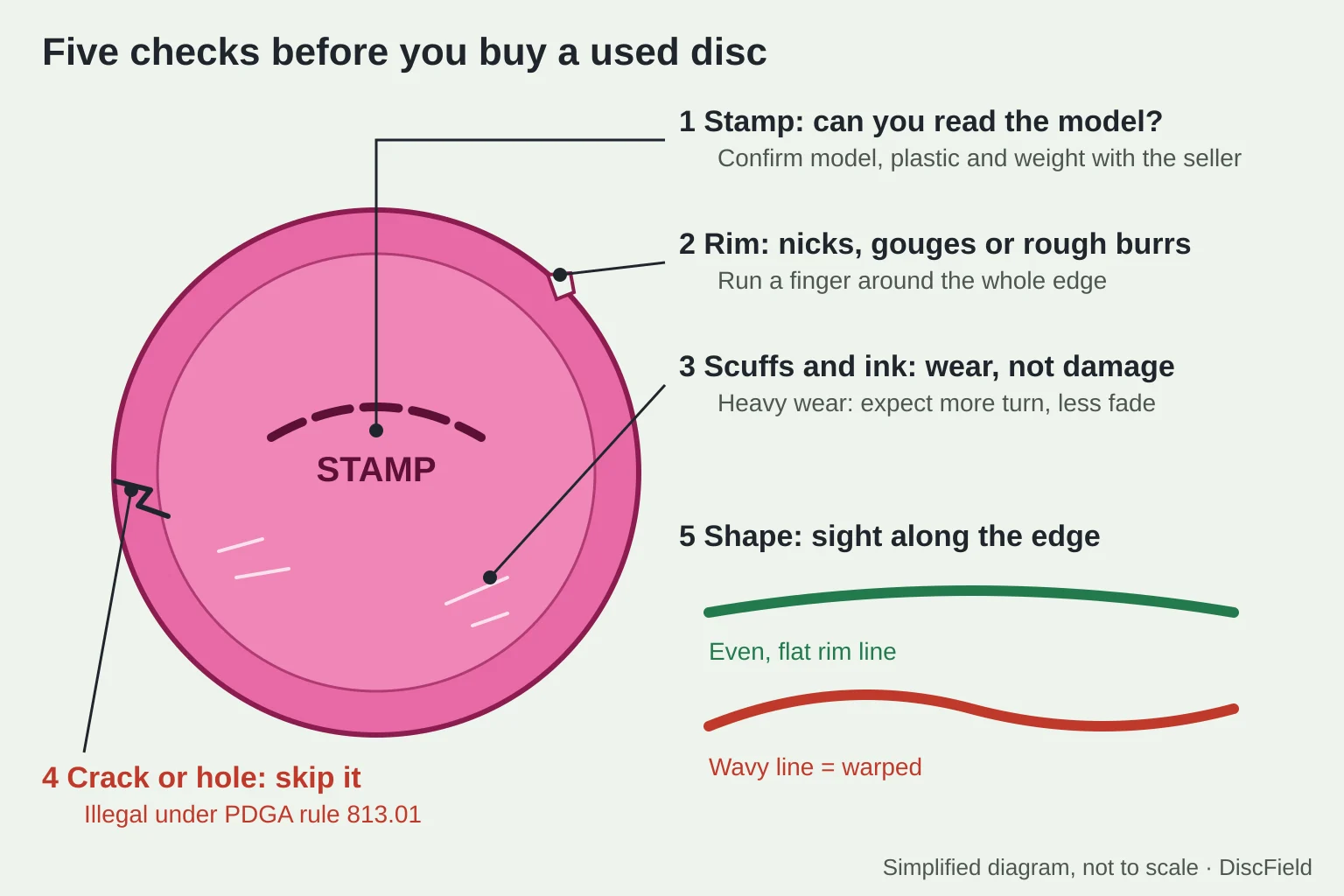
Used disc checklist at a glance
| Check | What to look for | Walk away if |
|---|---|---|
| Stamp and listing | Model name, plastic and weight you can confirm | Nobody can tell you which mold it is |
| Rim | A smooth edge all the way around | Deep gouges or sharp burrs where your fingers grip |
| Wear and ink | Scuffs, faded stamp, marker on the flight plate | You need it to match a new disc's flight |
| Cracks and holes | Any split in the plastic, especially along the rim | You see one, however small |
| Shape | A flat, even rim line when you sight along the edge | The rim line waves up and down |
Is buying used disc golf discs worth it?
Often, yes. A used disc makes the most sense when:
- you want to try a mold before buying it new, to see whether it fits your hand and your shot;
- you want a turnover or "flippy" disc, since a well-worn midrange or fairway driver will usually turn more than a fresh one, which helps with easy turnover shots and hyzer flips;
- you need practice discs for field work or putting, where cosmetic wear rarely matters;
- you are replacing a lost disc that was already worn, because a seasoned used copy may fly closer to your old disc than a brand-new one.
A new disc is the better choice when you need a specific, predictable flight, such as an overstable disc for headwinds or forehand shots. It also makes sense when you want a mold to last as long as possible. In that case, a new disc in a premium plastic gives you the most time before it changes.
How wear changes the way a disc flies
Flight numbers describe the manufacturer's rating for the mold, not your copy of it. Innova's flight-number guidance says that as discs wear, they tend to turn more and fade less. In other words, a used disc usually flies more understable than its numbers suggest.
How fast that happens depends on the plastic. Innova's plastic overview puts DX, XT, KC Pro and R-Pro in the group that changes flight characteristics more quickly than its premium plastics. Star, GStar and Champion are described as holding their original flight for longer. How often a disc hits trees, rocks and the ground matters too.
Some players use that wear on purpose. Innova's article on disc cycling describes carrying several copies of one mold: a fresh, overstable copy for headwinds, a seasoned one for straight shots and a well-worn one for turnovers. Its example is the Roc in DX plastic. A used disc can be a shortcut to the worn end of that range.
When you buy, treat a used disc's flight numbers as a starting point, then expect less fade and more turn the more beaten-in it looks. Our flight-number guide explains what each number describes.
What to check before you buy a used disc
1. The stamp, model and plastic
The stamp is the easiest way to confirm which mold you are getting. On heavily worn discs, the stamp may be faded or gone. If you cannot read it, ask the seller how they know the model. A disc listed only as "putter" or "midrange" could be anything.
Also confirm the plastic. Two equally scuffed copies of one mold can fly differently if one is DX and the other Champion, because DX changes faster. Our guide to DX, Star and Champion plastics explains how the common Innova blends differ.
2. The rim
Run a finger around the whole edge. Small dings and scuffs are normal. Look for deep gouges, chunks missing from the edge, or sharp burrs of plastic where your fingers grip the rim. They can be uncomfortable to hold and can catch on release.
3. Wear and ink
Scuffs across the flight plate, a faded stamp and marker ink are all signs of normal use. Under PDGA rule 813.01, wear from play, moderate sanding of wear or small molding flaws, and marking a disc with dye or permanent marker are all allowed. A scuffed, inked disc is still legal and can still be useful. Just expect the flight change described above.
If the disc has someone else's name and phone number on it, think about where it came from. It may have been sold by its owner, or it may have been lost on a course. If you find an inked disc yourself, call or text the number before keeping it.
4. Cracks and holes
This is the one check that should end the conversation. The same PDGA rule says a disc that is cracked or has a hole in it is illegal. In a casual round nobody inspects your bag, but a crack is still a weak point, and the split edge can be sharp. Check the rim closely, and the area where the rim meets the flight plate.
5. Weight and shape
Check the weight on the listing or ask the seller to weigh it on a kitchen scale. Weight affects how a disc handles; see our disc weight guide if you are unsure which range suits you.
Then hold the disc at eye level and sight along the edge as you turn it. A healthy disc shows an even rim line. A line that waves up and down means the disc is warped. Heat is a common cause, for example a disc left in a hot car; our disc care guide shows how to store discs so they keep their shape. A warped disc is hard to judge because it may not fly like any version of that mold.
Where to find used disc golf discs
- Local disc golf shops. Some keep a used bin. You can hold each disc, which makes the rim, crack and warp checks easy. Our disc golf store directory lets you search US stores by state or near your location; call ahead to ask about used discs.
- Online stores and marketplaces. Look for listings that photograph the exact disc you will receive, from the top and the bottom, with the weight stated. Generic stock photos tell you nothing about condition.
- Other players. League nights, local clubs and online groups often have players selling discs they no longer throw. Ask how much the disc has been used and whether it has hit many trees.
Sellers often grade condition on their own 1 to 10 scale. Those scales are not standardized, so a "7" from one seller may not match a "7" from another. Read the written description and look at the photos rather than trusting the number alone.
How to test a used disc after you buy it
Take the used disc to a field with a disc you already know well, such as your main midrange. Throw both on the same line, at the same power, several times each. Note where the used disc starts to turn and how much it fades at the end compared with the familiar one.
Then add it to Bag Check with a note about its condition and the shot you actually use it for. That makes it easier to see if it duplicates a disc you already carry, or if it covers a turnover shot your bag was missing. Our checklist for finding the disc missing from your bag walks through that decision.
If you are still building a starter set, the first disc golf bag guide shows which two or three roles to fill first. A used copy can fill any of them.
Innova's plastic, flight-number and disc-cycling pages and PDGA rule 813.01 were checked October 7, 2026. Wear claims describe general tendencies, not a measured change for any particular disc.