DISCFIELD / Learn
Winter disc golf: how to play in cold weather and snow
Winter disc golf takes a little preparation, because cold plastic gets stiff and slippery and a disc can vanish into snow. Bring softer plastic that stays flexible in the cold, leave white discs and favorites at home, and tape a long, bright ribbon to each disc when there is snow on the ground. Dress in layers you can still throw in, expect shorter throws and higher scores, and keep the round casual.
What cold weather does to your discs
Innova's winter disc golf guide says plastics are sensitive to temperature swings, and that cold makes many of them brittle and hard, so they lose flexibility and grip. A disc that felt familiar in July can feel very different in January.
Brittle plastic also breaks. Discmania's winter round guide warns that a stiff premium disc that hits a tree at low temperatures can end up in pieces. Our disc care guide explains how to check a disc for cracks after a cold round and how to store discs so they do not warp in a cold car.
Choosing plastic for winter
Pick plastic that stays soft and grippy in the cold, and save the stiff, glossy blends for warmer months.
| Brand | Plastic named for cold weather | What the brand says |
|---|---|---|
| Innova | GStar | Its pick for winter; stays pliable at freezing temperatures where other plastics turn stiff or brittle |
| Innova | XT | Grippy and durable, but loses some flexibility in the cold |
| Innova | R-Pro, Driver Pro, Proto Glow DX | Also on Innova's top five for cold weather: R-Pro handles cold and wet, Driver Pro gives grip and flex at a good price, Proto Glow DX feels soft in the cold |
| Discmania | Soft P-Line, G-Line | Softer plastics Discmania suggests in place of stiff ones |
Innova co-founder Dave Dunipace describes GStar as a softer grade of the same material as Star and Champion. Innova says that grip matters in fall and winter, when cooler, drier air dries out players' hands. Our DX vs Star vs Champion guide explains how Innova's main blends differ the rest of the year.
You do not need to buy a new bag. In the PDGA's collection of player tips for playing in the cold, one player suggests DX or KC Pro plastic, and two players describe keeping a separate winter bag so their favorite discs stay home.
Building a winter bag
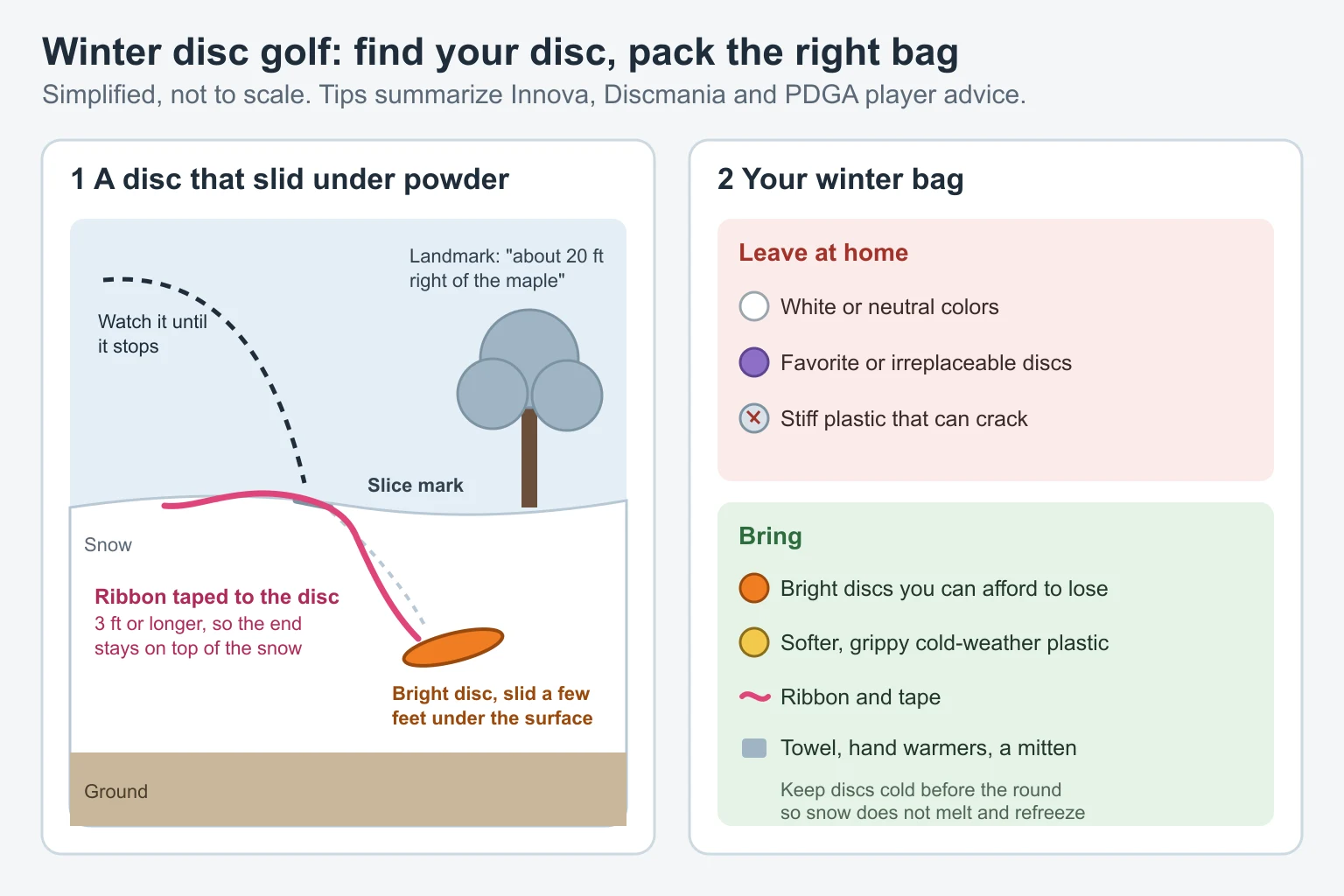
- Leave white and neutral colors at home. Innova ambassador Brad Lescalleet suggests swapping white discs for colors that are easier to see in snow. Players in the PDGA tips name bright yellow, orange and pink, or dark colors, and no neutrals. Our guide to pink disc golf discs explains which colors stand out on a course.
- Leave irreplaceable discs at home. Discmania lists them first among the discs not to throw in snow. Bring discs you would be fine losing.
- Consider lighter or less stable discs. Innova ambassador Craig Nettleship says winter layers restrict your reach-back and arm speed, so he suggests a lighter or less stable disc. Our disc weight guide and the guide to understable vs overstable discs explain both choices.
- Plan on standstill throws. A player in the PDGA tips calls winter a good time to practice standstill approaches and tee shots.
Innova's guide names a few of its own discs for winter, including the GStar Leopard3, Valkyrie and Aviar in its starter pack, and a DX Invader as a driving and approach putter. Any disc you already know is a fine choice if the plastic is soft enough.
Keep your discs cold before you play
Warming your discs before a snowy round makes things worse. In Innova's guide, pro Cooper Arnold explains that snow melts on a warm disc and then refreezes on it, so he leaves his discs in the car the night before. Players in the PDGA tips agree: a cold disc sheds snow, while a warm one needs constant wiping. Discmania also suggests letting your bag cool down in the garage or car before you go.
How to find your disc in the snow
A disc can land, slide under the snow and leave almost nothing on the surface. These habits help:
- Tape a ribbon to each disc. Discmania suggests a bright ribbon that stays on the surface after the disc goes in. A Vermont player in the PDGA tips recommends gift-wrapping ribbon at least three feet long, because discs can slide a few feet under powder.
- Watch the landing spot until the disc stops. Discmania suggests picking a landmark and saying it out loud, for example "about 20 feet right of the maple."
- Walk up slowly and look for marks. A Minnesota player in the PDGA tips looks for a slice or a skid mark where the disc went into the snow.
- Use chalk in deep snow. Another player puts carpenter's chalk on the disc so the impact spot shows.
- Play shorter, safer shots. Discmania suggests a short throw when you would not be able to see a longer one land.
Discmania says not to worry about a ribbon changing the flight in a fun winter round. If you want to know how your ribbon behaves, throw the disc once in an open area before the round.
What to wear for winter disc golf
Discmania recommends layers, but not so many that you can no longer throw. Nettleship's point applies here too, since heavy layers shorten your reach-back.
For your hands, Discmania calls a mitten with a hand warmer inside on the throwing hand a veteran move, with a regular glove on the other hand. Take the mitten off to throw. One player in the PDGA tips keeps a hand warmer or a small towel in a hoodie pocket, and grabbing the towel between throws keeps the fingers warm. Our grips guide suggests drying both hand and disc before you judge how a grip feels.
Another PDGA tip is to bring extra socks, and a change of footwear if you have it, for a long round in snow. Innova's guide quotes Das Loomis on drinking lukewarm water, more than you feel you need, because you lose water under all those layers.
A run-up gets slippery on snow and ice, and a standstill throw is easier to control. Our backhand guide teaches the standstill version step by step.
Look after the course and other players
- Clear the tee if you are first out after a snowfall. Discmania suggests bringing a shovel and a broom, and says a broom is surprisingly useful on light snow.
- Do not wander across fairways and greens. Discmania asks players to follow existing footsteps and retrace their own, because tracks in fresh snow make discs harder to find.
- Skip holes near sledding hills. Discmania notes that some courses become sledding areas in winter, so leave out any hole that plays across or near one.
- Plan for short days. Winter daylight ends early. Our glow disc golf guide covers playing after dark.
Winter disc golf rules: ribbons, snow and lost discs
In a casual round you can tape a ribbon to any disc. PDGA events are stricter. Rule 813.01 generally makes it illegal to add material of a detectable thickness to a disc, but when the Tournament Director has announced snow play, players may add a material or device to help find the disc. A cracked disc is illegal in PDGA play under the same rule, which is one more reason to check your discs after a cold round.
Snow does not automatically give you free relief. Under rule 806.03, a casual area is one the Tournament Director designates, and the only default casual area is in-bounds water. Ask the director at an event what the snow rules are. In a casual round, agree with your group before the first tee.
If you cannot find a disc, the normal lost-disc rule applies: after a three-minute search, add one penalty throw and throw again from your previous lie. Our disc golf rules guide explains it with the other basic rules.
Sources and scope
Sources checked October 9, 2026: Innova's Winter Disc Golf Guide (December 2025; plastic behavior in cold, its five cold-weather plastics, GStar and XT, keeping discs cold, colors, layers and the tips quoted above); Discmania's Navigating a Winter Round of Disc Golf (December 2018; disc selection, ribbons, layers, mittens and course care); the PDGA's They Said It: Tips for Playing in the Cold (October 2020; advice from players, not PDGA rules); and PDGA rules 813.01 and 806.03 (last updated December 31, 2025). Plastic descriptions are the manufacturers' own claims. DiscField has not tested discs or plastics in cold weather.