DISCFIELD / Learn
Disc golf grips: how to hold a disc for backhand, forehand and putting

For a backhand drive, start with a power grip: thumb on top, four fingers curled into the inner rim. For a short approach or putt, try spreading your fingers underneath the disc. For a forehand, start with two fingers underneath, the middle finger against the inner rim and your thumb above it.
Those are starting points. A deep putter and a wide-rimmed driver can feel very different in the same hand. Choose a grip you can set comfortably and repeat, then check it with easy throws before adding speed.
This guide shows seven grip examples and explains when to try each. The generated illustrations show the underside so you can see the fingers; the small inset shows the thumb on top. They demonstrate placement, not the angle to hold the disc during a throw. Left-handed players can mirror the positions. Select any image for a larger view.
Which disc golf grip should you try first?
| Your shot | Start here | What to check |
|---|---|---|
| Backhand drive with a fairway driver | Power grip | Fingers reach the inner rim without straining |
| Backhand putter or midrange approach | Fan grip | The disc feels supported and releases cleanly |
| Longer backhand with a putter or midrange | Modified fan or power grip | Enough hold for the throw, comfortable finger placement |
| Putting at the basket | Putting control grip | A relaxed setup you can repeat |
| Forehand drive or approach | Stacked forehand | Middle finger contacts the inner rim |
| Touch forehand that feels awkward with fingers together | Split forehand | Added underside support without catching a finger |
| Forehand with one finger already comfortable | One-finger forehand | Compare the release with a two-finger version |
These are our suggested starting choices, not rules about which grips a disc allows. Innova's 2009 catalog grip section describes power, control and forehand grips as options for different shots and encourages players to find what works for them.
Know the two surfaces your fingers touch
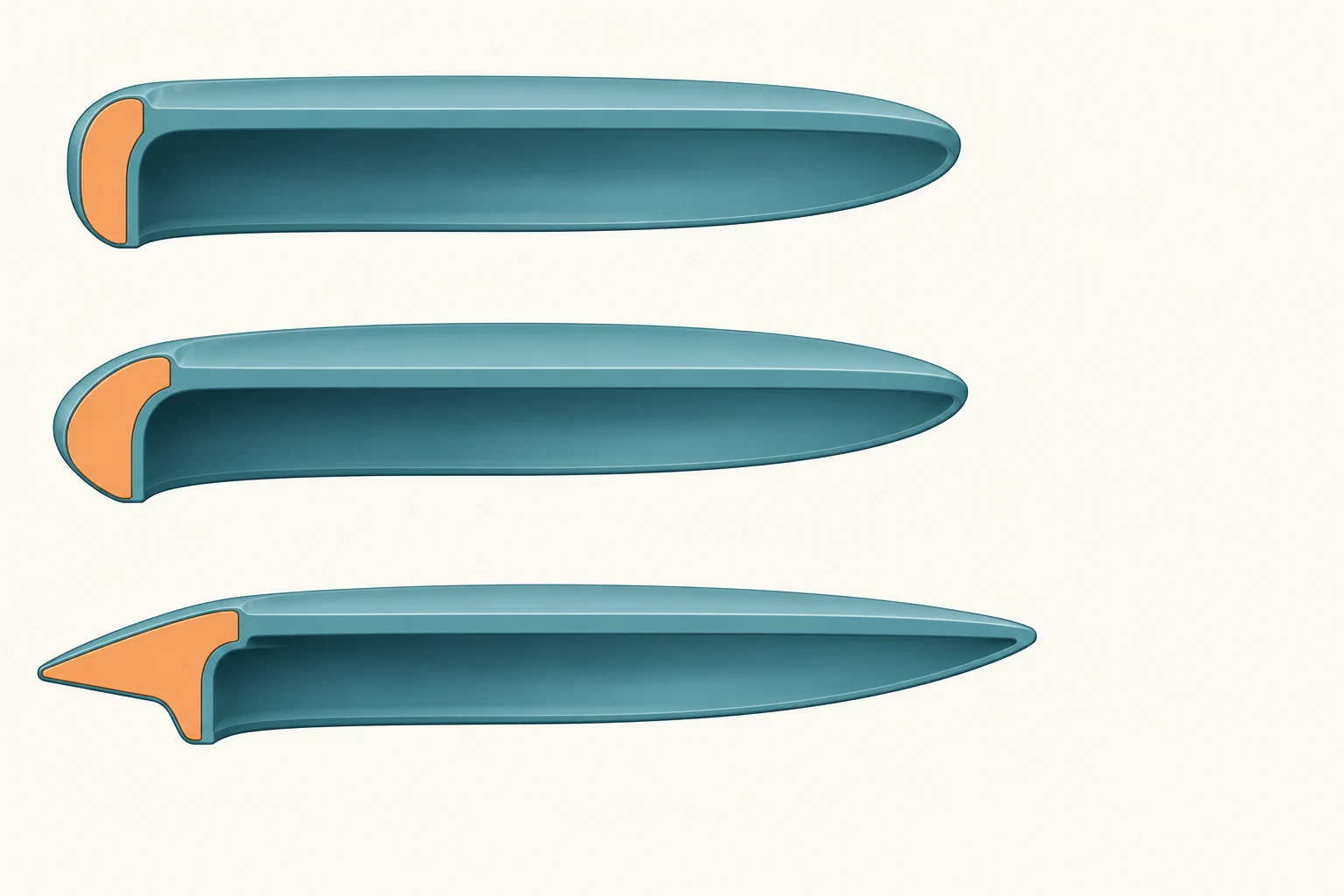
The flight plate is the broad, relatively flat middle of the disc. Its underside gives spread fingers somewhere to support the disc. The inner rim wall is the inside face of the thicker edge. Curled backhand fingers or an extended forehand finger can press against that wall.
Feel the difference with a disc in your hand. Run a finger across the underside toward the edge: the flat plate ends at the rim wall. For a forehand, pressing only upward into the plate feels different from making contact against that wall. The illustrated contact areas are simplified; your hand and the exact rim determine where the fingers settle.
Backhand power grip: a starting point for drives
Curl all four fingers underneath the disc and place their pads against the inside of the rim. Rest your thumb on top. Seat the edge into your hand so you can hold the disc without letting it rock around.
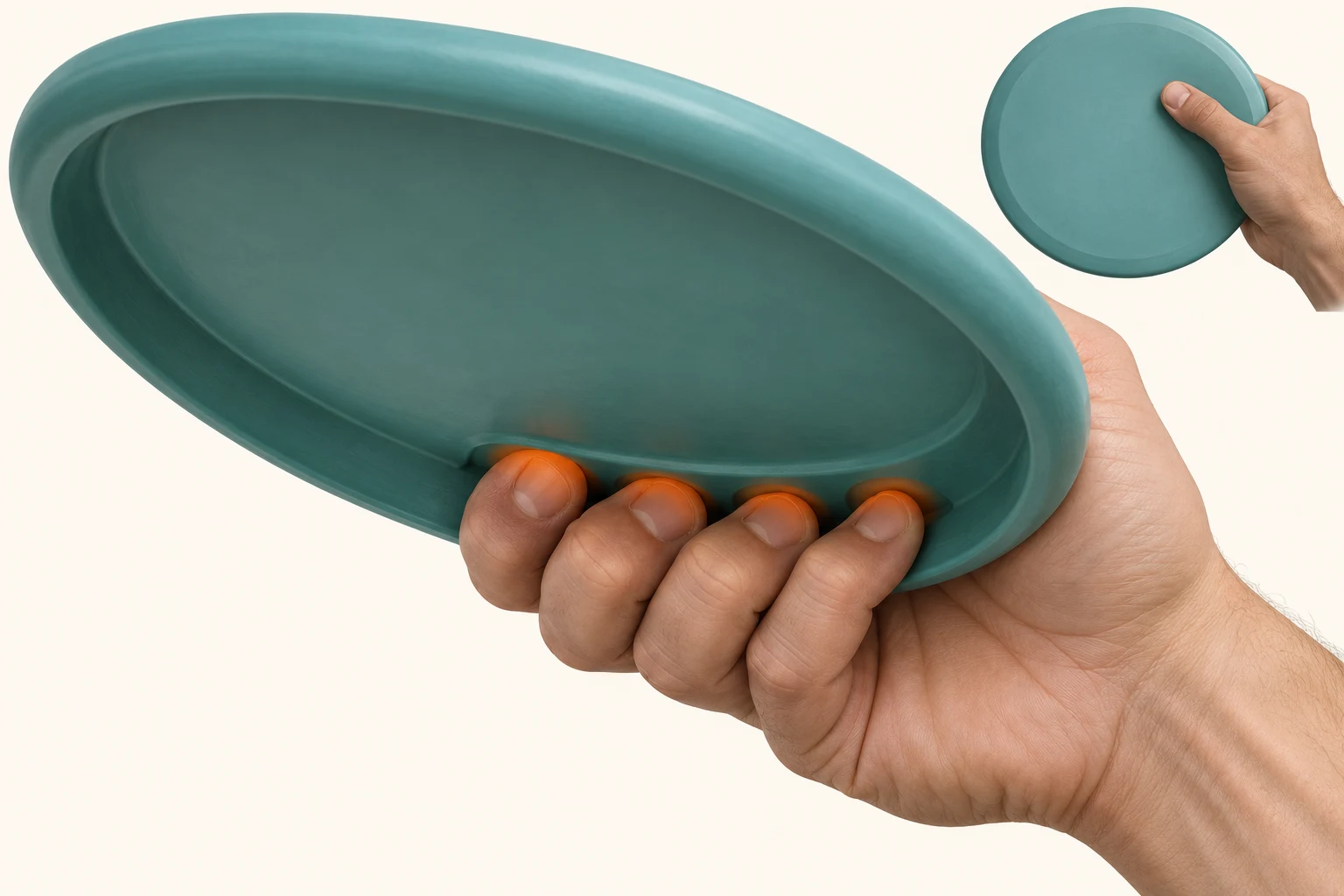
Try setting it in this order:
- Hold the disc loosely with your other hand while you arrange the throwing hand.
- Curl the index, middle, ring and little fingers under the rim. Check that they contact its inside face.
- Put the thumb on top and close the grip until the disc feels secure.
- Make a slow practice motion without releasing. Check that the grip stays comfortable and the disc keeps the angle you set.
Innova's 2006 catalog, with Des Reading's grip explanation, describes tucked fingers with pads against the inner rim and use of this grip for drives, midranges and some longer approaches. A power grip can therefore work with a throwing putter too.
Our suggestion is to learn it with a comfortable fairway driver or familiar midrange. If a wide driver rim makes you stretch your fingers, compare a narrower rim before deciding you need to squeeze harder. A driver feeling secure in your hand does not establish that you can throw it fast enough for its intended flight.
Backhand fan grip: spread fingers for shorter throws
Spread the fingers beneath the flight plate instead of curling all of them into the rim. In the example below, the index finger anchors at the rim while the other three support the underside. Keep your thumb on top.
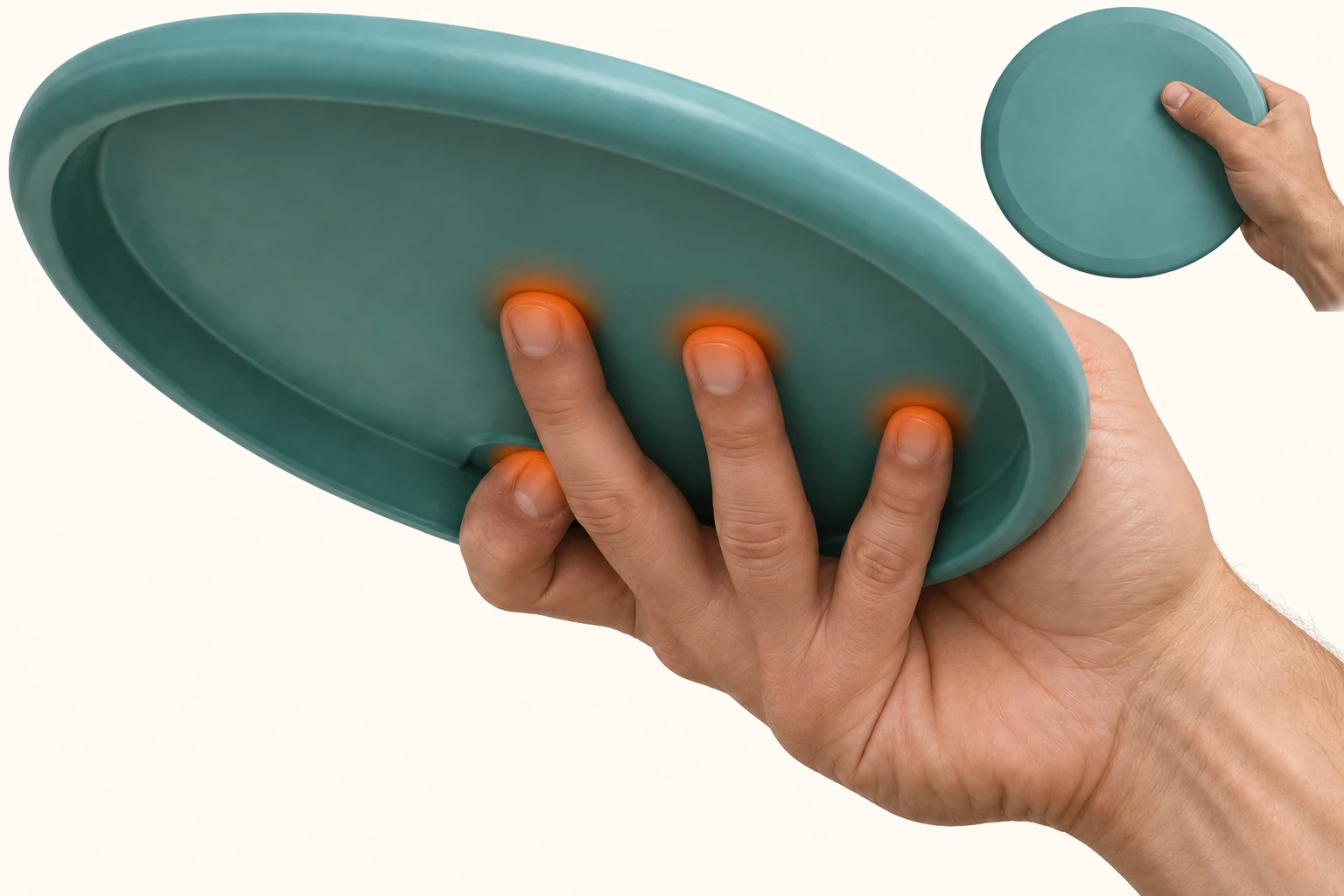
We suggest trying this for a short putter approach or a controlled midrange throw. Arrange the fingers so the disc feels supported without having to clamp it into a fist. Start with an easy standstill throw, then compare it with the same disc and target using a power grip.
Finger placement varies. Some fan grips keep the index finger under the rim; others rest it closer to the outside edge. The useful comparison is whether you can hold the intended angle and release the disc comfortably. Moving a finger a little can be more useful than changing the whole grip.
A fan grip is not restricted to short throws. Discraft player Adam Goodman describes using power and fan grips for different jobs; individual choices vary. Keep a fan grip that works for you rather than switching solely because a shot is called a drive.
Modified fan grip: a middle option for putters and midranges
A modified fan grip combines spread fingers with some rim contact. The term covers several arrangements. Here is one specific example: index and little finger at the rim, middle and ring finger extended underneath the flight plate.
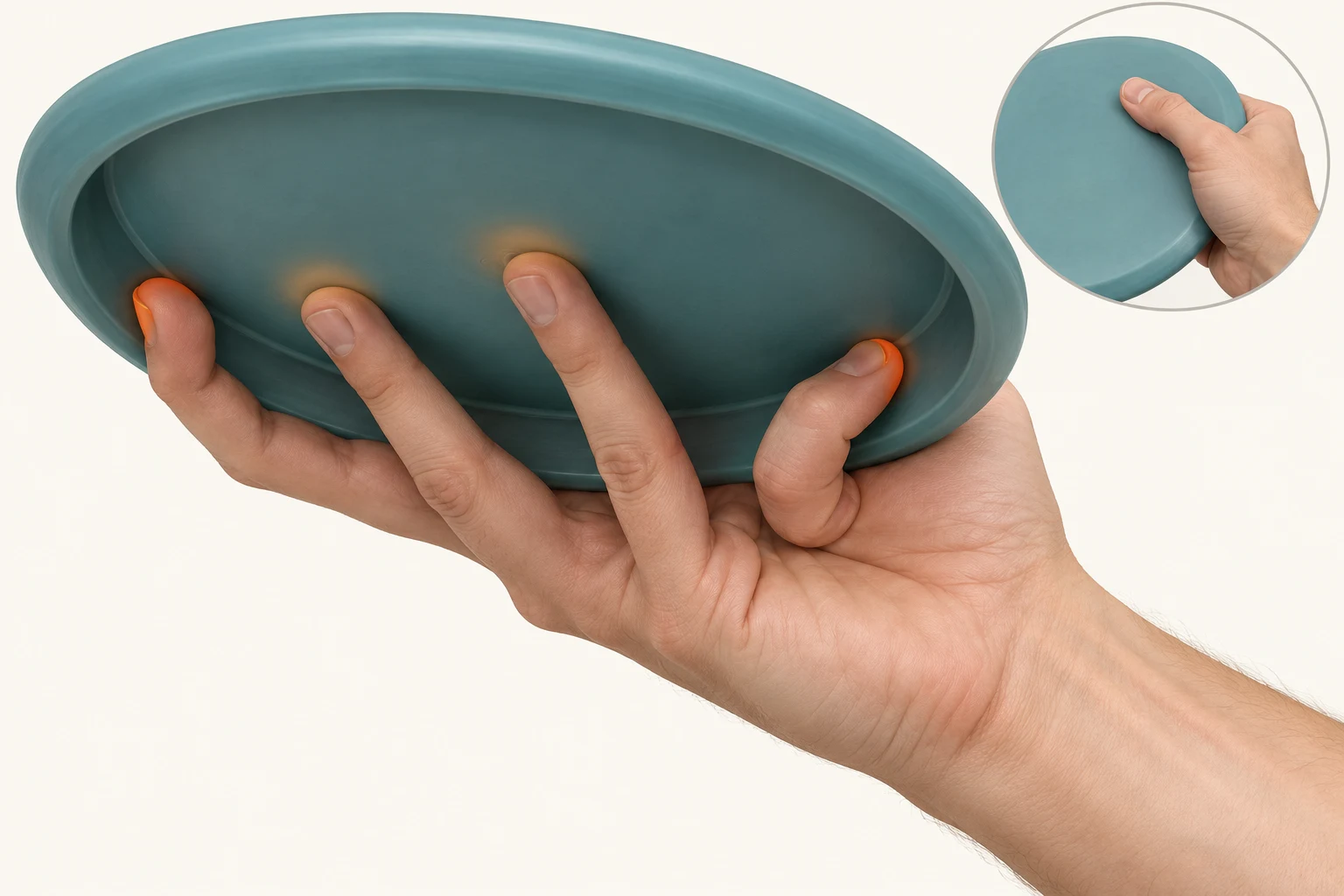
Try it if a full fan grip feels loose but curling every finger into a deep putter feels cramped. Set the two supporting fingers first, then bring the outer fingers to the rim without forcing their joints into position. Your thumb stays above the grip.
Use the same putter for a few easy approaches with each version. If the modified fan feels comfortable, gradually try a longer throw. You can keep a separate grip for short touch shots. There is no need to settle on one arrangement for every backhand in your bag.
This is an example to experiment with, not a standardized definition of a modified fan grip. When someone recommends that name, ask which fingers they put on the plate and which they curl into the rim.
Putting grip: let the putter sit comfortably in your hand
Start with a relaxed fan or control grip. Support the underside with your fingers and rest your thumb on top. In this example the index finger lies along the outside of the rim, with the other three fingers underneath. Innova's 2009 catalog describes this outside-index arrangement as a control grip for putting and approaches.
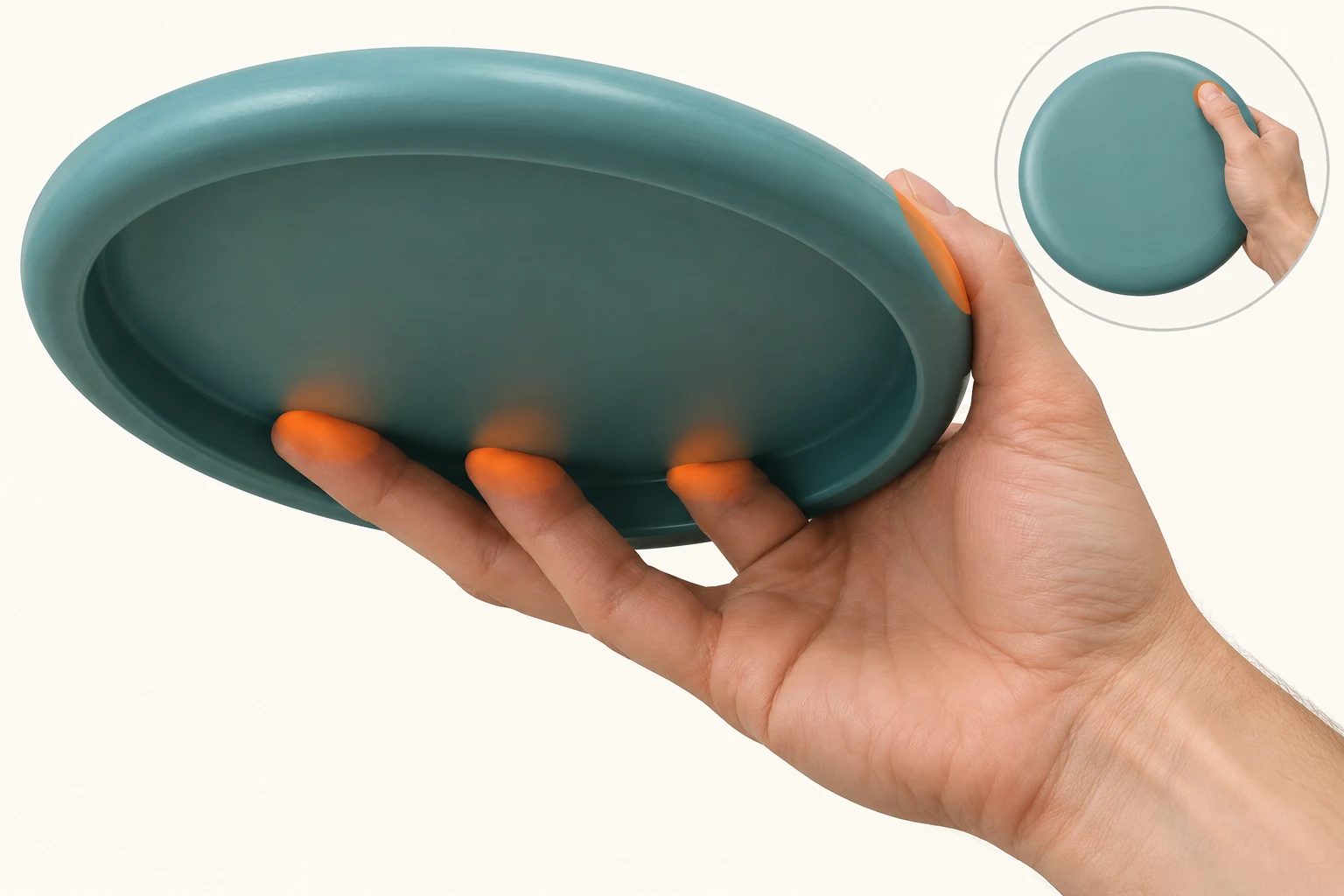
An index finger on the outside edge is an option. If it catches as you putt, try moving it underneath and compare a short set of putts. Goodman describes a putting fan grip with all four fingers slightly curved under the disc, so an outside index finger is not required.
Our suggested check is simple: choose a distance where you can putt comfortably, set the grip the same way each time, and watch whether the disc leaves your fingers cleanly. Use enough pressure to keep the setup steady. A tight fist that feels natural on a drive may feel awkward on a short putt.
The same mold can serve as a putting and throwing disc while you use different grips. For that decision, see putting putters versus throwing putters. Choosing a second putter is optional; start by changing the grip on the one you own.
Forehand grips: contact the inner rim, with the thumb above
A forehand, also called a sidearm or flick, uses a different hand position from a backhand. The examples below put one or two fingers underneath, with the thumb pressing from above and unused fingers tucked out of the way.
Innova's forehand coaching article advises finger-pad contact against the inner rim and treats grip as something to adjust for comfort and repeatability. Look for that contact before trying to throw harder. A finger pointing into the middle of the disc is not automatically pressing against the rim.
Stacked forehand grip: two fingers close together
Put the middle finger against the inner rim and bring the index finger close beside it to support it. Depending on how you turn your hand, the index may sit slightly below the middle finger. Rest your thumb on top, roughly above the fingers, and tuck the ring and little fingers away from the disc's release path.
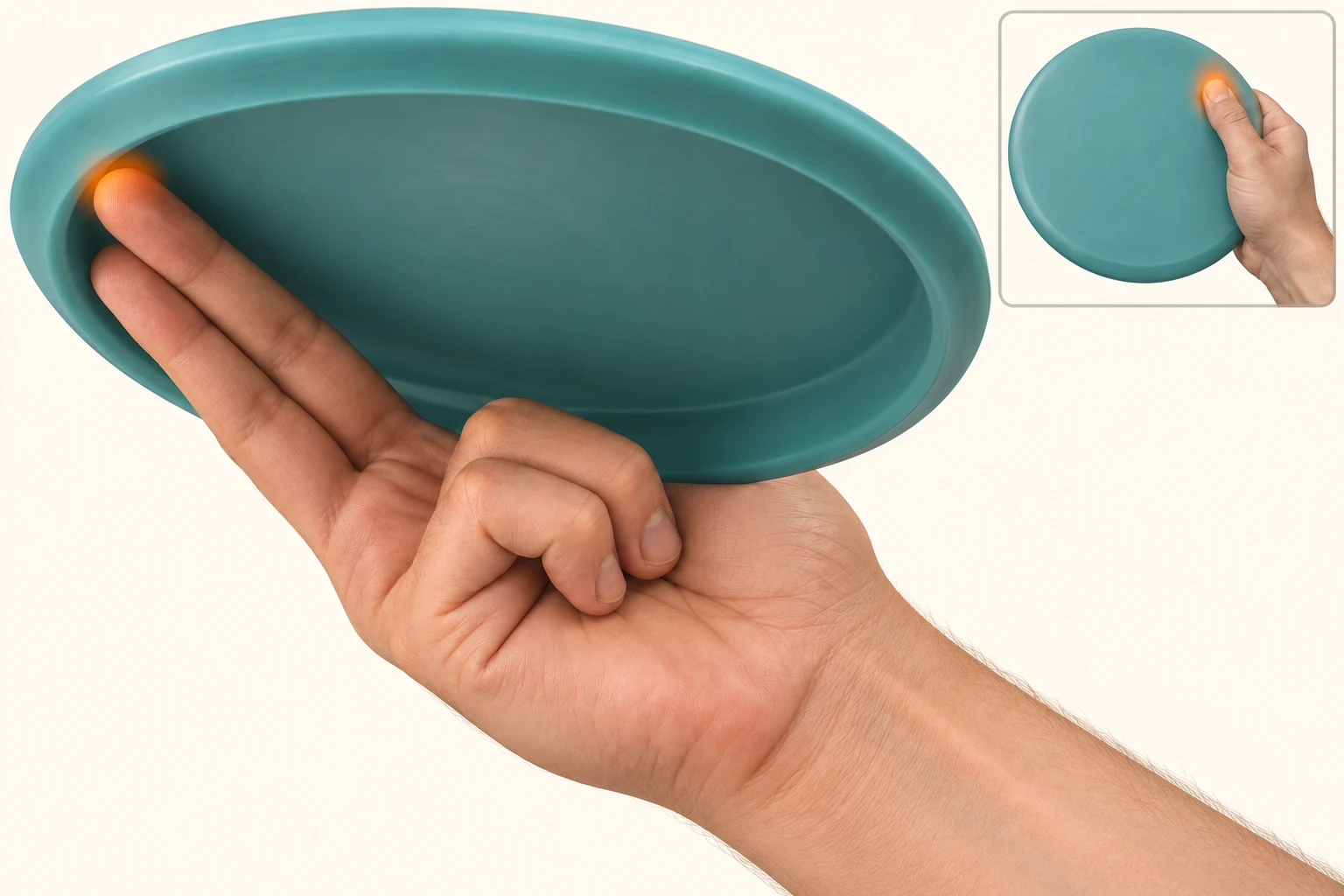
Try this as your first forehand arrangement. Before throwing, check the middle fingertip: it should meet the inside edge rather than only push up into the flat plate. Adjust the disc in your hand until that contact is comfortable. Begin with a short, easy throw at an open target.
The word stacked can sound as though both fingers must occupy one exact position. Hand sizes differ. Keep the contact clear and compare small changes in how the index finger supports the middle finger.
Split forehand grip: separate the supporting finger
Keep the middle finger against the inner rim, then spread the index finger away from it so the index supports the underside of the flight plate. Seen from below, the two fingers form a V. This is a forehand fan or split arrangement.
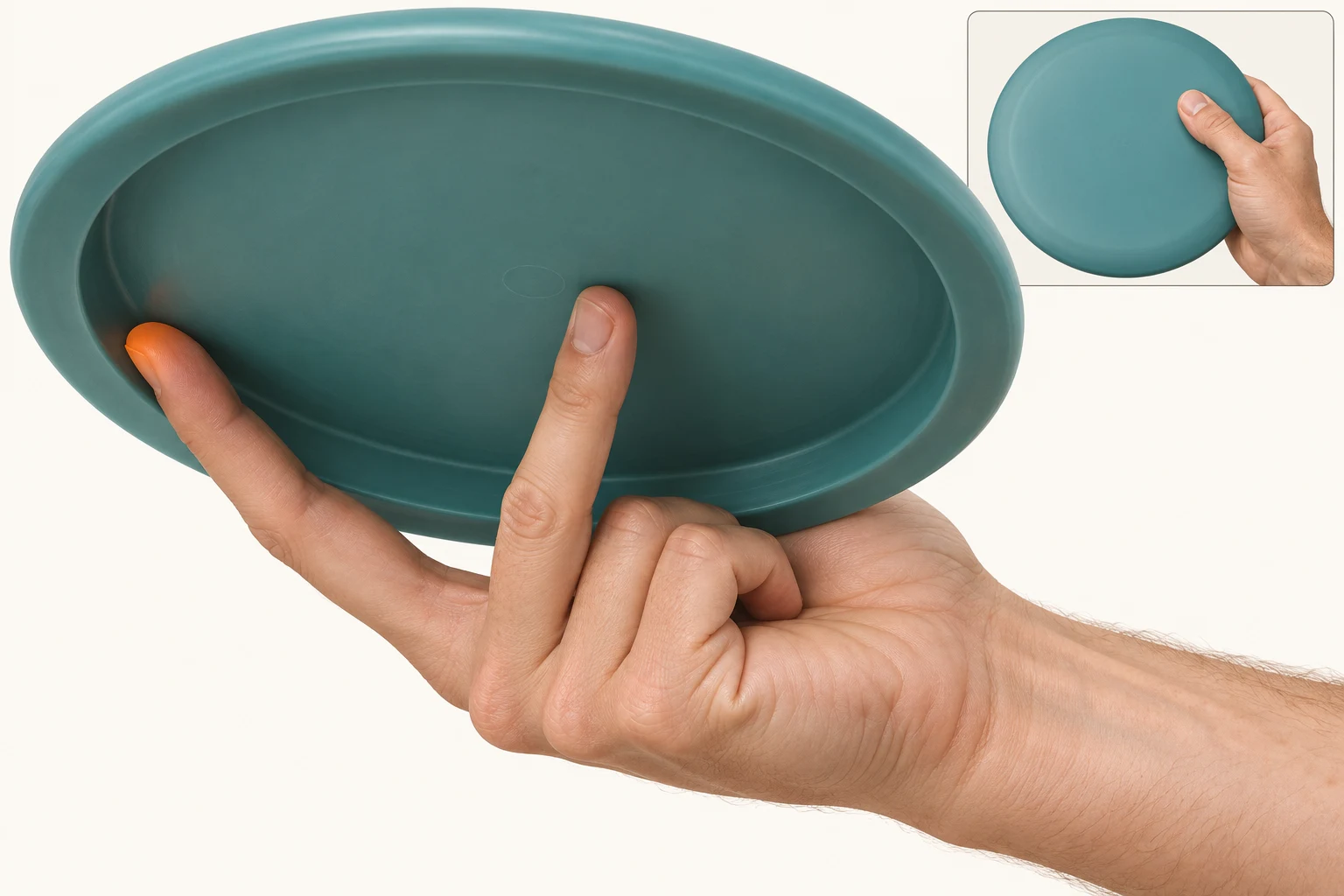
Try it on a short approach if the stacked version feels awkward or the disc feels poorly supported. Move only the supporting index finger at first. Keep the middle finger's rim contact and the thumb on top, so you can feel what the added support changes.
The split is a positioning option, not a promise of more accuracy. If it catches a finger or makes the disc wobble in your hand, compare a smaller gap or go back to fingers together. Use the easy approach you can repeat before adding effort.
One-finger forehand grip: an alternative to compare
Place the index finger against the inner rim, with your thumb on top. Tuck the middle, ring and little fingers into your hand so they stay clear. The index finger supplies the underside rim contact by itself.
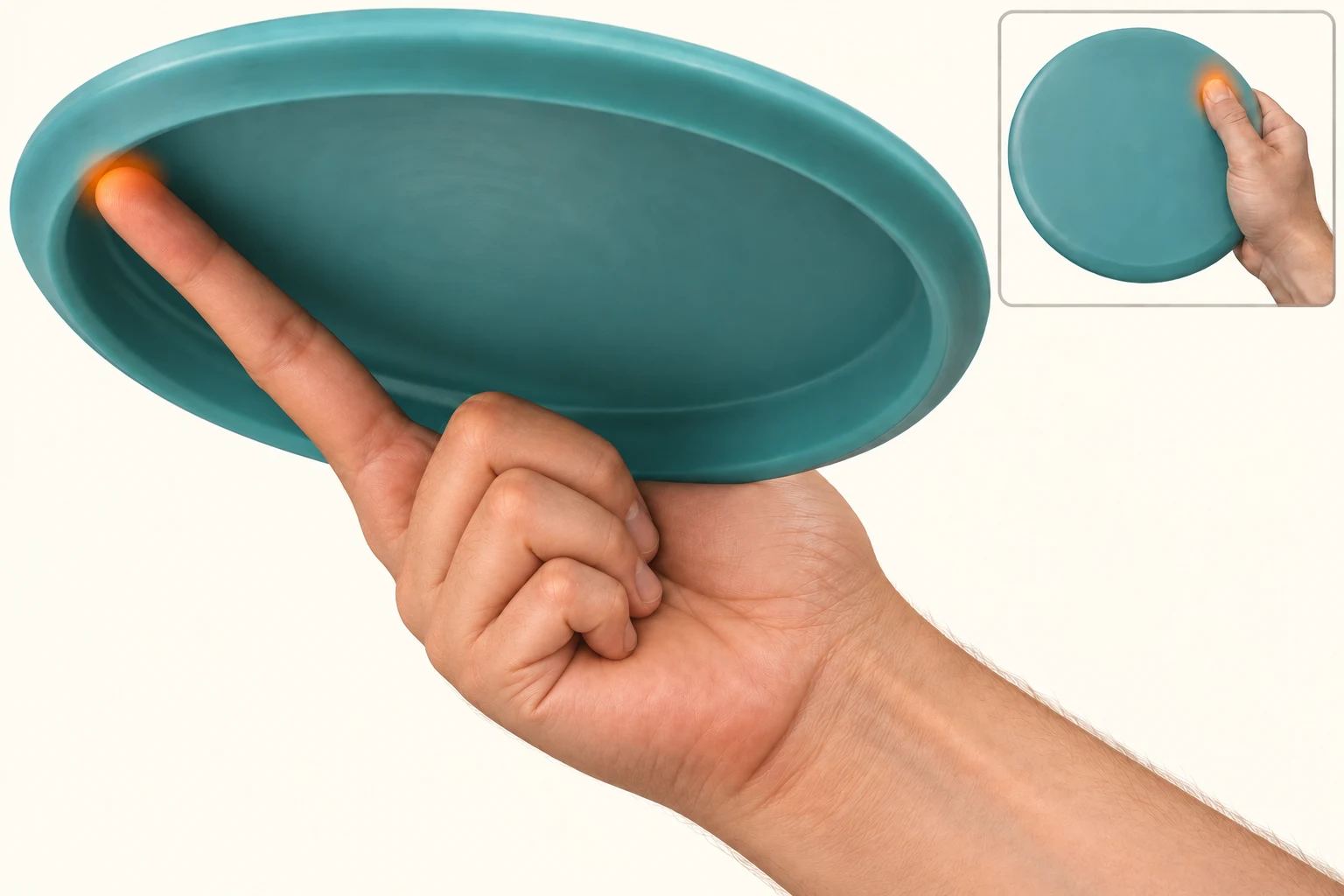
If you already throw comfortably this way, compare it with a two-finger grip using the same disc and short target. Notice whether adding the middle finger helps you hold the disc securely or makes the setup less comfortable. For someone learning a forehand from scratch, our starting suggestion remains the stacked two-finger version.
You can forehand a putter or midrange as well as a driver. Innova's forehand guidance specifically encourages practice across disc types. A deep putter may need a different finger bend from a shallow driver; test that fit with a short toss before attempting a drive.
Should you change grip for a putter, midrange or driver?
Change it when the rim or the shot gives you a reason. The disc's category alone does not dictate a grip.
| Disc or feature | What may feel different | A useful comparison |
|---|---|---|
| Deeper putting putter | More room beneath the plate; more edge to clear at release | Fan/control grip versus the same grip with index underneath |
| Putter thrown from the tee | You need a secure hold for a faster throw | Power grip versus modified fan |
| Midrange | Rim and underside shape differ between molds | Fan versus power on the same approach |
| Fairway driver | Often a more manageable rim than a very fast driver | A comfortable power grip for backhand; stacked for forehand |
| Wide-rimmed distance driver | Fingers must reach farther inward to meet the rim wall | Compare a narrower driver instead of forcing the grip |
| Bead or pronounced bottom edge | A small ridge may sit against or catch a finger | Shift that finger slightly and check the release |
These comparisons are practice suggestions. Molds vary within every category. A shallow putter can fit differently from a deeper one, and a bead can feel comfortable to one player and distracting to another.
If you have smaller hands, compare rim width and depth in person when possible. Hold the disc in both your backhand and forehand grip. Being able to reach the rim matters more for this check than liking the flight numbers on its stamp. Our disc directory can help narrow the type of disc to examine; it cannot tell you how a particular disc feels in your hand.
Grip pressure, thumb position and slippery plastic
Use enough pressure to keep the disc secure through the motion you are practicing. You should still be able to arrange the fingers comfortably and move the wrist. We do not recommend a universal squeeze percentage or exact thumb distance: neither accounts for the hand, rim or shot.
Start with the thumb above the gripping fingers, then make small position changes. If moving it changes the disc's tilt, reset the angle before comparing throws. A grip that looks flat while standing still does not guarantee a flat release during the motion.
Plastic can change the feel of the same mold. Innova's plastic overview describes differences in grip and flexibility between blends. Compare the actual disc, especially when it is cold or damp. Dry your hand and the disc first if they are wet; that gives you a fairer starting point for a grip comparison.
Before buying another version, read our DX, Star and Champion comparison. A plastic label alone does not guarantee the same feel across weights, runs or conditions.
Grip problems: what to check first
| What you notice | First thing to check | Next small experiment |
|---|---|---|
| Disc slips during an easy throw | Wet surfaces or loose contact | Dry both surfaces; reset the same grip |
| Putter seems to catch a finger | Index position, depth or bottom edge | Move the index underneath or try a fan grip |
| Forehand flutters out of the hand | Rim contact and a stable disc angle through the motion | Reset the fingertip at the inner rim and shorten the throw |
| Driver climbs and fades early | Release angle as well as grip | Compare an easy flat throw; do not assume more squeeze will fix it |
| Throw goes wide of your intended line | Timing and swing path as well as the fingers | Slow down and compare the same grip before changing it |
| Rim forces an uncomfortable finger position | Fit of that particular disc | Try a narrower or shallower disc you already own |
These are checks, not diagnoses from a flight result. A late release is often called grip lock, but grip, motion and timing work together. Changing finger pressure may not solve it. Our flight numbers guide explains why the disc's ratings cannot account for your release.
Keep the practice comfortable. If a grip or throw hurts, stop that experiment rather than forcing the position.
A short practice session to find your grip
Use a familiar putter and midrange, plus a fairway driver if you already throw one. Find an open area with a clear landing space. The point is to compare releases, so choose easy throws you can repeat.
- With the putter, make five short approaches using a fan grip and five using a modified fan. Keep the target and effort similar.
- With the midrange or fairway driver, compare five easy power-grip throws with your current grip.
- For forehands, choose one comfortable disc and compare stacked with split on short tosses. Leave full drives for another session.
- Finish with a few close putts. Compare the index on the outside edge with the index underneath.
Write down which setup felt comfortable, which released cleanly, and which held your intended angle. Five throws are a small practice sample, so repeat the comparison another day before replacing a grip that usually works. You can fit these checks into our 30-minute practice routine.
Keep the comfortable putting grip and the throwing grips that give you a useful release. If two discs need slightly different finger placement, record that difference instead of buying a replacement immediately.
Sources and illustration notes
Sources checked October 5, 2026: Innova's 2006 catalog, Des Reading grip tip, Innova's 2009 catalog, common grips, Innova's forehand coaching, Adam Goodman's Discraft player page, and Innova's plastic overview. The older catalogs supply basic grip descriptions; they are not current product or price references.
The grip comparisons, practice sequence and troubleshooting checks are DiscField editorial suggestions. We have not measured grip performance or conducted a field test for this guide. The seven hand illustrations and rim comparison were generated for DiscField, reviewed for visible placement and clarity, and revised where the initial finger contact was unclear. They show generic examples rather than a photographed coach, an exact disc mold or a complete throwing motion.