DISCFIELD / Learn
Glow disc golf: how to play disc golf at night
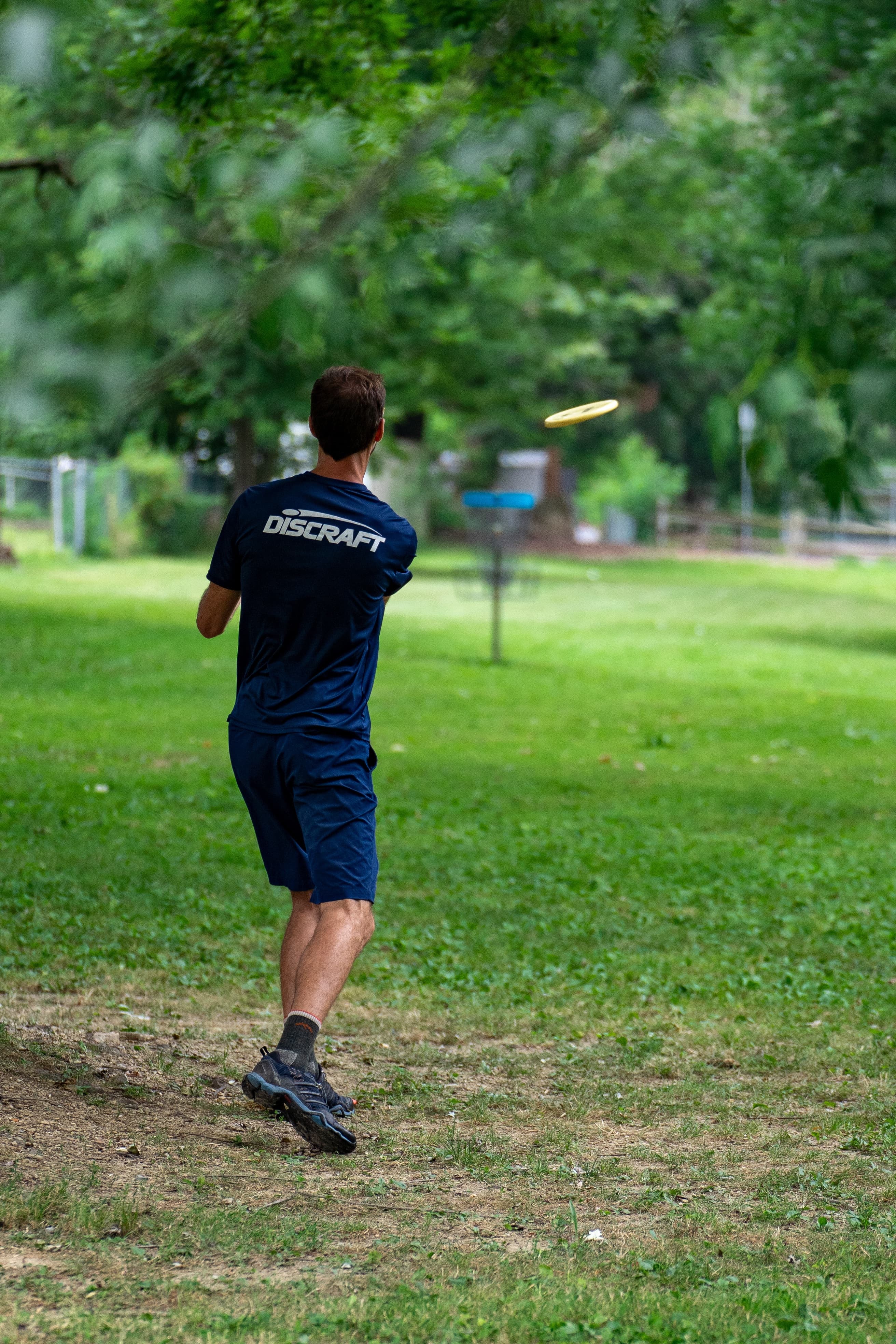
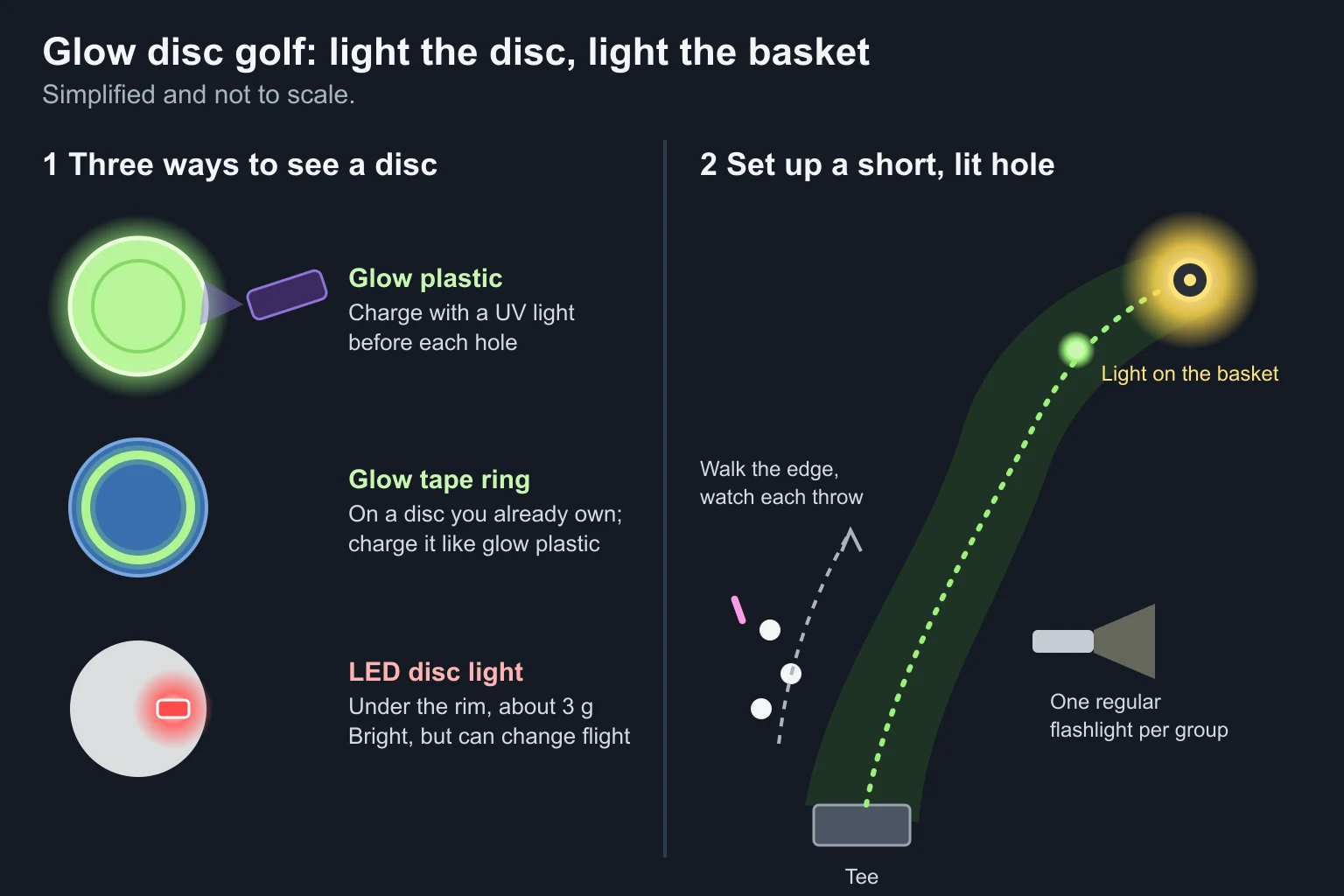
Glow disc golf is an ordinary round played after dark with discs you can see in flight. There are three ways to light a disc: glow-in-the-dark plastic that you charge with a UV flashlight, glow tape stuck to a disc you already own, or a small LED light taped under the rim. Add some light on each basket, bring a regular flashlight for the group, and start on a short, open course you know well. First, check that the course is open after dark.
This guide covers what to bring, how to choose between glow plastic, glow tape and LED lights, how to charge a glow disc, how to light the baskets, how to stay safe and what the PDGA rules say about lights in sanctioned events.
Check that the course is open after dark
Many parks close at dusk, and a course being open in daylight says nothing about night play. Infinite Discs' guide to disc golf at night suggests checking with the local government before you go, and Discmania's glow disc golf tips ask players to respect posted park hours. The PDGA's roundup of glow tips from players ends with the same reminder: check park hours and follow local rules.
If your usual course closes at dusk, ask a local club whether it runs glow rounds somewhere play is allowed after dark.
What to bring to a glow round
You do not need a full bag. In the PDGA roundup, one player suggests that a midrange and a putter are really all you need, with an extra driver or two only if you want them. A smaller bag also means fewer discs to charge and fewer to lose. If you are still building a bag, our two- to three-disc starter bag is a good base for a glow round.
| Item | Why it helps |
|---|---|
| A putter and a midrange you can see in the dark | Glow plastic, glow tape or an LED light on each one |
| A UV (black light) flashlight | Charges glow plastic and glow tape quickly, and makes a lost glow disc light up when the beam hits it |
| A regular flashlight for the group | For walking, reading a scorecard and searching |
| Lights for the baskets | Glow sticks, a small battery light or a flashlight in the bottom of the basket |
| Glow sticks or bracelets | On your bag and on each player, so you can see each other and find your bag again |
| A phone with a charged battery | For safety, not as your main light |
The basket, flashlight and glow-stick items come from the PDGA roundup and Infinite Discs' night-round guide. One player in the PDGA roundup suggests one small black light for every two people and one regular flashlight for every group of four. Treat that as a starting point.
Glow discs, glow tape or LED lights?
Which one suits you depends on how many discs you want to light and how close you want them to stay to their normal flight.
| Option | Good for | Watch out for |
|---|---|---|
| Glow plastic | Discs you already throw, in a glow version | Needs charging before throws; the glow fades; brightness varies by brand and plastic |
| Glow tape | Lighting discs you already own, cheaply | Needs charging like glow plastic |
| LED disc light | The brightest, steady light without charging | Adds weight, can change the flight, and a light that lands in water usually stops working |
Glow plastic
Infinite Discs points out the main advantage: if your favorite disc comes in glow plastic, you already know how it flies. Innova lists glow versions of several common models, for example a Glow Aviar (170 to 175 g) and a Glow Champion Leopard3. Our records for the Aviar and Leopard3 cover how those molds are rated.
Glow plastic is still its own plastic. Innova lists the general Tern at 12 / 6 / -3 / 2 but its Champion and Glow Champion versions at 12 / 6 / -2 / 2. Our Tern record shows the difference. If you buy a glow version of a disc you already throw, check the flight numbers on that exact listing. Our plastic guide explains why DX and Champion versions of the same mold can feel and wear differently.
Not every glow disc glows equally. Infinite Discs reported in December 2023 that Innova was switching to a brighter glow formula because its older glow plastic was not glowing well enough, and that older stock would be sold as "Old Glow". Before a round, charge your glow discs and look at them in the dark. You will see quickly which ones fade first.
Glow tape
Glow tape rings are stickers made for discs. Infinite Discs describes them as light enough not to change a disc's weight or flight, and says they charge quickly with UV light and glow for several minutes. Tape is the cheapest way to try a glow round with discs you already like.
LED disc lights
A small flat LED taped under the disc stays bright for the whole hole and does not need charging, but it adds weight. In its tips for applying LED lights, Infinite Discs says each light weighs about 2.9 g (roughly 3.1 g once taped) and will affect the flight. Discmania makes the same point and prefers charged glow plastic for that reason. If you use two lights, Infinite Discs suggests placing them on opposite sides of the disc to keep the flight more even.
To keep a light on the disc:
- Wash and dry the disc first, so the tape sticks to plastic, not dirt.
- Let the discs and tape reach room temperature before taping, ideally a few hours before the round.
- Wrap the light in clear tape before you attach it. That protects it and may help keep water out.
- Tape it to the underside of the disc, shining up through the plastic. Lighter, translucent plastic lets more light through.
Those steps follow Infinite Discs' guide. The extra 3 g or so is small, but it is in one spot on the rim, so throw a lit disc a few times before you trust it on a tight line. Our disc weight guide explains how weight affects a throw.
How to charge a glow disc
A UV flashlight charges glow plastic much faster than a regular light. Infinite Discs recommends one as the key accessory for glow discs and glow tape, and Discmania recommends a proper LED or black-light flashlight over a regular one.
- Shine the UV light over the top and bottom of the disc just before you throw.
- Charge it again before each hole. Infinite Discs notes that Innova's older glow plastic worked well enough at night when it was recharged with a UV flashlight before each hole.
- After a long search or a long walk, charge it again before the next throw.
- If a glow disc goes missing, sweep the UV beam across the area where it landed. A glow disc lights up when the beam hits it.
Light up the baskets
A glowing disc is only half the job if you cannot see the target. The first tip in the PDGA roundup is to put as much light on the baskets as you can: a permanent solar LED is ideal, but glow sticks or a flashlight in the bottom of the basket also work. Infinite Discs suggests taping glow sticks to the baskets.
If the course has no lights, a small group can carry two or three portable lights. Drop one at the next basket as you walk up and collect it when the group leaves.
Stay safe in the dark
A night round needs a few extra habits:
- Pick an easy course. Infinite Discs calls open park courses the easiest place to play without tripping over roots, rocks and holes. Discmania advises against courses with rough terrain at night.
- Play shorter holes. One player in the PDGA roundup notes that holes under 300 feet work fine at night, and a shorter throw is easier to follow to the ground. Our approach shot guide covers the shorter, controlled throws you will use more after dark.
- Keep your eyes on the disc in flight and walk along the side of the fairway, not down the middle of it. Wait until everyone has thrown before walking ahead.
- Keep lights low when you can, because your eyes adjust to the dark better without bright lights in them. Say so before you switch on a flashlight, so you don't dazzle the group, and do not skip a light when the ground is uneven.
- Carry a phone and play with others. A group can help search, spot throws and get help if someone falls.
Glow rounds and the PDGA rules
For a casual round with friends, you can tape lights or glow tape to any disc. Sanctioned PDGA events are different. Rule 813.01 Illegal Disc generally makes it illegal to add material of a detectable thickness or to change a disc's original flight characteristics. The same rule says that when the Tournament Director has announced night or snow play, players may add a material or device to help find the disc. In an event, ask the director before you tape anything to a disc.
The usual round rules still apply after dark: the three-minute search for a lost disc, out-of-bounds lines and the order of play. Our disc golf rules guide covers them, and our free printable beginner handout fits in a pocket for a club glow night. If you play on snowy winter evenings, our winter disc golf guide explains how to find a disc in snow and what to wear.
Sources and scope
Sources checked October 9, 2026: PDGA rule 813.01 (last updated December 31, 2025); the PDGA News roundup Glow Up: Tips For Playing Disc Golf After Dark (December 2020; player tips shared on the PDGA's Facebook page); Infinite Discs' Disc Golf at Night, tips for applying LED lights and Innova's brighter glow plastic; Discmania's glow disc golf tips; and Innova's model pages for the Aviar, Leopard3 and Tern. The equipment list and safety steps are DiscField's editorial summary of these sources. DiscField has not tested glow plastics, tape or lights, and does not rank glow brands.
Read next
- Disc golf rules for beginners: how to play a round
- Pink disc golf discs are the best
- Best disc golf discs for beginners: a simple 2–3 disc bag
- Innova DX vs Star vs Champion: which plastic should you choose?
- Disc golf approach shots: how to throw an upshot for beginners
- Winter disc golf: how to play in cold weather and snow