DISCFIELD / Learn
Disc golf approach shots: how to throw an upshot for beginners
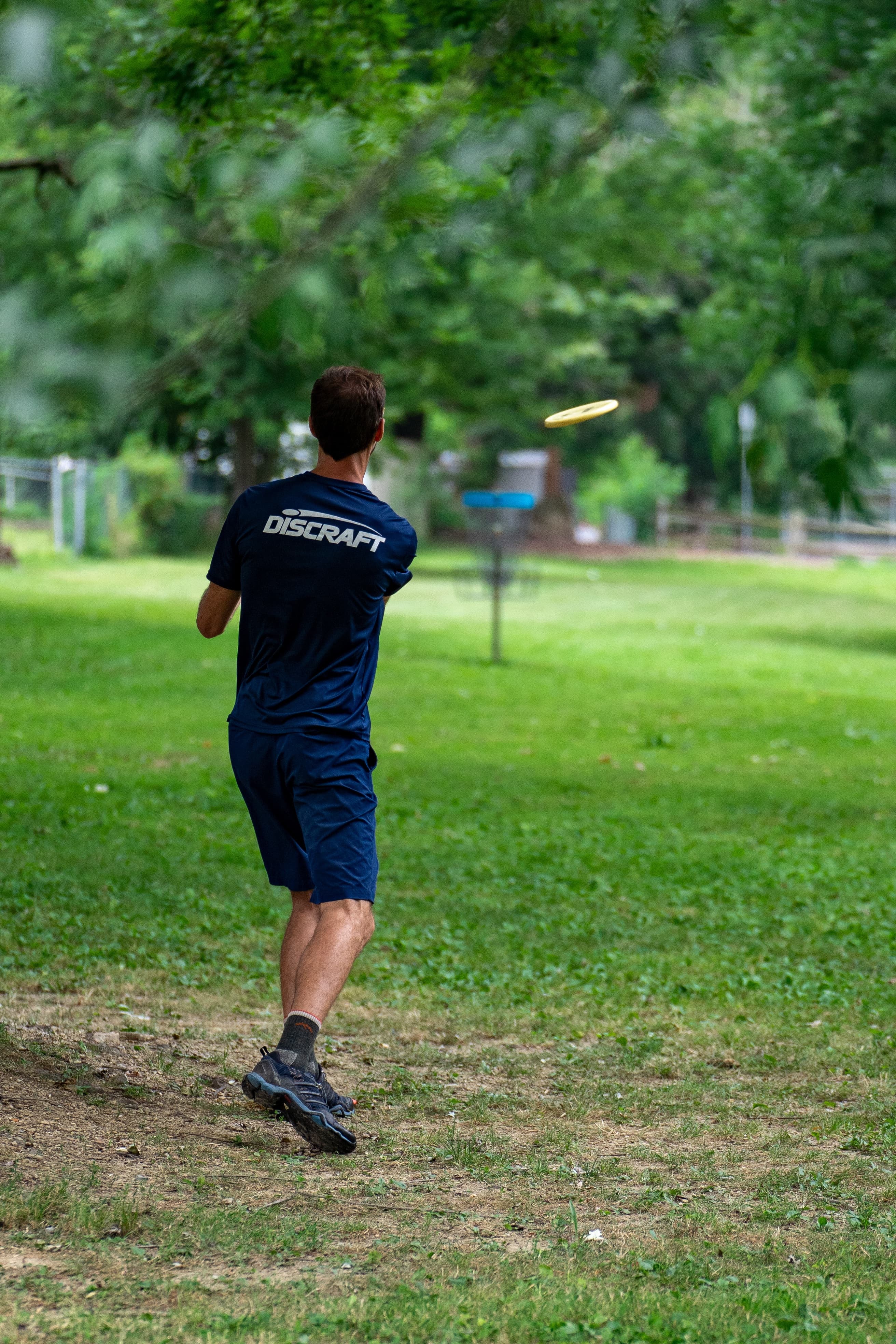
A good disc golf approach shot does not have to hit the chains. Pick a landing zone you are comfortable putting from, on the safe side of the basket, and throw a putter or midrange you know at less than full power. Use a shorter reach-back, keep your eyes on your aim point and release the disc slightly nose up so it slows down and stops instead of skipping away.
This guide is for right-handed backhand throws (left-handers mirror the directions). It covers how to pick the landing zone, which disc to use, a simple pre-shot routine, the throw itself, how ground, slopes and wind change the finish, and a practice plan.
What an approach shot is for
An approach, or upshot, is the throw that sets up your putt. On most holes it is the shot after your drive, when you are too far to putt but close enough that distance no longer matters much. Innova's Master Your Approach Game describes approach shots as a way to create scoring chances, not to force a perfect result. That changes the goal from "get it in" to "leave yourself an easy next throw."
Team Innova also calls approach play an underrated part of scoring and suggests practicing upshots from about 100 to 250 feet as often as you practice driving and putting.
Pick a landing zone, not the chains
Before you choose a disc, decide where you want the disc to stop. A few questions help:
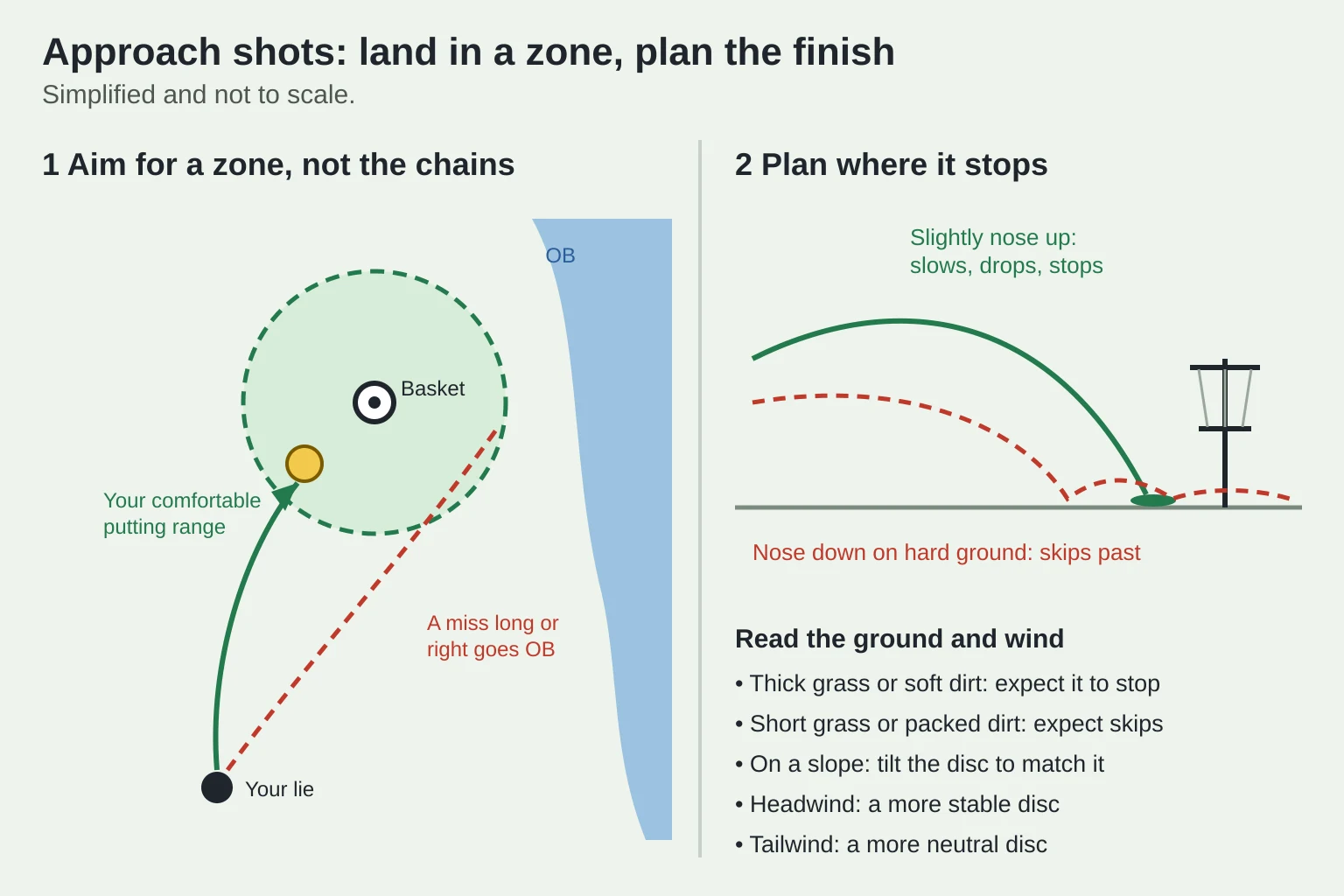
- How far can you putt with confidence? That distance sets the size of your target. Innova points out that the farther out you are confident putting, the bigger your landing zone becomes. If you make most putts from 15 feet, aim for a zone about that size around the basket, not the basket itself. Our disc golf putting guide helps you grow that range.
- Where is the trouble? If there is out-of-bounds behind or to one side of the basket, aim for the opposite side. A miss there still leaves a putt; a miss into OB costs you a penalty throw.
- Which side gives the easier putt? On a slope, Discmania's short game tips suggest landing on the high, uphill side of the basket, so you putt downhill.
Infinite Discs' approach tips put a number on it: think of a 25-foot circle around the basket instead of trying to park the disc. Players who always try to land right under the basket end up choosing riskier lines. Innova's advice is similar: instead of forcing a disc through a tiny gap, take the wider route that leaves a comfortable putt.
Which disc to use for approach shots
Use the disc you control best at this distance, usually a putter or a midrange. Slower discs need less power to fly the way their flight numbers describe, which makes them easier to throw softly.
| Shot | A sensible starting disc |
|---|---|
| Short approach on an open line | Your throwing putter, such as an Aviar |
| Longer approach or more distance needed | A midrange you already know, such as a Mako3 |
| Headwind approach | A more overstable putter, such as an AviarX3 |
| Tailwind approach | A more neutral putter or midrange |
The wind rows follow Innova's approach guide, which suggests more overstable, lower-glide discs into a headwind and more neutral discs in a tailwind. Innova calls the AviarX3 a disc for headwind approaches and drives. Our disc golf in the wind guide explains why.
You do not need a separate approach disc to start. If you want one disc for approaches and another for putting, read putting putter vs throwing putter.
A simple pre-shot routine
Innova's approach guide lists a routine you can repeat on every upshot:
- Check your lie and where you can stand.
- Feel the wind.
- Pick the landing zone.
- Choose the flight path to get there.
- Pick an aim point and line your feet and shoulders up with it.
Innova's point is that the exact steps matter less than repeating them every time. A steady routine keeps you from rushing a decision on a shot that feels easy.
How to throw an approach shot
The throw is a smaller, calmer version of your disc golf backhand:
- Take a short reach-back. Innova notes that a shorter reach-back often makes it easier to keep your eyes on the aim point and to control distance.
- Keep your eyes on the aim point. For short approaches, Innova suggests looking at it through the whole throw.
- Release slightly nose up. Innova explains that a slight nose-up release lets the disc slow down, stall and land with less forward speed. That means fewer skips and less roll near the basket. In Infinite Discs' summary of a clinic by Paul Ulibarri, Ulibarri suggests keeping your wrist above your elbow to help get the nose up.
- Follow through toward the target. A smooth, complete follow-through helps you repeat the same release.
- Throw at a pace you can repeat. Control matters more than power here. If you have to throw hard to reach the zone, take a faster disc rather than forcing a putter.
If the disc is landing on the wrong side, check your release angle first. A hyzer release (outer edge tilted down) makes a right-handed backhand finish left, and an anhyzer release (outer edge tilted up) makes it move right.
Plan where the disc stops, not just where it lands
Innova's approach guide says the best approach players plan where the disc finishes, not just where it first lands. The ground and the wind decide a lot of that:
- In thick grass or soft dirt, expect the disc to stop quickly. You can land it close to the zone.
- On short grass or packed dirt, plan for skips and slides. Land it short and let it move up.
- On a slope, Innova suggests matching the angle of the disc to the angle of the ground, so it lands flat on the slope instead of rolling away.
- In wind, remember that a tailwind can carry the disc farther, and a headwind makes it drop sooner. Adjust the landing spot, not just the disc.
A short approach practice plan
You can practice approaches in any open field with a few discs and a marker:
- Set a target, such as a basket, a cone or a towel.
- Throw five approaches each from three distances, for example 60, 120 and 200 feet.
- Count how many finish inside your comfortable putting range, not how many hit the target.
- Try each disc on a hyzer, a flat and a slight anhyzer line, so you learn how it behaves on each angle.
- Write down which disc and angle gave you the most good finishes from each distance.
The distances and scoring are our suggestions, not a standard drill. Our 30-minute practice routine fits a shorter approach block into a full session with putting and drives.
Sources and scope
Sources checked October 8, 2026: Innova's Master Your Approach Game, Best Tips from Team Innova and AviarX3 page; Infinite Discs' approach tips and Paul Ulibarri clinic summary; and Discmania's short game tips. The disc rows are DiscField's editorial starting points, not a test of these discs. DiscField has not measured approach shots or run a controlled test of these techniques.