DISCFIELD / Start here
Disc golf rules for beginners: how to play a round

Disc golf is scored like golf. You count every throw it takes to get your disc into the basket, add any penalty throws, and the lowest total for the round wins. After the tee shot, each throw starts from where your last one came to rest.
For a casual round, you only need a handful of rules: where to stand, who throws next, how putting works near the basket, and what to do when a disc goes out-of-bounds or gets lost. This guide summarizes the PDGA Official Rules of Disc Golf (2026 edition) in plain language. The official text governs PDGA events. On any course, the tee sign or course map tells you where that hole's out-of-bounds areas, mandatory routes and drop zones are.
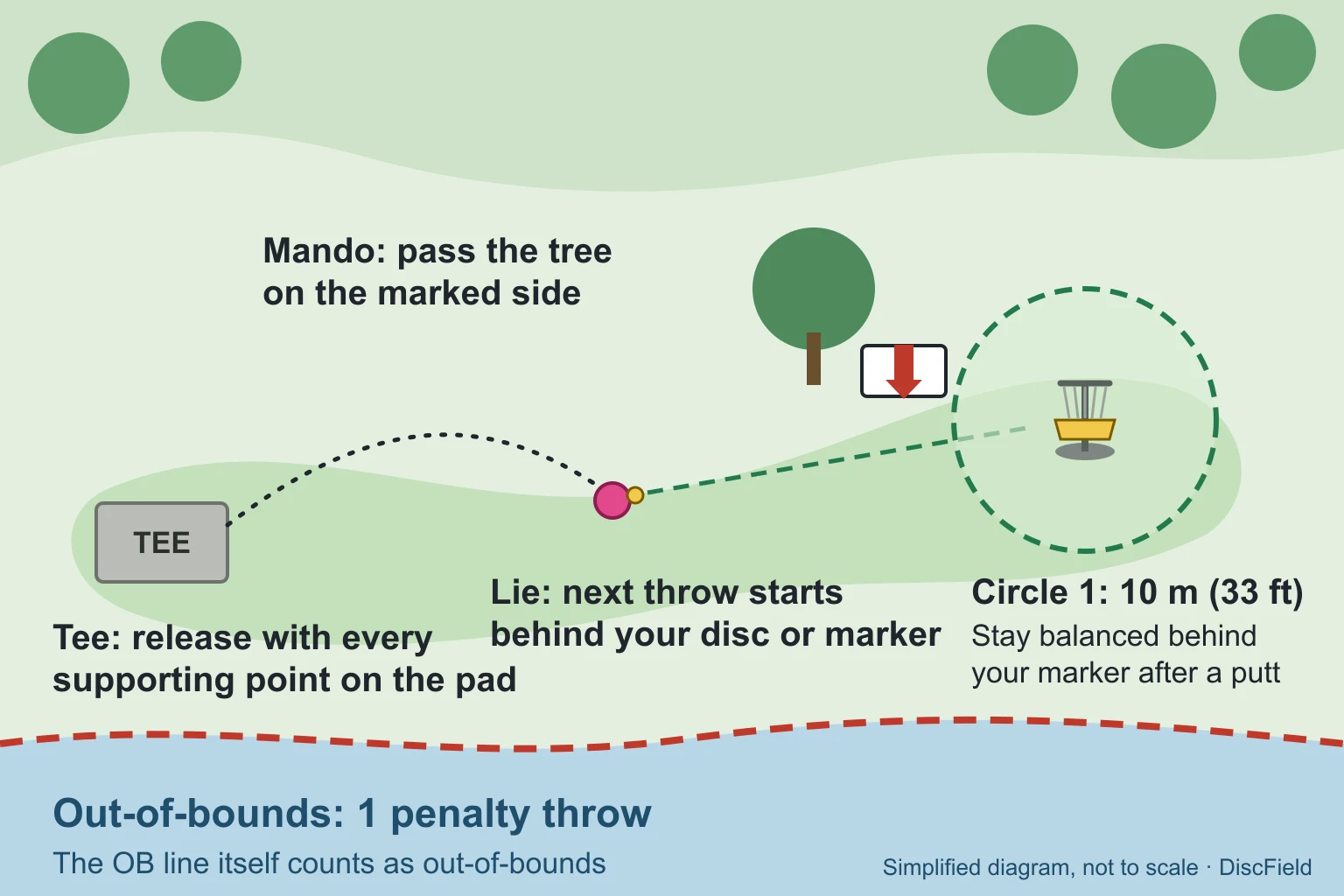
Disc golf rules at a glance
| Situation | What the rules say | Penalty |
|---|---|---|
| Teeing off | At release, every part of your body touching the ground is inside the teeing area | 1 throw |
| Throws after the tee | Throw from your lie, directly behind your disc or marker | 1 throw |
| Putting within 10 m (33 ft) | Stay balanced behind your marker before stepping forward | 1 throw |
| Out-of-bounds | Play from your previous lie, or within 1 m of where the disc was last in-bounds | 1 throw |
| Missed mandatory route | Play from the drop zone, or from your previous lie if there is none | 1 throw |
| Lost disc | After a three-minute search, throw again from your previous lie | 1 throw |
| Finishing the hole | The disc comes to rest supported by the basket's tray or its chains | None |
How a hole works and who throws first
Every hole starts at a tee and ends at a target, usually a basket. Courses typically have 9 or 18 holes, and each hole is scored separately (PDGA rule 800).
The order of play works like this:
- First tee: players throw in the order they are listed on the scorecard. In a casual round, pick any order.
- Later tees: the player with the lowest score on the previous hole throws first. A tie keeps the existing order.
- After everyone has teed off: the player farthest from the target throws next. This player is often called "away."
To keep the round moving, a player who is not next may throw if the next player agrees or will not be affected. Before any throw, make sure nobody is within range.
Teeing off
Throw your first shot from the teeing area. If the hole has a tee pad, the pad is the teeing area. Without one, the area extends three meters behind the tee line (rule 802.04).
The rule only checks your position at the moment you let go. A supporting point is any part of your body touching the ground or another object that supports you. At release, all supporting points must be inside the teeing area. You can step off the pad after the disc leaves your hand, so a normal run-up and follow-through are fine as long as your release happens on the pad.
Marking your lie: where to stand after the tee
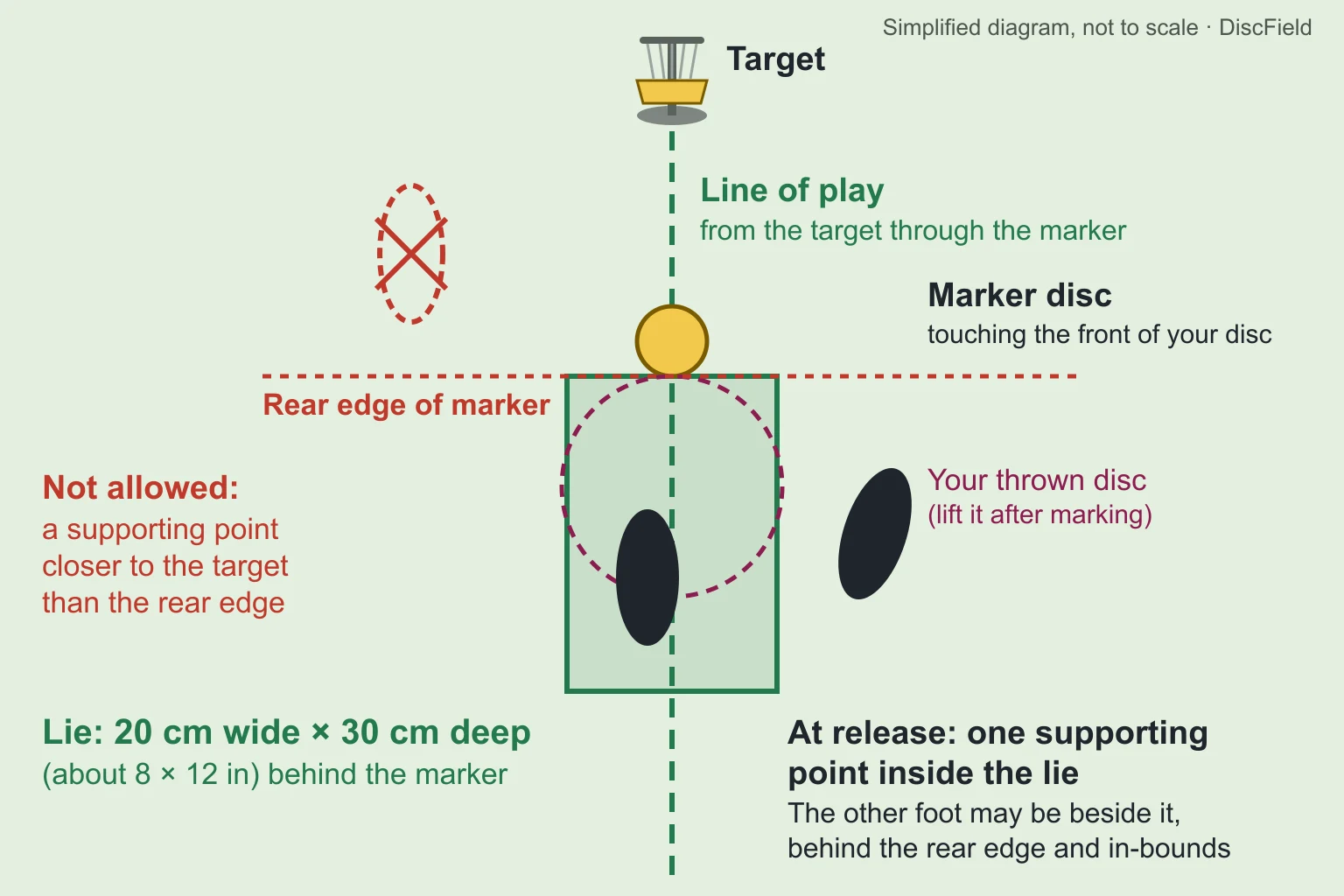
Your next throw starts from your lie. You can leave your disc where it landed, or place a mini marker disc touching the front of your thrown disc on the line between the target and your disc (rule 802.06). That imaginary line from the target through your marker is the line of play.
The lie itself is a rectangle 20 cm wide and 30 cm deep (about 8 × 12 inches) directly behind the rear edge of the marker (rule 802.05). The PDGA's simplified rules compare it to a sheet of paper laid behind the disc.
When you release the disc from a marked lie, the stance rule requires that you:
- Have at least one supporting point touching the lie.
- Have no supporting point closer to the target than the rear edge of the marker.
- Have every supporting point in-bounds.
Your other foot can be outside the rectangle, for example to the side, as long as it is not ahead of the marker. If your disc is stuck in a tree, its position is on the ground directly below it.
Play the course as you find it. The simplified rules allow you to move small loose objects behind your lie, such as twigs, pinecones and small stones. You may not break branches or move fixed obstacles to make room for a throw.
Putting rules near the basket
A throw from within 10 meters (about 33 feet) of the target, measured from the front of your lie to the base of the basket, counts as a putt. This area is often called circle 1, or C1. After you release a putt from there, you must show full control of your balance behind your marker before you walk toward the basket (rule 806.01). That rules out jump putts, step putts and falling putts inside 10 meters.
Outside that distance, you only need a legal stance at the moment of release. You may step or jump past your marker after the disc leaves your hand.
To finish the hole, the disc must come to rest supported by the basket's tray or the chains below the chain support (rule 807). A disc that hits the chains and falls out does not count. Neither does one resting on top of the basket. If you are unsure which putter to use for this short throw, our guide to putting and throwing putters explains the difference.
Out-of-bounds, mandatory routes and lost discs
Out-of-bounds (OB)
An out-of-bounds area is defined for the course or event: a road, a pond, a parking lot or an area beyond a marked line. The OB line itself counts as out-of-bounds. A disc is OB only when it is clearly and completely surrounded by the OB area.
If your disc is OB, add one penalty throw and play your next shot from either:
- your previous lie, or
- a spot up to one meter from where the disc was last in-bounds.
Some courses and events also allow play from a marked drop zone. If your disc lands in-bounds but within one meter of the OB line, you may move your lie up to one meter in from the line, on a line through your disc at a right angle to the OB line.
Mandatory routes (mandos)
A mandatory route requires your disc to pass on a specific side of a tree, pole or other marked object. The course sign or the marker shows which side counts. If your disc passes on the wrong side, add one penalty throw and play from the drop zone for that mando. If there is no drop zone, throw again from your previous lie.
Lost discs
If you cannot find your disc within three minutes of reaching the area where you think it landed, it is lost. Everyone in the group should help search. Add one penalty throw and throw again from your previous lie, or from a lost-disc drop zone if the hole has one. A disc lost inside an OB area is played as OB.
Bright colors can save some of those three minutes. See our guide to choosing disc colors that are easier to find, and write a contact method on the bottom of every disc. Our guide to cleaning, storing and marking your discs covers the rest of their care.
The two-meter rule
You may hear about a penalty for a disc that stops high in a tree. Under the current PDGA rules, the two-meter rule applies only when an event's director declares it. Without that declaration, a disc in a tree is simply played from the ground directly below it.
How to keep score
Your score for a hole is your number of throws plus any penalty throws. Three throws and one OB penalty make a score of four. Add up all hole scores for your round total.
Each hole has a par, usually shown on the tee sign: the expected number of throws for that hole. Finishing one under par is a birdie; one over is a bogey. Our disc golf terminology page defines these and other common words.
The PDGA's simplified rules suggest that everyone in the group records everyone's scores after each hole, using whole numbers such as "4" rather than "+1." A shared score app or a paper card both work for a casual round.
Courtesy and safety rules
The PDGA courtesy rules cover behavior that keeps the round safe and fair:
- Do not throw when your disc could hit someone. Wait until the group ahead is out of range.
- Shout only to warn someone who might be hit. "Fore!" is a common warning.
- Stay still and quiet while another player throws. Do not stand ahead of the player who is away.
- Help search for lost discs and keep your bag out of other players' way.
- Do not litter, and do not damage trees, baskets or equipment.
In PDGA play, a first courtesy violation gets a warning and later ones in the same round cost a penalty throw. In a casual round, a reminder is usually enough.
Casual rounds and tournament rules
You can play a casual round by the official rules. Before the first tee, agree on how strictly your group will play. For example, decide whether you will count stance penalties while someone is still learning. Apply the same choice to everyone.
If you later play a league night or a beginner event, read the PDGA's simplified rules first. The PDGA wrote them for beginner-focused and unsanctioned events. Sanctioned events also require PDGA-approved discs. For your first round, our disc golf beginner guide covers what discs to bring, and a simple practice routine helps you work on putting before you play.
PDGA rule pages and the simplified rules were checked October 7, 2026. This guide summarizes them for recreational players and does not replace the current official text or a course's posted rules.