DISCFIELD / Learn
Disc golf etiquette: how to play with other people
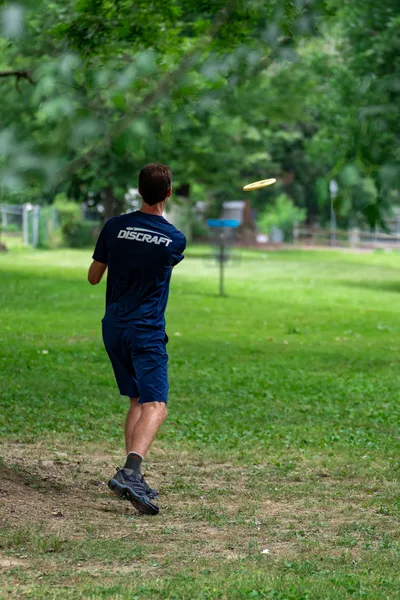
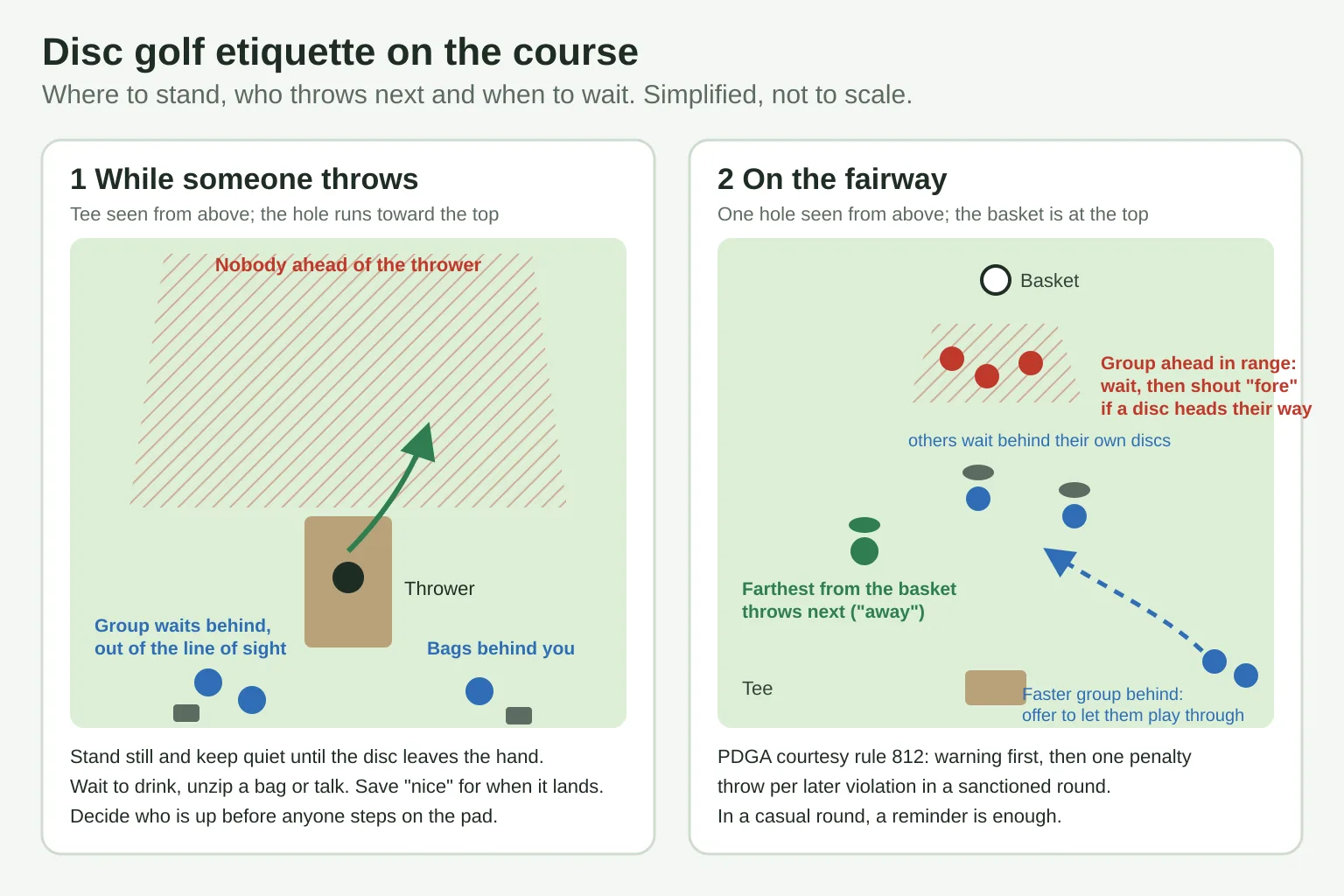
Disc golf etiquette comes down to a few habits. Do not throw until everyone ahead is out of range. Stand still and quiet behind the player who is throwing. Keep the order: lowest score tees off first, then the player farthest from the basket throws next. Let a faster group play through, help look for lost discs, clear your disc out of the basket, and leave the park as you found it. The PDGA writes some of this into its courtesy rule, with penalties in sanctioned play; the rest are course habits that Innova and UDisc describe the same way. This guide covers a casual round on a public course with people you may not know.
Disc golf etiquette at a glance
| Situation | The habit | In PDGA sanctioned play |
|---|---|---|
| Someone is throwing | Stand behind them, still and quiet, out of their line of sight | Distracting a thrower is a courtesy violation |
| People within range ahead | Wait until they are clear; shout "fore" if a disc heads their way | A throw that could injure someone is a courtesy violation |
| Whose turn it is | Lowest score tees off first; farthest from the basket throws next | Throwing out of turn is a courtesy violation |
| A faster group behind you | Offer to let them play through | Tournament groups keep their order |
| A lost disc | Everyone searches, for up to three minutes | Helping to search is required |
| Trash, cursing, a kicked bag | Pack it out and keep frustration small | Littering, cursing and kicking equipment are courtesy violations |
| Scores | Offer to keep score and agree on each hole's number | Keeping score correctly is required |
The right-hand column summarizes PDGA rules 812 and 802.02, which the next section links; the middle column is what the same habits look like in a casual round.
What the PDGA writes down
PDGA rule 812, Courtesy (2026 edition) is short. A player must not make a throw that could injure or distract someone, throw out of turn, curse, kick equipment, litter, or let smoke bother other players. A player must help look for lost discs, move equipment when asked and keep score correctly, and players are expected to watch the other members of the group throw so the rules are followed. In a sanctioned round the first courtesy violation is a warning and every later one in the same round costs a penalty throw; a tournament director can disqualify a player who keeps going. The rule on group decisions adds that abstaining from a group vote is a courtesy violation unless you were not there.
The PDGA also publishes a three-line Disc Golfer's Code, written so that it fits on a course sign: play smart (never throw into a blind area or when players, spectators, pedestrians or other facility users are within range, and use a spotter), respect the course (observe posted rules; no littering, graffiti or abuse of equipment or plants) and represent the sport (be positive and responsible, and teach others).
In a casual round nobody counts penalty throws for these. They still describe what the people around you expect. Our disc golf rules guide covers the playing rules themselves: the tee, the lie, putting inside 10 meters, out-of-bounds and scoring.
Who throws first
On the first tee of a casual round, any order works. After that, the player with the lowest score on the previous hole tees off first, and once everyone has left the tee the player farthest from the basket throws next. Innova's etiquette page lists the same order, and it is PDGA rule 802.02. A player who is not next may throw if the next player agrees or will not be affected, which keeps a round moving. Throwing out of turn without that is a courtesy violation.
Tees are the one place where order matters most, because the group stands close together. Decide who is up before anyone steps on the pad.
While someone else is throwing
Innova's list puts it plainly: when others are throwing, get out of their line of sight, do not move and be quiet. UDisc's rules of disc golf etiquette adds the small things. Stand well back, and wait to take a drink, open a bag or unwrap anything until the disc has left the thrower's hand. Save the conversation for the walk down the fairway. Many players also hold their compliments until the shot lands, since saying "nice" too early is treated as bad luck.
If you are waiting for your turn on the fairway, stand behind the player who is away, not level with them and never ahead. Put your bag down behind you so nobody has to step around it.
Safety: never throw into people
Innova's rule is the one to remember: make sure everyone is well out of range before you throw, and if there is even a chance you can reach someone ahead of you, do not throw. Shout "fore" if a disc is heading toward another group. UDisc says the same about people and their pets, and adds the awkward case: if someone is sitting or walking in the fairway, ask politely whether they would mind moving, and if they would, skip the hole.
Most courses share their park with walkers, dogs, anglers and picnickers, and the posted rules usually say who gives way. Scott County, Iowa, for example, tells players on its West Lake course that golfers must yield to all park users. Read the sign at the first tee; it also marks any blind holes where the Disc Golfer's Code asks for a spotter.
A disc thrown hard can injure someone, which is why every source above says to wait rather than guess. If you cannot see the landing area, wait or send someone ahead.
Pace of play and letting groups through
Innova asks you to be aware of the groups around you. If you are playing slowly and a faster group is behind you, invite them to play through; if you want to pass a larger group, ask politely first. UDisc says the same for casual rounds and notes that tournament groups keep their order. A simple way to offer: step aside on the tee, say "go ahead," and wait until their discs are well out of range before you throw again.
Keep your own pace up without rushing anyone. Pick your disc while you walk to your lie, be ready when it is your turn, and search for a lost disc as a group so the three minutes do not become ten. Bright discs help here; our guide to disc colors that are easier to find explains which colors disappear in grass and leaves.
Being a good card mate
UDisc's guide to being a great disc golf card mate (Amanda Hayes) covers the social side. Watch where your card mates' discs land and help search. Offer to keep score. Brief encouragement is welcome, but read the mood first; a player having a bad round may not want it. Keep trash talk for friends who enjoy it, not strangers. And do not give tips on someone's form unless they ask. Some players welcome advice and others find it irritating, so the safer move is to wait until after the round and ask whether they want any. Hayes notes that unasked-for tips are a particular problem for women in the sport, citing pro Sarah Hokom.
The rest is attitude. Laugh off your own bad throws, and keep frustration small: a muttered word and a shrug rather than yelling, cursing or throwing a bag. Innova points out that in sanctioned play rude behavior can be called as a courtesy violation. Without referees, most calls in a group are settled by a vote, so a calm group makes fairer calls.
At the basket and on the course
Once your putt is in, take your disc out of the basket before the next player putts. UDisc lists it among the habits that keep a round smooth. Our putting guide covers the stance rules inside 10 meters that apply at the same moment.
Carry out your own trash and pick up any you find. Follow posted signs, keep off closed areas, and on a course laid over a ball golf course keep carts off greens and tee pads. Do not snap branches to open a line or carve anything into a tree; the Code names graffiti and damage to plants and equipment specifically.
Playing with beginners and kids
Explain the order and the range rule before the first tee, and keep the tee a quiet, one-at-a-time place; a group of new players tends to drift forward to watch. Our guide to disc golf for kids has a one-throwing-spot rule for groups of children, and our beginner guide covers what to bring. The printable one-page beginner handout sums up the basic rules for a group. A round of best shot doubles is an easy way for a new player to team up with someone more experienced.
A short checklist for your first round with strangers
- Introduce yourself and agree on the tee order.
- Before every throw, look at the group ahead and at anyone else in the park.
- Stand still, quiet and behind the thrower; bag behind you.
- Farthest from the basket throws next.
- Help search, offer to keep score, and keep tips to yourself unless asked.
- Offer a faster group the chance to play through.
- Clear your disc from the basket, pack out your trash, and thank the group.
Sources and scope
Read October 12, 2026: the PDGA's rule 812, Courtesy and Disc Golfer's Code; Innova's Disc Golf Etiquette; UDisc's Stay Classy, Disc Golfers: Rules of Disc Golf Etiquette and How To Be A Great Disc Golf Card Mate; and Scott County, Iowa's West Lake Park disc golf course rules as one example of posted park rules. The order of play follows PDGA rule 802.02, summarized in our rules guide. The checklist, the pace suggestions and the advice for groups with beginners are DiscField's editorial additions. Posted course rules take precedence over this guide.
Read next
- Disc golf rules for beginners: how to play a round
- Disc golf beginner guide: choose your first discs and build a bag
- Disc golf for kids: best discs and how to get started
- How to putt in disc golf: putting tips for beginners
- Pink disc golf discs are the best
- A 30-minute disc golf practice routine for beginners
- Disc golf doubles: how best shot and other formats work