DISCFIELD / Learn
How to putt in disc golf: putting tips for beginners
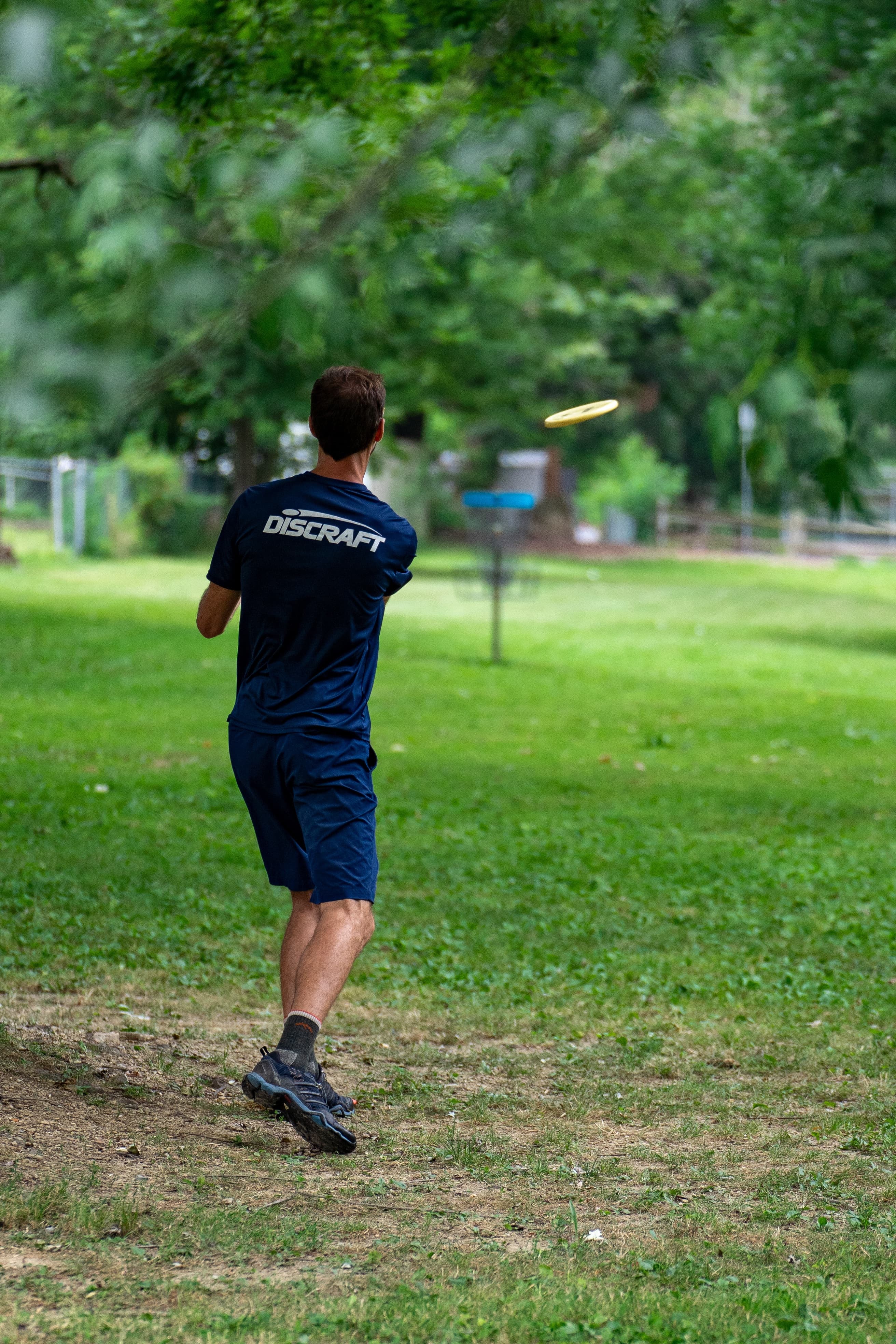
To putt better in disc golf, pick one small spot in the chains and keep your eyes on it, set a stable stance behind your marker, let your legs supply the power, accelerate your arm smoothly through the release and follow through toward that spot. Then practice short putts until they feel routine.
This guide covers a right-handed backhand putt; left-handers mirror the directions. It explains the grip, the two stances you will use most, a five-step putting motion, when a spin or push putt makes sense, the putting rules near the basket and a short practice plan.
Putting grip
Use a relaxed fan or control grip, with your fingers spread under the disc and your thumb on top. Our disc golf grips guide shows this grip with an illustration and explains where the index finger can go.
There is no single correct grip. In Innova's Make More Putts video, co-founder Dave Dunipace says the grip just has to give you traction on the disc. He notes that Ricky Wysocki uses three finger pads and his thumb, while Dunipace himself prefers more contact points, similar to a fan grip. His main advice is to keep the whole putt as simple as possible, as long as it has enough power, because more moving parts give more things a chance to go wrong.
Putting stance: staggered or straddle
Innova's 6 Quick Putting Tips recommends learning more than one putting style, because one style limits your options. The two stances below are a good place to start.
Staggered stance
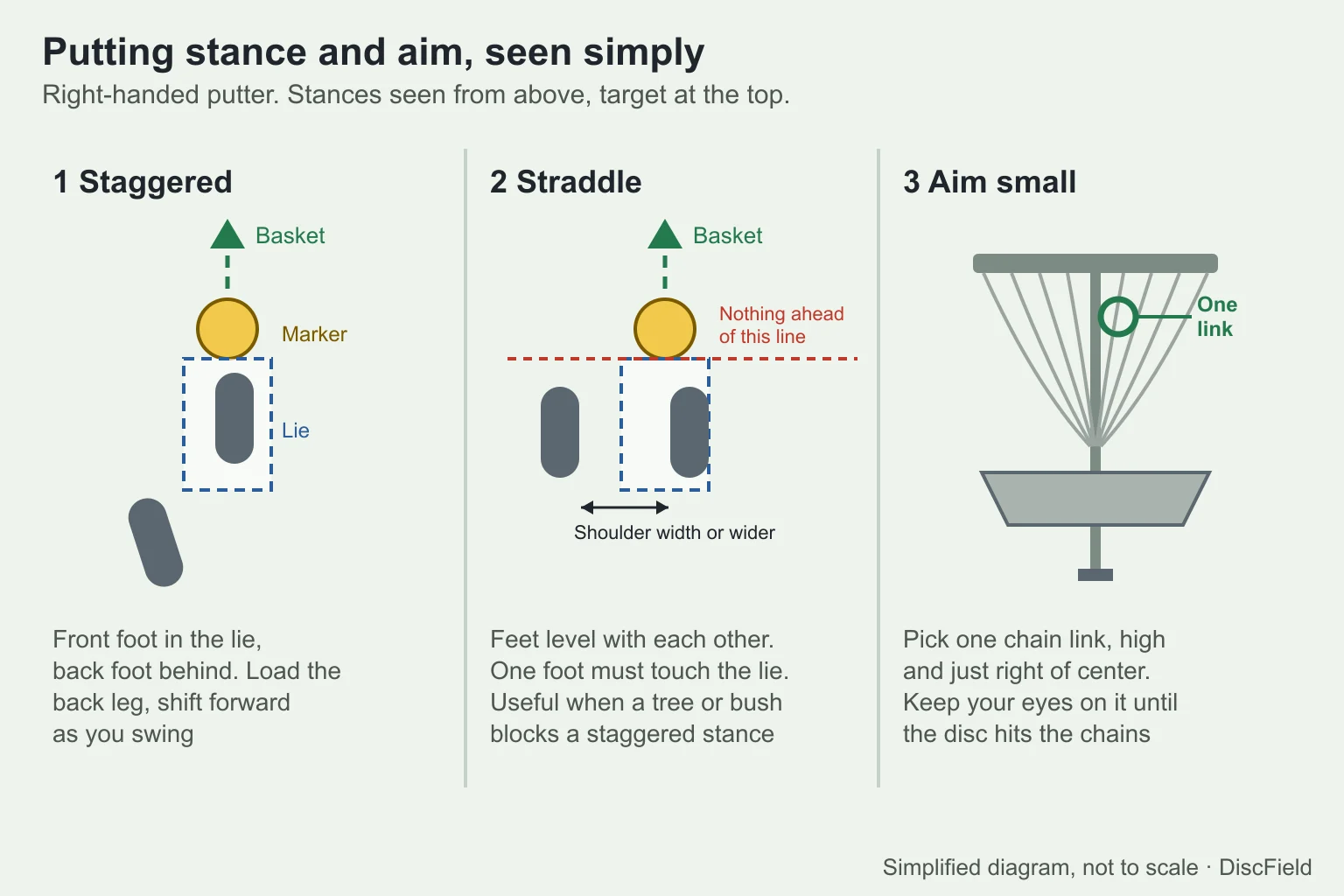
Put your front foot (the right foot for a right-handed putter) in the lie just behind your marker, with your back foot behind it. It is a good default for open putts, and it makes the weight shift in step 3 below easy to feel.
Straddle stance
Stand with your feet level with each other, about shoulder width apart or wider, facing the basket. Innova's glossary of disc golf terms compares the position to riding a horse. Innova's tips suggest a straddle when your disc lands in a bush or behind a tree, because a staggered stance may not fit there.
Whichever stance you use, the PDGA stance rule applies when you release the disc: at least one supporting point must touch your lie, nothing may be closer to the target than the rear edge of your marker, and every supporting point must be in-bounds. In a straddle, that means one foot has to be in the lie rectangle behind the marker. Our disc golf rules guide explains the lie and these rules in more detail.
How to putt in disc golf, step by step
1. Pick one chain link
Do not aim at the basket in general. Innova's putting tips recommend picking a specific chain link, because a smaller target sharpens your focus and keeps your misses closer. For a right-handed putter, it suggests a link high on the chains and just right of center.
2. Set your stance and grip
Take the staggered or straddle stance, settle the grip and hold the disc in front of you, pointed at your link. Take the same short routine each time, so a nervous putt feels like the others.
3. Load the back leg and shift forward
Innova's tips say much of the power on longer putts comes from the lower body. Load into your back leg, then shift your weight forward as you swing. On short putts the shift is small; from farther out it grows. The idea is to keep the arm motion the same and let the weight shift adjust the distance.
4. Accelerate smoothly through the release
Swing the disc back a short way, then bring it forward toward your link. According to Innova, your hand should be accelerating from the bottom of the swing through the release. It does not need to be fast, only smooth, so the disc comes out clean and your hand does not interfere with it.
5. Follow through to the link
Innova notes that many players pick a link and then lose sight of it just as the disc leaves the hand. It suggests keeping your eyes on the chain link until the disc makes contact, and following through as if you were shaking hands with your aim point.
Spin putt or push putt?
You will hear players talk about spin putts and push putts. The terms are loose, and Dunipace points out in the same video that many putts people call push putts are really pulled to the target. Innova's putting tips match each style to a situation:
| Situation | What Innova suggests | Innova's reason |
|---|---|---|
| Wind or a low ceiling of branches | Spin putt | Spin putts help in those conditions |
| Disc in a bush or behind a tree | Straddle stance | You will need it in a tight lie |
| Trouble behind the basket | Push putt | It can keep you safe |
Learn one comfortable style first, then add the others for these situations. When wind is part of the problem, our disc golf in the wind guide covers short approaches and when laying up before a hard comeback putt is the sensible choice.
Putting rules near the basket
A throw from within 10 meters (about 33 feet) of the basket counts as a putt. After you release it, PDGA rule 806.01 requires you to show full control of your balance behind your marker before you move toward the basket. That rules out jump putts, step putts and falling putts inside the circle.
Outside 10 meters you only need a legal stance at the moment of release. Innova's pro tips describe a step putt for a blocked lie outside circle one: set up like a staggered putt with the back foot behind your lie and the front foot in front, then push off so the front foot leaves the ground before release. The putt is legal as long as that foot is in the air when the disc leaves your hand.
To finish the hole, the disc has to come to rest in the basket's tray or in the chains below the chain support (rule 807). A putt that hits the chains and falls out does not count.
Which putter to use
Use the putter you already have. A comfortable grip and a clean release matter more than the model. If you are choosing one, our guide to putting and throwing putters explains when one putter is enough and when a second one helps, and the Aviar record shows a common beadless starting option.
A simple putting practice plan
Innova's tips say to learn to love 20-foot putts. If you make those consistently, you will feel more comfortable going for longer putts without worrying about a long comeback.
A short session can look like this. These distances are DiscField suggestions, not a tested program:
- Start about 10 feet out and make several putts in a row, using the full routine every time.
- Move back to about 15 feet, then 20 feet. Stay at each distance until most putts go in.
- Finish with a few putts from a straddle stance and note your most common miss: short, long, left or right.
Change one thing at a time, such as your aim point or weight shift, so you can tell what helped. Our 30-minute practice routine shows how to fit putting into a session with approaches and throws.
Sources
Innova's 6 Quick Putting Tips, Make More Putts video transcript, pro tips article and glossary, and PDGA rules 802.07, 806.01 and 807 were checked October 8, 2026. The steps above are a common way to learn to putt, not the only correct form, and DiscField has not measured or tested putting styles for this guide.