DISCFIELD / Learn
Disc golf doubles: how best shot and other formats work
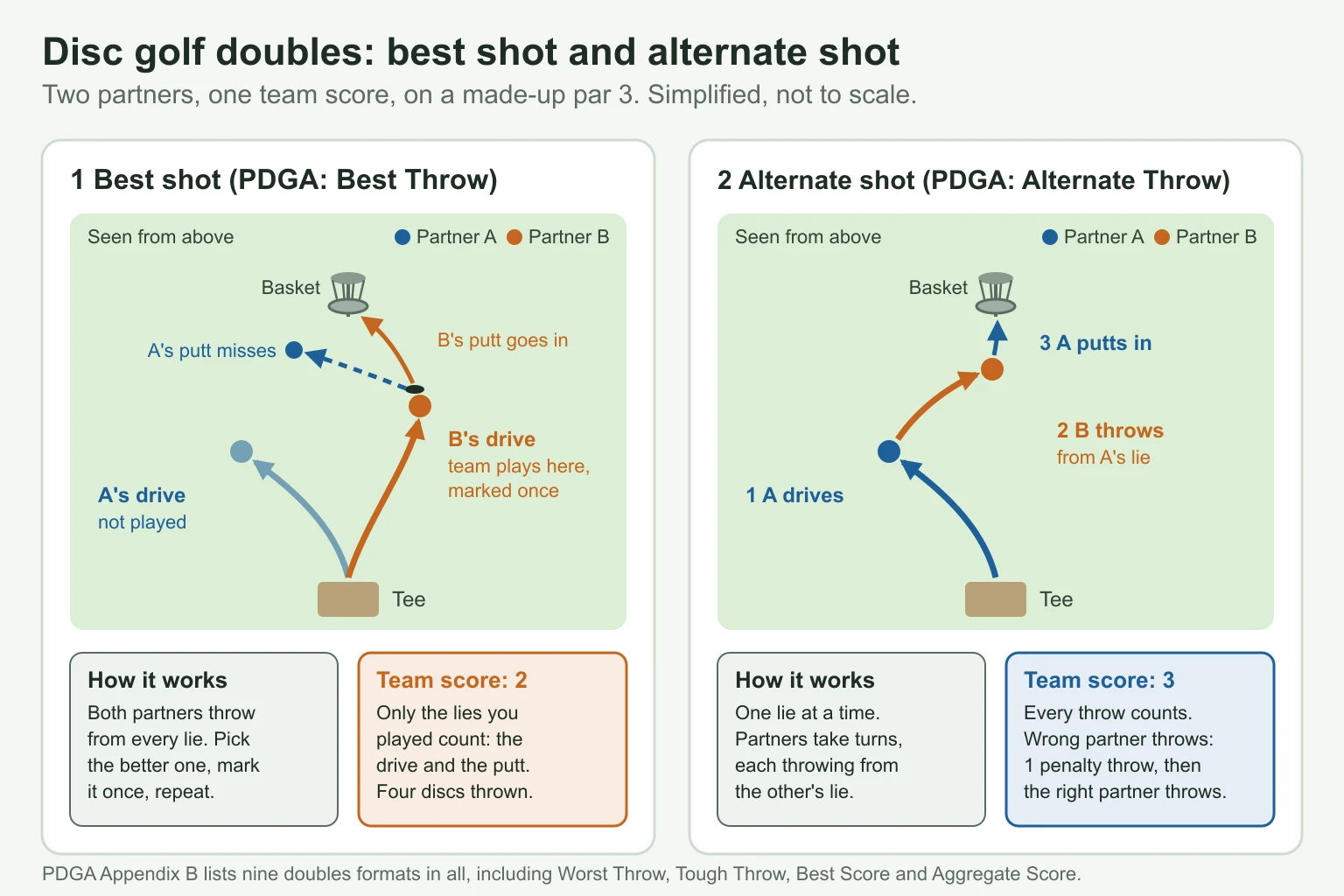
Disc golf doubles is two players playing as one team, with one team score on each hole. In best shot, the format the PDGA rules call Best Throw, both partners tee off, the team picks the better drive, both partners throw again from that spot, and you keep going until either of you gets the disc in the basket. In alternate shot (Alternate Throw), the team plays one lie at a time and the partners take turns, each throwing from where the other's throw landed. Innova's report on the 2026 DGPT Doubles Championship notes that the first edition of that event played two rounds of best shot, then switched to alternate shot for the final round on Sunday.
The PDGA's doubles rules, Appendix B of the Official Rules of Disc Golf, describe nine formats. Below you'll find each one, how to mark a lie you share with your partner, how a hole is scored and what to ask before a club doubles night. Doubles uses the normal rules everywhere else, so our disc golf rules for beginners are the place to start if you are new to the game.
Disc golf doubles formats at a glance
| PDGA format | How it works | The hole is done when | Team score for the hole |
|---|---|---|---|
| Best Throw (best shot) | Both partners throw from every lie, then the team picks which result to play next | Either partner holes out | Throws from the lies you played, plus penalties |
| Modified Best Throw | Best Throw, but the tournament director can limit when the team may use each partner's tee shot | Either partner holes out | As Best Throw, plus two penalty throws each time the team goes over the limit |
| Alternate Throw (alternate shot) | Partners take turns, each throwing from the lie the other's throw left | Either partner holes out | Every throw the team makes, plus penalties |
| Modified Alternate Throw | Alternate Throw, but the director can say which partner throws first on each hole | Either partner holes out | As Alternate Throw |
| Worst Throw | Both partners throw, and the other team picks which lie you play, aiming to push your score up | Both partners hole out from the same lie | Throws from the lies you played, plus penalties |
| Tough Throw | Worst Throw with an earlier finish | Either partner holes out | As Worst Throw |
| Best Score | Each partner plays the hole alone | One partner holes out with a score the other can no longer beat | The lower of the two scores, plus team penalties |
| Best Score Alternate Throw | Both partners tee off, and each drive starts its own alternate-shot sequence | One sequence finishes with a score the other can no longer beat | The lower of the two sequence scores, plus team penalties |
| Aggregate Score | Each partner plays the hole alone | Both partners hole out | Both scores added together |
The everyday names in parentheses come from Innova's DGPT report. Everything else in the table follows Appendix B as last updated on December 31, 2025.
How best shot doubles works, step by step
- Both partners tee off. On the first hole, teams throw in the order they are listed on the scorecard. After that, the team with the lowest score on the previous hole goes first, and a tie keeps the order. Partners throwing from the same spot can go in either order.
- Pick the lie. Walk up, look at both discs and agree which one the team will play. Mark it before anyone picks a disc up. Under the rules, a team that picks up a thrown disc before a lie has been chosen or marked cannot choose that throw. If both discs get picked up with nothing marked, the second one picked up goes back where the group agrees it was, and the team plays from there.
- Mark it once. Place one mini marker in front of the chosen disc, the same way you mark your own lie, and both partners throw from behind that marker. Appendix B says a lie both partners play must be marked with the same marker disc, and the PDGA's rules Q&A adds that a team uses a single marking method and marks the lie only once: if your partner threw from behind the thrown disc itself, you cannot swap in a mini for your throw. A partner who throws from a different spot than the first partner takes one penalty throw for misplay, and if the lie has to be moved for any reason, both partners play from the new spot.
- Both throw, then repeat. Choose the better of the two new positions, mark it and keep going. Once all the teams are off the tee, the team whose lie is farthest from the basket throws next.
- Stop when one of you holes out. The hole is over as soon as either partner's disc is in the basket. Don't throw the other putt for practice: the rules call any throw that cannot improve the team's score an extra throw. The first one gets the team a warning, and each one after that costs a penalty throw.
Your score is the number of throws from the lies you actually played, plus any penalties. A drive, an approach and a putt make a 3, although the two of you threw five or six discs between you.
A penalty that comes from a particular throw applies only to the partner who made that throw. Other warnings and penalties, a courtesy violation for example, count against the team. If one partner is absent, late or stops playing, the other can carry on alone, but nobody throws on the missing partner's behalf, and a late partner can join only between holes.
When to play it safe and when to take a risk
In best shot, the second thrower already knows where the first throw ended up, so the first partner can throw the safe shot: keep the drive in the fairway, or lay an approach shot up short of the basket where a putt is easy. If that throw lands well, the second partner can try the riskier line, for example a hyzer or anhyzer around a tree, with a good spot to fall back on if it doesn't work.
The same order helps when you putt. If the first putt goes in, the hole is done; if it misses, the second putter has just seen the line and the wind. Decide before the round who usually putts first so nobody hesitates at the basket. The putting rules don't change in doubles: inside 10 meters, both putters still have to stay balanced behind the marker, as our disc golf putting guide explains.
This plan is DiscField's suggestion, based on how best shot counts throws; the PDGA rules give no strategy advice.
How alternate shot works
- The team chooses which partner throws first on the first hole. From then on the partners alternate, each throwing from where the other's throw stopped, until the disc is in the basket.
- Every throw counts. The team's score is the number of throws it made, plus penalties.
- If the wrong partner throws, it is a misplay: one penalty throw, the throw is ignored and the correct partner throws. If another throw has already been made after the wrong one, the team takes two penalty throws and play continues.
- When a throw has to be made again from the same lie, the same partner makes it.
- A team gets par plus four on any hole that a late or absent partner misses. If either partner withdraws, the team withdraws.
- Modified Alternate Throw lets the tournament director decide which partner throws first on each hole.
Alternate shot is less forgiving than best shot. There is no second chance on any throw, so it suits two players of similar level who want every throw to matter.
Worst throw, best score and the other formats
Worst Throw turns best shot inside out. Both partners throw, and the other team picks which lie you play next, with the aim of making your score as high as possible. You finish the hole only when both of you hole out from the same lie. If you pick up or mark a disc before your opponents have chosen, it goes back where the group agrees it was, and they can choose between that disc's lie, the other disc's lie and the previous lie. The rules also let the tournament director disqualify opponents who choose a clearly favorable lie. Tough Throw works the same way, except the hole ends when either partner holes out.
Best Score and Aggregate Score are the closest to singles, because each partner plays the hole as an individual, from their own lies. In Best Score the lower of the two scores counts, and the hole is done once one partner holes out with a score the other can no longer beat. In Aggregate Score both scores count and are added together. Best Score Alternate Throw mixes the two ideas: both partners tee off, each drive starts its own alternate-shot sequence, and the better sequence is the team's score.
One hole, four formats: a worked example
Here is how the same two players could score one made-up par 3 under four formats. The throws are invented to show the counting.
| Format | What happens on the hole | Team score |
|---|---|---|
| Best shot | A's drive stops well short and B's stops about 25 feet from the basket. The team plays B's drive. A's putt misses and B's goes in | 2 |
| Alternate shot | A drives well short, B throws from there to tap-in range, and A putts in | 3 |
| Best Score | A drives short, throws an approach and putts in for a 3. B drives to 25 feet and misses the putt. B can no longer beat A's 3, so B stops: a tap-in would be an extra throw | 3 (A's score) |
| Aggregate Score | The same throws, but B also taps in for a 3, because both scores count | 6 (3 + 3) |
The same pair scores anywhere from 2 to 6 on one hole depending on the format. Ask which format you are playing before you compare your round with anyone else's.
Which format to choose for your group
| Your group | Format to try | Why |
|---|---|---|
| A new player with an experienced friend | Best shot | The team plays the better throw, so the newer player's poor throws only matter when the partner's throw is worse |
| Two players of similar level who want every throw to count | Alternate shot | Each throw is the team's only throw from that lie, so nobody gets a second try |
| Players who want their own round as well as a team score | Aggregate Score | Both partners finish every hole and every stroke counts for the team; in Best Score a partner stops once the other's score can't be beaten |
| A side game among friends | Worst Throw | The other team picks your worse lie, so it is hard on purpose |
These are DiscField's suggestions, based on the scoring of each format. The PDGA rules do not rank the formats.
Random draw doubles and club doubles nights
The PDGA's page on sanctioned leagues says all PDGA leagues must be singles play. A weekly doubles league therefore can't be a PDGA-sanctioned league, so the club chooses the format and whether PDGA rules or house rules apply. In random draw doubles, partners are paired by a random draw, so you play with whoever you get.
Whether the official rules apply depends on the announcement. The PDGA's rules Q&A says that if an event announces PDGA rules, the Official Rules apply whether or not the PDGA sanctions it. If nothing has been announced, the players can agree on whatever rules they want to use.
Before your first doubles night, ask:
- Which format is it: best shot, alternate shot or something else?
- Do PDGA rules apply, or house rules?
- Is there a limit on how often you can use one partner's drives (Modified Best Throw)?
- Do you bring a partner, or is it a random draw?
- Who keeps the team's score, and on what card or app?
The usual courtesy still applies in doubles: wait until the group ahead is out of range, stand still behind the thrower and help both teams look for lost discs. Our disc golf etiquette guide covers the rest of what a group expects.
Sources and scope
Sources read October 20, 2026: the PDGA Official Rules of Disc Golf, Appendix B: Doubles Play (last updated December 31, 2025; formats, order of play, penalties, marking and extra throws); the PDGA rules Questions and Answers (last updated March 18, 2026; QA-DOU-1 on marking a shared lie and QA-APP-6 on events that are not PDGA-sanctioned); the PDGA's sanctioned leagues page (leagues must be singles play); and Innova's Top Innova Storylines from the 2026 DGPT Doubles Championship (Riley O'Neill, August 19, 2026; the best shot and alternate shot names and the event's format). The worked example and the format and strategy suggestions are DiscField's own and are labelled as such. This guide summarizes the doubles rules for casual and club play; the official text and an event's own rules take precedence.
Read next
- Disc golf rules for beginners: how to play a round
- Disc golf etiquette: how to play with other people
- Disc golf approach shots: how to throw an upshot for beginners
- How to putt in disc golf: putting tips for beginners
- Hyzer vs anhyzer: disc golf release angles explained
- A 30-minute disc golf practice routine for beginners