DISCFIELD / Learn
Disc golf for kids: best discs and how to get started
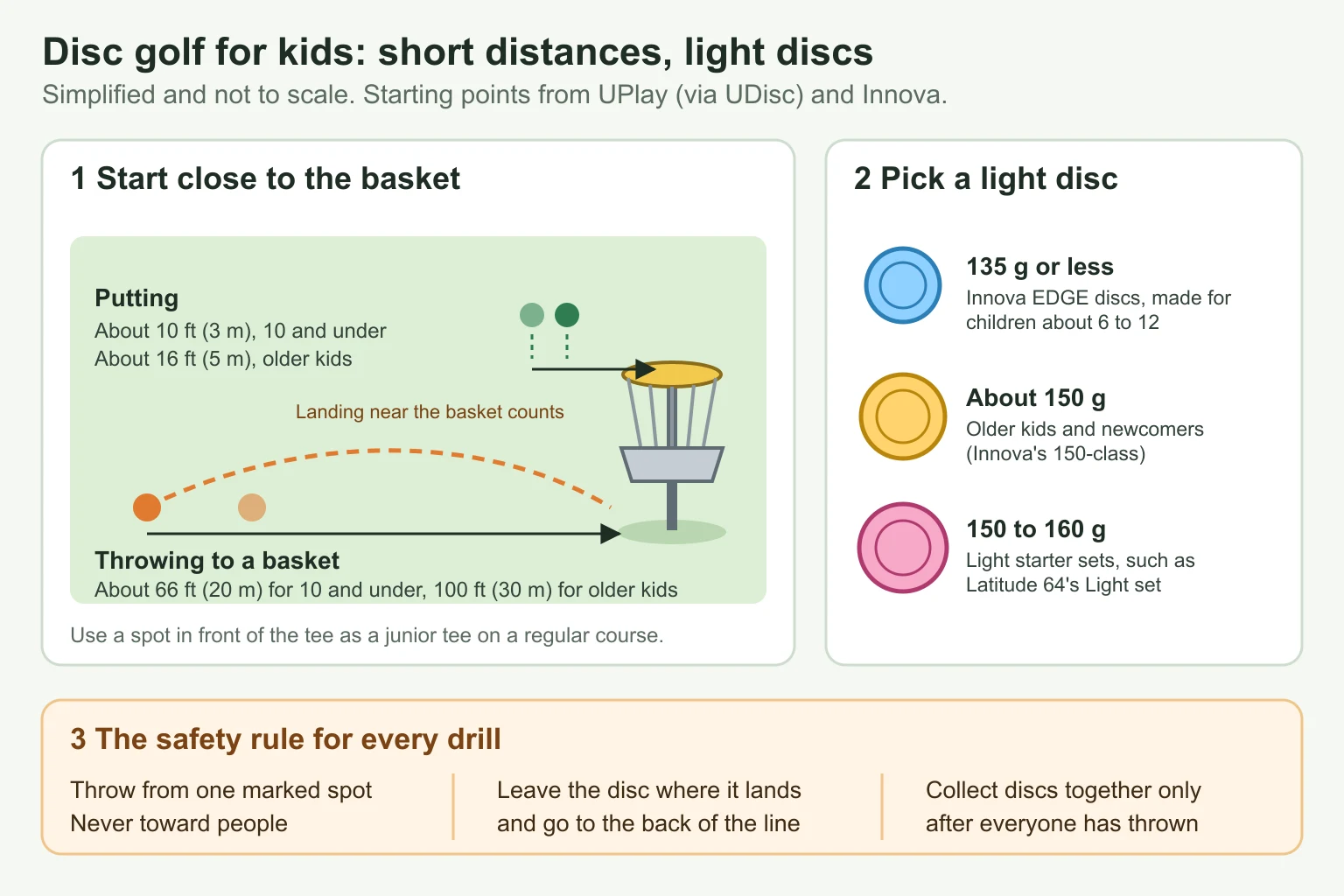
Disc golf for kids works best with light discs, short holes and short sessions. Innova recommends its EDGE discs, which weigh 135 grams or less and are made for children ages 6 to 12, and 150-class discs for older children. Start with putts a few steps from the basket, then move back to about 66 feet (20 m) for kids 10 and under. Give one tip at a time, and never let anyone throw while someone is in front of them.
Below you will find disc weights by age, a kid-sized course setup, a few games, safety habits for a group and the PDGA's junior divisions.
Which discs are best for kids?
Start with the weight. A disc that is too heavy is hard for a small hand to grip and hard for a short arm to keep in the air. Innova's disc golf FAQ says the best discs for a child come from its EDGE line, which weighs 135 grams or less and was designed for children ages 6 to 12 in the EDGE school program. It names the EDGE Leopard, Polecat, Shark and Skeeter, and adds that 150-class discs are a good choice for older children.
| Player | Weight to look for | Examples named by the manufacturer |
|---|---|---|
| Children about 6 to 12 | 135 g or less | Innova EDGE Leopard, Polecat, Shark, Skeeter |
| Older children and newcomers | About 150 g | Innova Aviar, Leopard, Sidewinder, Valkyrie and Archangel in 150-gram weights |
| A family starter set | 150 to 160 g | Latitude 64's Light Starter Set: Diamond driver, Pearl midrange, Ruby putter |
Latitude 64 describes its Light Starter Set as made for children, seniors and anyone with lower arm speed, and says the Pearl and Ruby have smaller rims for smaller hands. Our records for the Aviar, Leopard, Sidewinder, Valkyrie and Diamond list each model's flight numbers. Those ratings describe the mold, so check the weight on the actual disc or listing before you buy. Our disc weight guide explains what lighter weights change.
Don't let equipment stop you, though. In UDisc's guide on teaching disc golf to kids, Zoe AnDyke of Universal Play Disc Golf (UPlay) says that any disc a child can get their hands on and throw is better than none. If the family already owns a few discs, start with the lightest one.
How many discs does a child need?
One or two is enough. We suggest a putter first, because it works for putting, short throws and catch games. A light, easy-to-throw driver such as a 150-gram Leopard can come second. Innova's FAQ also warns beginners against trying lots of different discs, especially fast drivers. Our starter bag guide explains how a two- or three-disc bag fits together when a child is ready for more.
Start with putting
UPlay starts lessons with putting because the goal is easy to see and kids like the sound of the chains. UDisc's guide gives these starting distances:
| Age | First putts | Basket for backhand and forehand throws |
|---|---|---|
| 10 and under | About 10 feet (3 m) | About 66 feet (20 m) |
| Older kids | About 16 feet (5 m) | About 100 feet (30 m) |
Make a putt or two so the kids hear the chains, show the grip, then let them take turns from a marker. Our putting guide covers the staggered and straddle stances, which UPlay teaches both of, and our grips guide shows how to hold a putter.
Make the course kid-sized
A regulation hole can be several hundred feet long, which is too long for a young child to enjoy. Shrink the course instead:
- Play only the shortest holes, or start part of the way down the fairway. A spot in front of the tee works as a junior tee.
- Keep holes short. AnDyke says distance is not valuable in the beginning and calls 100-foot (30 m) holes appropriate and more fun.
- Count getting close as a good throw. In UPlay's drills the goal is to land near the basket.
- Stop while it is still fun. UDisc's guide mentions six- or nine-hole loops for lessons, and that is plenty for a first outing.
A 2017 Dynamic Discs article on junior-sized equipment compares this to youth soccer, where kids play on a shorter field with a smaller ball. Dynamic Discs makes a smaller Junior Recruit practice basket so that young children can reach in and take out their own disc after a putt. A regular basket works fine too.
Keep it fun: games and coaching
"Always focus on fun and success first," AnDyke told UDisc. A throw that lands in or near the basket is a success, even with rough technique. Most kids are ready for group lessons at about five or six, when they can follow simple instructions. A few of UPlay's ideas from the UDisc guide:
- Circle catch: stand in a circle and toss a disc gently to someone who has not caught it yet. Each player says their name, then a favorite food, then an animal noise.
- Spin-catch: while kids wait in line, challenge them to spin and catch the disc in their hands without letting it fly. It keeps hands busy and discs on the ground.
- Relays: teams take turns putting or throwing at a basket and pass one disc along like a baton.
- One tip per throw: give one thing to improve after a throw. More than one is too much.
Skip the fine print at first. Throwing order and foot faults can wait. Our disc golf rules guide covers them when a child starts keeping score, and our free printable beginner handout explains the basics on one page.
Safety around flying discs
A disc can hurt someone even when it is thrown by a child. These habits come from UPlay's teaching advice:
- Pick one throwing spot and never let anyone throw toward another person or group.
- After a throw, the disc stays where it landed and the thrower goes to the back of the line.
- Nobody walks out to collect discs until everyone has thrown.
- Adults stay out of the line of throw too. A beginner's disc can leave the hand in any direction.
- Keep groups small. UPlay suggests no more than six children per instructor for kids 9 and under, and up to ten for older kids with an experienced instructor.
On a public course, also watch for other groups, let faster players play through, and check whether the course is shared with walkers or a playground.
Junior leagues and PDGA junior divisions
A child who enjoys it can try a junior league run by a local club or a PDGA event. The PDGA's junior competition page lists six age-based junior divisions (18, 15, 12, 10, 8 and 6 and under), each in a mixed and a girls' version. A player's PDGA age is based on the birth year, not the birthday. The 6-and-under division is no longer offered at the Junior World Championships, where players must turn at least 8 during that year.
Schools and youth groups can look at EDGE, the Educational Disc Golf Experience, a nonprofit that offers disc golf lessons linked to physical education standards along with equipment and supply packages.
Sources and scope
Sources checked October 9, 2026: Innova's disc golf FAQ (EDGE line, 150-class discs, beginner advice); Latitude 64's Light Starter Set (150 to 160 g, flight numbers, intended players); UDisc's How To Teach Disc Golf To Kids (October 2022, advice from UPlay director Zoe AnDyke); Dynamic Discs' junior-sized equipment article (June 2017); the PDGA's junior competition page; and EDGE's about page. The distances and group sizes are starting points from those sources; adjust them to the child. DiscField has not tested kids' discs and does not rank brands for children.