DISCFIELD / Learn
Disc golf forehand: how to throw a sidearm for beginners
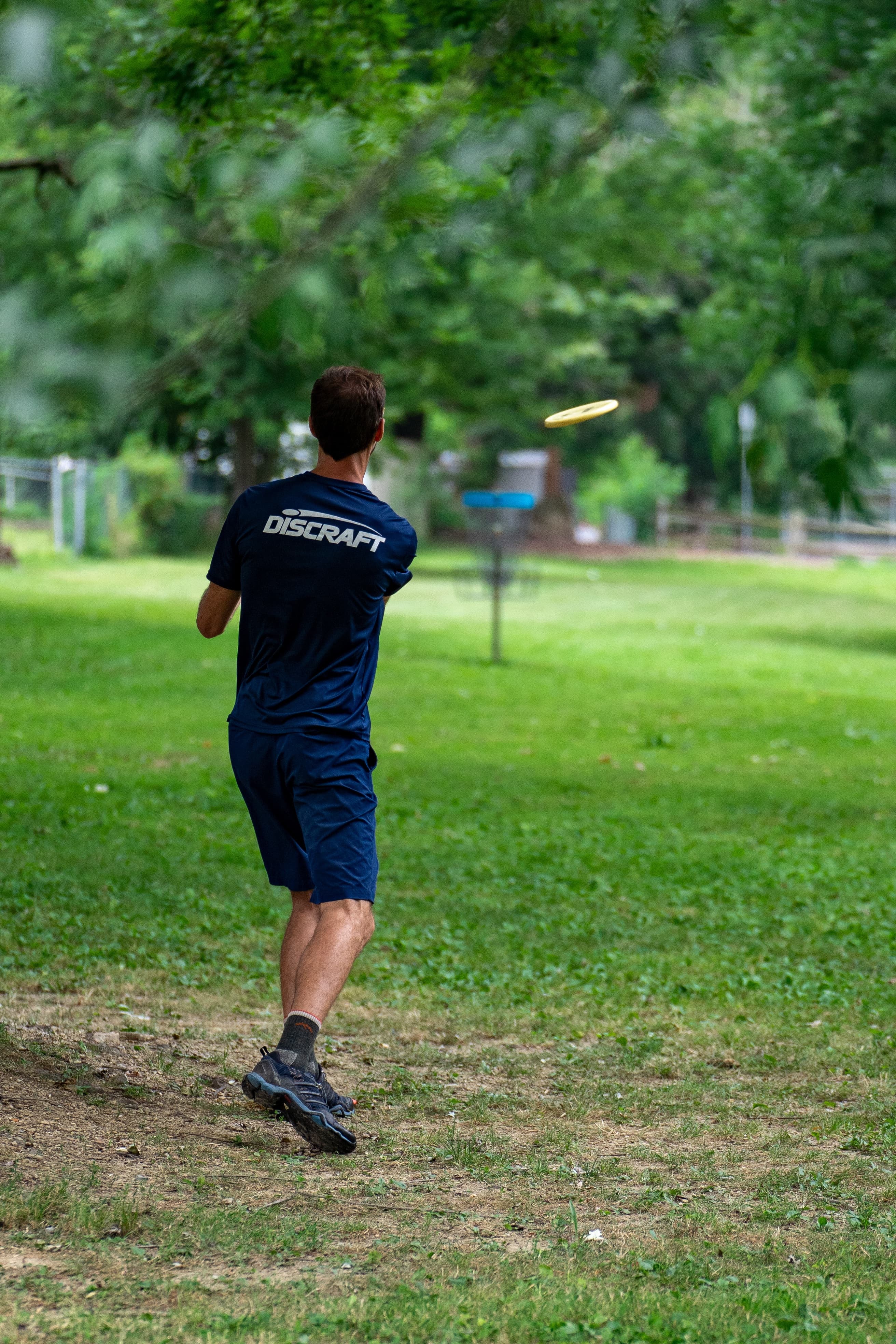
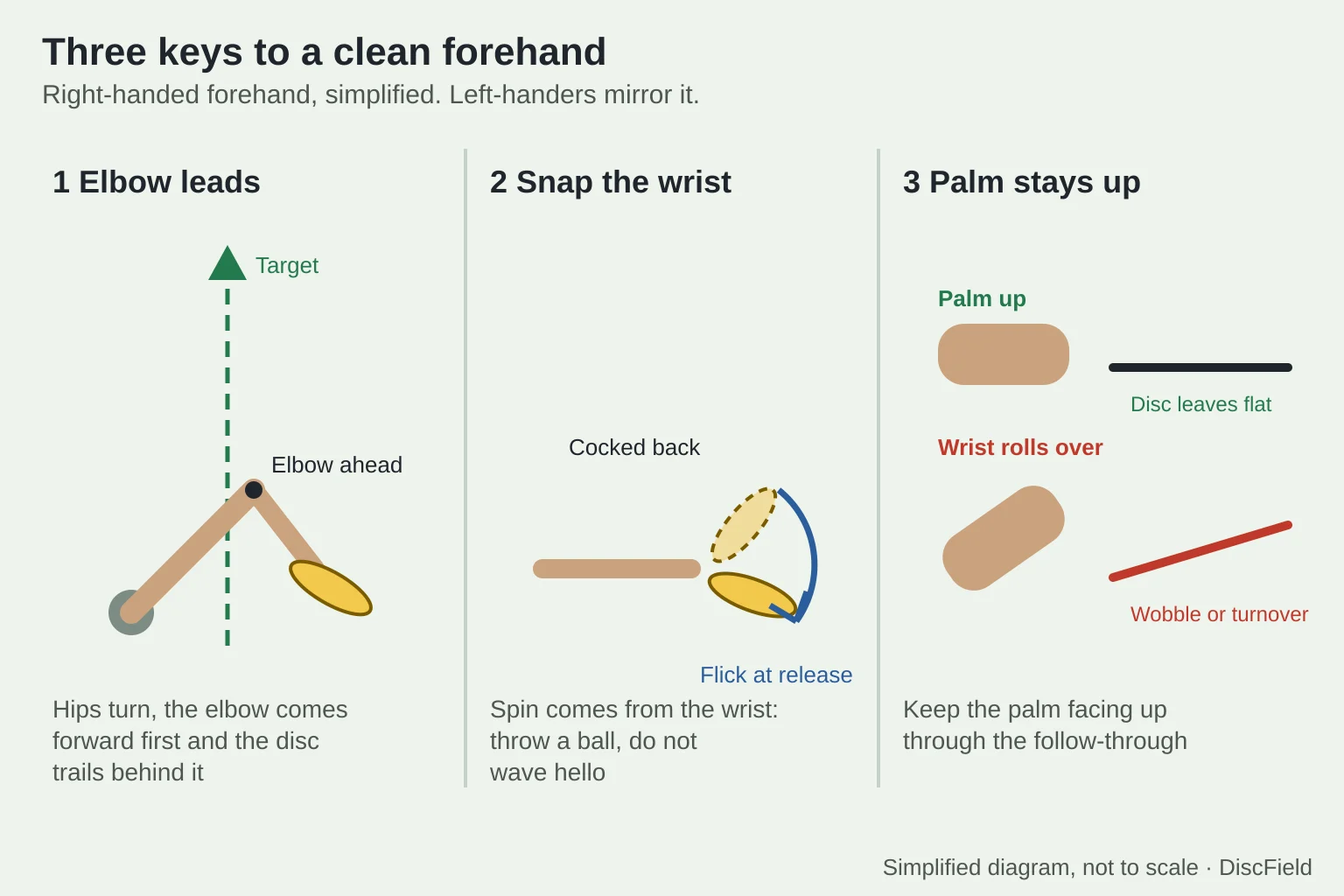
A disc golf forehand, also called a sidearm or flick, is thrown from your dominant side with the palm facing up. The basic motion is simple to describe. Hold the disc in a two-finger grip, let your hips turn and your elbow lead, snap your wrist at release and keep your palm facing up through the follow-through.
Most of the power and spin come from that wrist snap and from your body, not from swinging the arm harder. This guide covers a right-handed forehand (RHFH); left-handers mirror every direction. It explains the grip, the throw, which discs to learn with and how to fix the most common problems.
Why learn a forehand?
A forehand curves the opposite way to a backhand. For a right-handed forehand, a disc's turn is usually to the left and its fade to the right, the reverse of a right-handed backhand, as our terminology page explains. That gives you a shot for holes that bend right, a way out from behind a tree on your backhand side, and a second option for short approaches.
You do not need one to start playing. If you are still learning the disc golf backhand, there is no harm in practicing both side by side.
Forehand grip
Start with a stacked two-finger grip: middle finger pressed against the inner rim, index finger beside it for support, thumb on top. Innova's forehand article, Level Up Your Forehand, recommends pressing the pads of your fingers into the rim rather than touching it only with the side of a finger. It says that change can bring more speed with less effort once it feels natural.
Our grips guide shows the stacked, split and one-finger versions with illustrations. Pick one, check that the fingertip meets the inside of the rim, and keep it while you learn the motion.
How to throw a forehand step by step
1. Start from a standstill
Stand with your feet about shoulder-width apart and your chest turned partly toward the target, so your throwing arm has room beside your body. Hold the disc at about waist height, flat or slightly tilted, with your palm up. Leave the run-up for later.
2. Cock the wrist on the reach-back
Bring the disc back beside your hip with the wrist bent back. Innova's article describes the forehand as depending on an active wrist: you cock it on the reach-back and flick it at release.
3. Turn the hips and let the elbow lead
Push off your back leg and turn your hips toward the target. Your elbow moves forward first, close to your side, while the disc trails behind it. Innova puts it this way: the power should come from your legs, hips and core, with the elbow leading and the disc slinging out rather than being forced.
4. Snap the wrist at release
As the elbow passes your body, flick the wrist forward. That snap puts spin on the disc, and according to Innova the spin stabilizes it so it flies straighter and farther. A passive wrist tends to make the disc flutter and lose distance. Innova's shorthand is to throw a ball rather than wave hello.
5. Keep the palm up through the follow-through
After release, let the arm continue toward the target with the palm still facing up. Innova recommends this to keep the release angle consistent, and it says that forehands that wobble or turn over unexpectedly usually point to a wrist rolling over at the last moment.
Which discs to learn the forehand with
Start with discs you already own. Short, easy flicks with a putter or midrange teach you the wrist snap without needing much power. Our grips guide notes that Innova encourages forehand practice across disc types, and a deep putter may need a slightly different finger bend from a shallow driver.
When you are ready to buy a disc for forehand drives, Innova's own advice points two ways:
- Its forehand coaching article suggests lighter, less stable discs, because they can add distance with less strain on the arm.
- Its older list of forehand discs names the Leopard as a fairway driver that helps hesitant forehand throwers build confidence. It saves the Firebird, a very overstable fairway driver, for players who have developed the snap.
A practical reading of both: if your forehands fly flat and fade at the end, a neutral fairway driver will give you more distance. If they keep turning over to the left and crashing, a more overstable disc resists that turn while you work on the wrist roll. Our guide to understable vs overstable discs explains how stability changes the flight, and the first fairway driver guide compares the Leopard, TeeBird, Escape and Firebird.
Common forehand problems and fixes
| What you see | Likely cause | What to try |
|---|---|---|
| The disc flutters and wobbles | Passive wrist, or the wrist rolling over at release | Snap the wrist and keep the palm up through the follow-through |
| The disc turns hard left and crashes (RHFH) | Wrist roll, or a disc too understable for your throw | Check the palm angle; try a more overstable disc |
| Little distance even at full effort | All-arm throw | Push off the back leg and turn the hips before the arm moves |
| Your elbow is sore after practice | Too much arm effort | Stop for the day; next time throw easier and use your whole body |
Protect your elbow while you learn
Innova's forehand article puts timing ahead of power. It warns that overpowering the throw strains the elbow without adding distance, and that using your full body, staying loose and following through spread the load more evenly. Short sessions at easy effort are the safest way to build the motion. If pain continues, stop throwing forehands and get it checked rather than playing through it.
A short forehand practice session
- Stand 20 to 30 feet from a basket or other target and flick a putter at an easy effort, ten times. Watch only for a flat, clean release.
- Throw ten more with a midrange. Note whether the disc wobbles, turns over or fades early.
- Pick one fix from the table and keep it for the next ten throws.
- Move back only when most throws leave your hand flat and spinning cleanly.
Our 30-minute practice routine shows how to fit this into a session with putting and approaches. Innova's forehand coaching article and forehand disc list were checked October 7, 2026. The steps above are a common way to learn the throw, not the only correct form; grip and run-up vary between players.