DISCFIELD / Learn
How to throw a roller in disc golf: discs, angle and steps
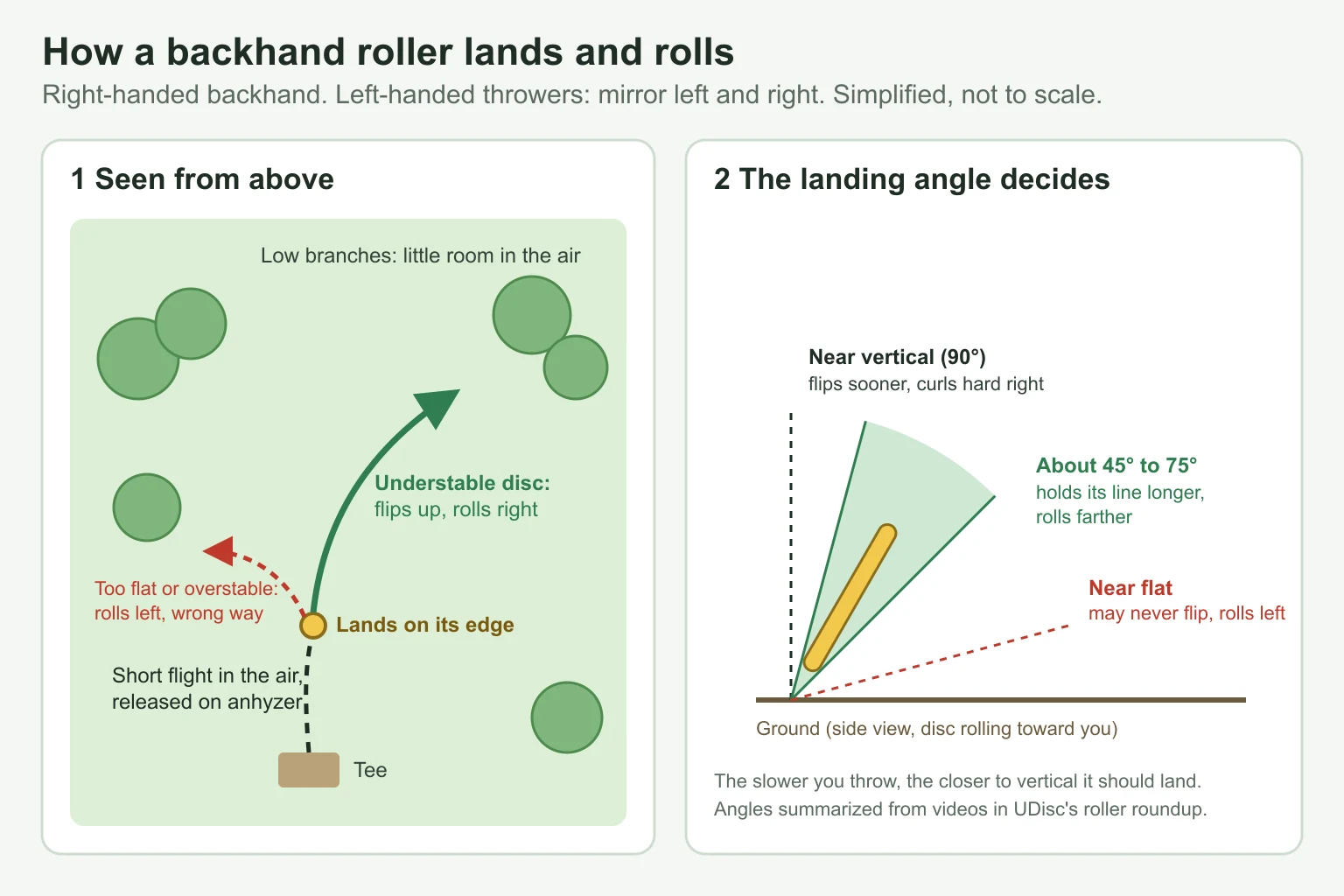
A roller is a throw that lands on its edge soon after release and rolls along the ground. To throw a backhand roller, use a power grip and an understable disc, lean back, and release the disc on an anhyzer angle so it meets the ground at roughly 45 degrees. For a right-handed backhand thrower, the disc flips up and rolls to the right, the same direction a forehand curves. Left-handed backhand throwers should mirror every direction in this guide.
The sections below cover when to throw one, which discs roll well, how the landing angle steers the roll and how to fix a roller that hops or goes the wrong way.
When a roller is the right shot
Infinite Discs' guide to roller discs describes two uses: getting out of trouble with a short, technical shot, and covering distance when there is little room in the air. A low tree canopy is the typical case. A roller needs open, fairly even ground. The same guide warns that a ditch or pond in the fairway can stop or catch it, and that a bump in the ground can send the disc somewhere you did not intend.
Distance is the other reason. UDisc's roundup of roller videos cites one analysis that says rollers can add 10 to 15 percent to a player's longest air throw. That figure comes from a single video, so treat it as a rough guide.
Choosing a roller disc
Innova's Rollo page explains its flight ratings and says discs rated -3 to -5 for turn make good roller discs. Infinite Discs notes that many roller discs have a lot of turn, which makes it easier for players of any skill level to get the angle a roller needs.
| Disc | Type | Flight numbers | Why it rolls |
|---|---|---|---|
| Innova Rollo | Midrange | 5 / 6 / -4 / 1 | Innova calls it a disc for rolling, easier to roll than almost any other |
| Innova Leopard | Fairway driver | 6 / 5 / -2 / 1 | Infinite Discs calls it a good disc to start learning rollers |
| Latitude 64 Diamond | Fairway driver | 8 / 6 / -3 / 1 | Easy to get to the ground at a good angle, per Infinite Discs |
| Innova Sidewinder | Fairway driver | 9 / 5 / -3 / 1 | Made for rollers and turnovers, per Infinite Discs |
| Innova Roadrunner | Fairway driver | 9 / 5 / -4 / 1 | A popular roller disc since its release, per Infinite Discs |
Flight numbers are the manufacturer's ratings. Our flight numbers guide explains turn, and our guide to understable vs overstable discs explains why some discs flip and others fight it.
Overstable discs behave differently. In the UDisc roundup, Discraft's video notes that overstable discs often never flip, even when thrown nearly vertical, so a backhand roller with one rolls in the same direction as a hyzer air shot: left for a right-handed thrower.
More understable is not always better. In a Latitude 64 lesson summarized by UDisc, Tomas Ekström says beginners often choose discs that are too understable and flip too soon. More overstable discs roll farther for players with the power to get them on edge, and flat-topped discs tend to roll better than domed ones. A good plan is to learn with something like a Leopard, then try a slightly more stable disc once your rollers flip too early.
How the landing angle steers a roller
The angle at which the disc meets the ground decides most of what happens next. The Discraft video in UDisc's roundup puts it this way: the closer to vertical, the sooner the disc flips; the closer to 45 degrees, the longer it takes to flip and the farther it is likely to go.
| Landing angle | What usually happens (right-handed backhand) |
|---|---|
| Close to vertical | Flips quickly and curls hard to the right |
| About 45 to 75 degrees | Holds its line longer and rolls farther |
| Close to flat | May never flip and can roll sharply left, the wrong way |
The 45 to 75 degree range comes from the distance analysis in the same roundup. It adds that the slower you throw, the closer to vertical the landing angle should be.
How to throw a backhand roller, step by step
- Grip: in the Latitude 64 lesson, Ekström suggests a power grip for rollers. Our grips guide shows it.
- Lean back. Ekström says leaning back is important for most rollers, and Overthrow Disc Golf's video in the same roundup says you cannot lean forward if you want the disc to meet the ground on an angle.
- Paint the rainbow. In Dave Feldberg's video, the disc travels in an arc while still in your hand and usually passes face level or higher before release. Feldberg says this gives smoother rollers than pulling low and straight across the body and flipping the wrist into a steep anhyzer just before release.
- Release on anhyzer. Let go with the outside edge of the disc tipped up. Our backhand guide explains hyzer and anhyzer if the terms are new.
- Let it fly a short way first. Ekström says beginners often put the disc on the ground too soon, which makes it hop and lose speed. A short flight before it lands is normal.
- Watch the landing. Note the angle at touchdown and where the roll ends, then change one thing at a time: the disc, the release angle or how far it flies before landing.
Common roller mistakes and fixes
| What you see | Likely cause | Try this |
|---|---|---|
| The disc hops and dies | It reaches the ground too soon or too steep | Release a little later and higher on the arc |
| It rolls left (right-handed backhand) | It landed too flat, or the disc is too overstable | Tilt it more on release or use a more understable disc |
| It flips right away and curls into the rough | The disc is too understable or landed close to vertical | Use a slightly more stable disc or a lower landing angle |
| A power roller never gets onto its edge | Nose-up release with a collapsed elbow | Keep your forearm parallel with your shoulders |
The last fix comes from Discraft's tip for power rollers, a version thrown with a stable or overstable disc on a straighter line. Collapsing the elbow and releasing nose up makes that shot impossible.
Practice and safety
Practice in an open field before you rely on a roller in a round. Bring two or three discs of different stability, throw a few rollers with each at different angles, and write down which one holds its line for you. You can add a short roller block to our practice routine, and the hyzer flip guide covers another way to use an understable disc's turn.
A roller can travel a long way after it lands and does not always go where you aimed. Make sure the fairway ahead and to both sides is clear before you throw, and check for water or out-of-bounds lines the disc could roll into.
Sources and scope
Sources checked October 9, 2026: Innova's Rollo page (roller description and turn ratings of -3 to -5 for roller discs); Infinite Discs' Best Disc Golf Roller Discs (uses, risks and disc list); and UDisc's How To Throw Disc Golf Rollers: 5 Great Videos (September 2025), which summarizes videos from Discraft with Brian Earhart, Dave Feldberg, Latitude 64 with Tomas Ekström, Best Disc Golf Discs and Overthrow Disc Golf. Flight numbers come from DiscField's disc records, which cite the manufacturers. Angles are rough guides from those sources. DiscField has not measured roller distances or tested these discs.