DISCFIELD / Learn
Lost a disc golf disc? How to find it and get it back
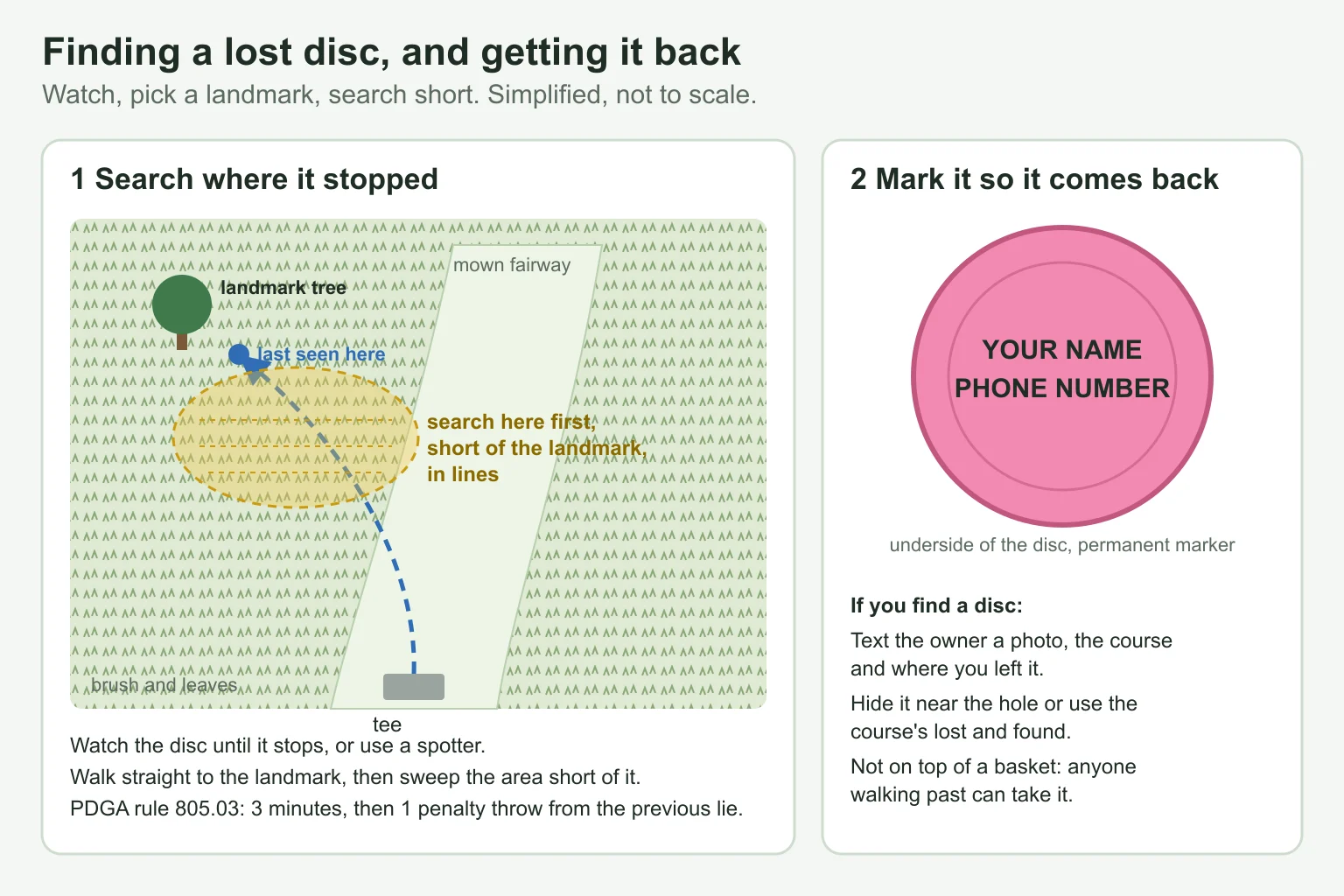
A lost disc is usually found in the first few minutes or not at all, unless a finder can reach you. So watch the whole flight and pick a landmark where you last saw the disc. Search the area short of that landmark before you go long. Write your name and phone number on the underside of every disc you carry. In a round, the PDGA's lost-disc rule gives you three minutes of searching once you reach the area. After that, the disc counts as lost, you take one penalty throw and throw again from your previous lie.
What to do when a disc goes missing
| When | What to do | Why it helps |
|---|---|---|
| Before the round | Write your name and phone number on the underside of each disc | A finder can text you; a blank disc usually stays with whoever picks it up |
| While it flies | Watch it until it stops, or ask someone in your group to spot it | The last place you saw it is your best clue |
| Before you walk | Pick a tree, post or bush at that spot as a landmark | Distances look different once you are in the rough |
| Searching | Start short of the landmark and sweep the area in lines; spread out instead of searching the same patch | Players report that discs in brush and leaves usually stop short of where they seemed to land |
| After three minutes (PDGA round) | Declare it lost, add one penalty throw, throw again from your previous lie or a lost-disc drop zone | That is the rule in PDGA 805.03 |
| After the round | Walk back and look again, check the course's lost and found if it has one, and keep your phone on | A finder with your number may text you |
How to find a disc in the rough
Watch the disc until it stops moving, even after it clears the trees. If you can't see where it landed, ask someone in your group to watch it. The PDGA's Disc Golfer's Code already asks players to use a spotter on blind throws, and the same habit finds discs.
Before you walk out, pick a landmark at the spot where you lost sight of it: a trunk with a split, a fence post, a bush with red leaves. Walk straight to it. Once you are standing in the brush, everything looks the same, and the landmark is the only fixed point you have.
Players on r/discgolf give the same advice over and over: look short. A disc that disappears into leaves or brush usually stops before the point where you thought it went. Search in lines through the area instead of wandering, and if two people are looking, take different patches. When the first pass finds nothing, walk back toward the tee, picture the flight again and come at the area from a new direction.
Color helps too. Bright pink, orange and yellow stand out against leaves and grass. Dark blue, purple, green and clear plastic blend in. Our guide to pink disc golf discs covers which molds come in bright colors. If you play in fall or winter, the winter disc golf guide has the ribbon trick for snow.
The lost-disc rule in a PDGA round
Rule 805.03 is short. A disc is declared lost if you can't find it within three minutes after you reach the area where it is thought to be, and anyone in the group can start the clock. Everyone in the group has to help search; refusing is a courtesy violation. A lost disc costs one penalty throw, and the next throw is from your previous lie, or from a drop zone if the hole has one for lost discs. If the disc turns up later, it still counts as lost for that hole, but you may keep playing with it. The rule doesn't apply when the disc went out-of-bounds; that is played as OB.
In a casual round nobody holds a stopwatch, but the three-minute limit is a good habit anyway. It keeps the group behind you moving. Our disc golf rules guide covers out-of-bounds and drop zones, and the etiquette guide covers helping others search and letting a faster group play through while you look.
Mark every disc so it comes back
Write your name and phone number on the underside of the disc with a permanent marker. Some players add their city or the home course. Without a number, a finder can't reach you, and most players treat a blank disc as theirs to keep. With one, plenty of finders will text you a photo of the disc and say where they left it.
A few more things help:
- Keep the number current. If you change phones, re-mark the discs you still throw.
- Answer unknown numbers for a few days after you lose a disc. Finders often text once and give up.
- Check the course for a lost and found. Some courses have a box near the first tee or a pro shop; the club or park can tell you. Our course guides list what each official course page says.
When you find someone else's disc
If it has a number, text the owner a photo of the disc, the course and where you left it. Most players who post about this hide the disc near the hole or put it in the course's lost and found rather than arranging a meetup. Putting it on top of a basket is a bad idea: anyone walking past can take it.
If it has no name or number, there's no one to contact. Leaving it at the course's lost and found gives the owner a chance. Some disc golf shops also collect found discs.
When the disc is in water or deep brush
A disc in a pond is not always lost. Before wading in, read the park's posted rules; some parks don't allow entering ponds, and water can be deeper than it looks. A long stick or a retriever pole reaches more discs than wading does. Deep brush and tall grass are where ticks and poison ivy are, so read our guide to ticks and poison ivy on the course before you go in after it.
Replacing a disc you lost
If the disc is gone, the replacement doesn't have to be the same mold. Look up the old disc's flight numbers in our disc database and use the disc comparison tool to find molds with similar numbers. Flight numbers are the manufacturer's own ratings, so two discs with the same numbers can still fly differently. The guide to finding a missing disc type helps if you are rebuilding a bag.