DISCFIELD / Learn
Ticks and poison ivy on the disc golf course
Wooded disc golf courses put you right where ticks and poison ivy grow: the tall grass, brush and leaf litter at the edge of the fairway, which is also where errant drives land. The CDC's advice covers most of it: treat your shoes, socks and bag with 0.5% permethrin, use an EPA-registered repellent on your skin, and stay on mown ground when you can. After the round, check your body for ticks and shower within two hours. If you touch poison ivy, rinse your skin right away. Its oil also sticks to discs, towels and bags, so wash those too.
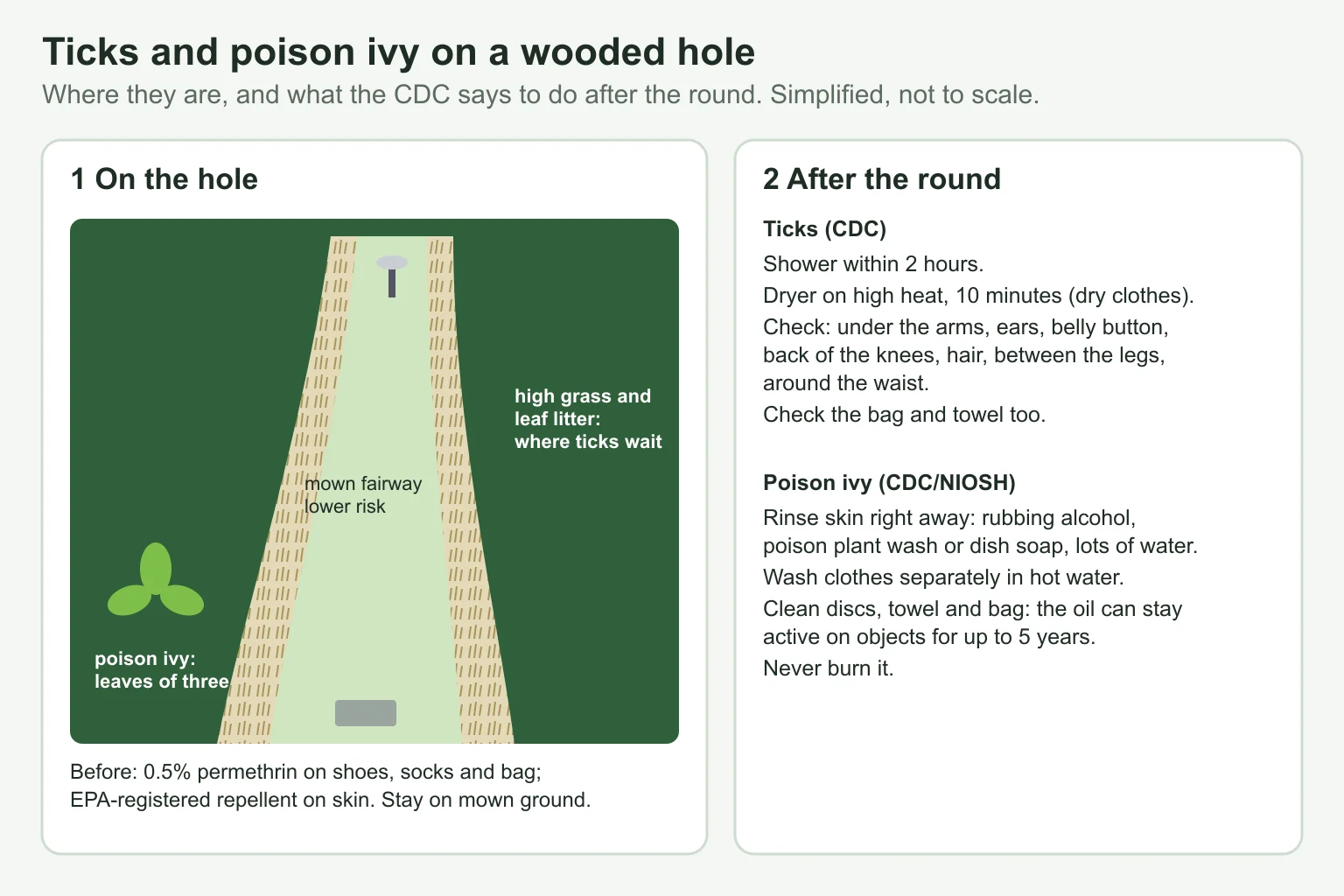
Ticks and poison ivy at a glance
| Ticks | Poison ivy | |
|---|---|---|
| Where on a course | Wooded and brushy areas with high grass and leaf litter | Woods edges, brush and fence lines; "leaves of three" |
| Before the round | 0.5% permethrin on clothing and gear; an EPA-registered repellent on skin | Learn what it looks like; long pants help |
| During the round | Stay on the fairway and mown paths; walk in the middle of trails | Don't reach into vines for a disc with bare hands |
| After the round | Check your body, shower within two hours, tumble-dry clothes on high heat for 10 minutes | Rinse skin right away; wash clothes separately in hot water; clean discs, towel and bag |
| Source | CDC: Preventing tick bites | CDC/NIOSH: Poisonous plants |
Why disc golfers meet ticks
The CDC tells people to "avoid wooded and brushy areas with high grass and leaf litter" and to walk in the center of trails. On a wooded course that is hard to do: the tee and the fairway are mown, but every shot that misses the line ends up in exactly that kind of ground, and so does every search for a lost disc. Players on r/discgolf describe rounds that ended with several ticks brushed off their clothes.
The CDC says ticks are most active in the warmer months, April through September, but that exposure can happen year-round, so keep the habits going in spring and fall too.
Before the round: permethrin and repellent
Start with the CDC's line to "treat clothing and gear with products containing 0.5% permethrin." For disc golf that means shoes, socks, pants and the bag you set down in the grass on every hole. The advice is for clothing and gear, not skin, so treat them before the round and follow the product label.
Then put an EPA-registered insect repellent on exposed skin. The CDC lists repellents containing DEET, picaridin, IR3535, oil of lemon eucalyptus (OLE), para-menthane-diol (PMD) or 2-undecanone. Follow the product label.
Long pants and tall socks keep ticks on the outside of your clothes, where you can see and brush them off.
During the round
- Play from the fairway when you can. A disc that lands in waist-high grass is a good reason to take a quick look and move on; the PDGA lost-disc rule gives you three minutes in a round anyway.
- Set your bag on the tee pad or mown grass, not in the weeds beside it.
- Brush off your legs and shoes between holes on overgrown parts of the course.
After the round: the tick check
The CDC recommends checking your body after you come in from tick habitat, with special attention to:
- under the arms
- in and around the ears
- inside the belly button
- the back of the knees
- in and around the hair
- between the legs
- around the waist
Showering within two hours of coming indoors, the CDC says, "has been shown to reduce your risk of getting Lyme disease," and it is a good time to do the check. To kill ticks on dry clothes, tumble-dry them on high heat for 10 minutes; damp clothes need longer, and cold or medium-temperature water will not kill ticks. Check your disc bag and towel too, since they spent the round on the ground.
If you find a tick attached, the CDC's tick pages explain how to remove it and which symptoms to watch for afterward.
Poison ivy on the course
Poison ivy, poison oak and poison sumac release an oil called urushiol when the plant is damaged. The rash comes from that oil, and you don't need to touch the plant itself. According to CDC/NIOSH, indirect contact, "such as touching tools, livestock, or clothing that have urushiol on them," is enough, and urushiol "can remain active on the surface of objects for up to 5 years."
For disc golfers, that means a disc fished out of a poison ivy patch carries the oil. So does the towel you wipe it with and the bag pocket you drop it into. The old line "leaves of three, let it be" is the CDC's own reminder for spotting poison ivy and poison oak.
If you think you touched it:
- Rinse your skin right away. NIOSH suggests rubbing alcohol, a poison plant wash or dishwashing soap, with lots of water.
- Wash the clothes you wore separately, in hot water with detergent.
- Clean the disc, your towel and anything else that touched the plant, so you don't pick up the oil again on the next round.
- Never burn poison ivy you clear from a course. NIOSH warns that the smoke can irritate the lungs.
What a course page can and can't tell you
Our disc golf course guides quote what each official course page says: whether a course is wooded or open, about water, hills and restrooms. None of the 153 official course pages we read mention ticks or poison ivy, so plan for both on any wooded course. If you play wooded courses often, a bright disc is easier to spot from the fairway; our pink disc golf discs guide lists molds that come in colors that stand out in the brush, and the lost disc guide covers how to search without wading through the whole rough.