DISCFIELD / Learn
Hyzer vs anhyzer: disc golf release angles explained

Hyzer and anhyzer describe the tilt of the disc at the moment it leaves your hand, not the disc itself and not the whole flight. For a right-handed backhand, a hyzer release has the outside (left) edge tilted down, an anhyzer has it tilted up, and a flat release is neither. A hyzer usually finishes to the left, and an anhyzer drifts right first. The angle in your hand, the disc's stability and how hard you throw decide the shape together, so check the angle before you change discs.
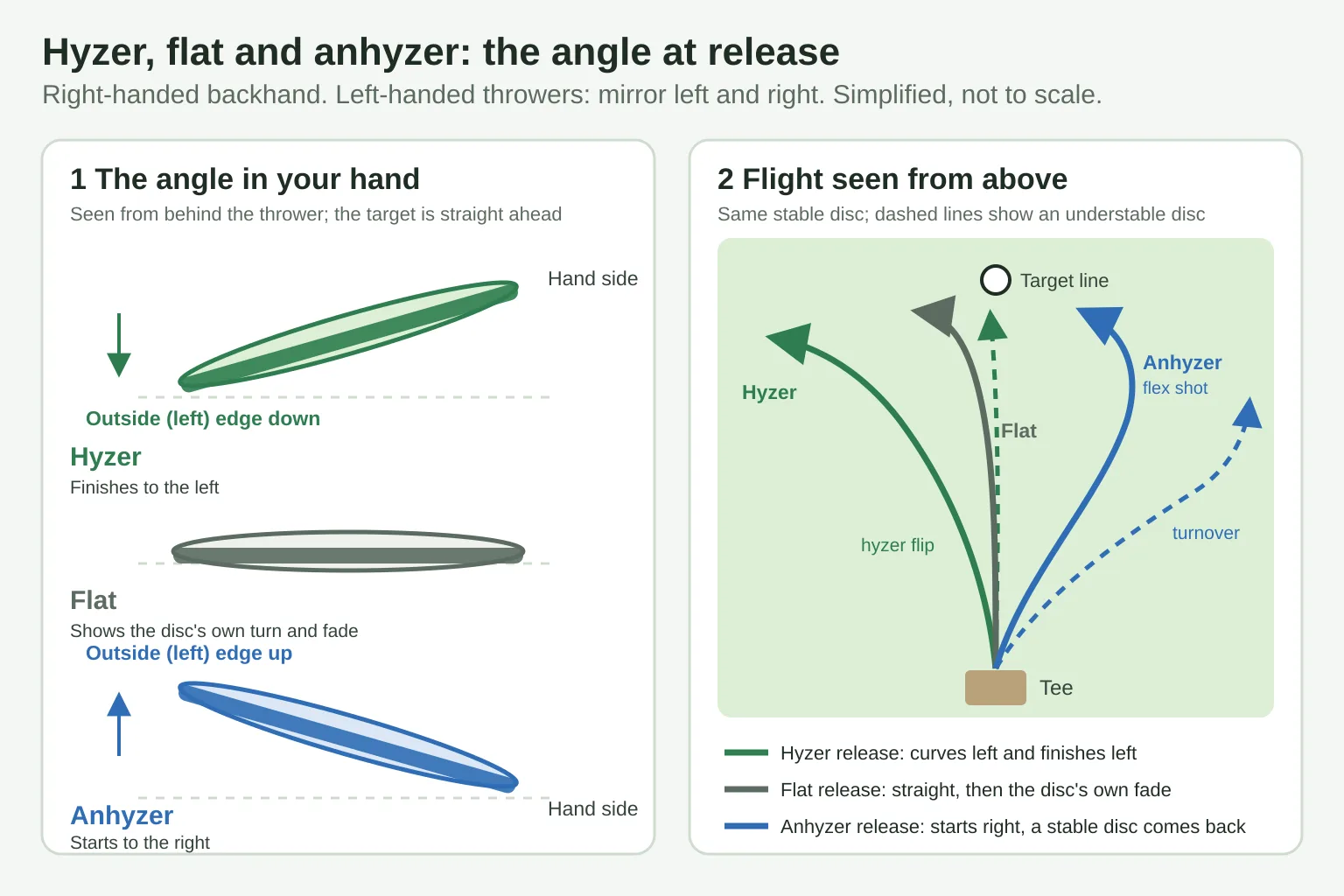
What hyzer and anhyzer mean
Innova's disc golf FAQ defines hyzer and anhyzer as the bank angle of the disc at release. For a right-handed backhand thrower, the outside edge of the disc is tilted down on a hyzer and up on an anhyzer. Innova adds that the angles are reversed for a left-handed backhand and for a right-handed sidearm, because the outside edge is then on the other side of the disc.
The words have a history. UDisc's article on the meaning and origin of hyzer traces it to Dr. Stancil Johnson's 1975 book Frisbee, which named the angle after H.R. "Fling" Hyzer, a long-distance champion who used it successfully at a 1960s tournament. Johnson meant the word only for the disc's angle at release. Anhyzer was coined later as its opposite; even Johnson did not know by whom. Players now use both words for flight shapes as well, which is where the confusion starts: a throw released on hyzer can fly straight, and a throw released flat can curve. Infinite Discs' Hyzer vs Anhyzer (Ted Hegemann, December 2025) says the same: a flat release is neither, and a tilted release creates one or the other. When a flight surprises you, look at the release rather than the name.
Which edge tilts down
The outside edge is the edge farther from your body at release. For a backhand it is on the side opposite your throwing hand; for a forehand it is on the same side.
| Throw | Hyzer release | Anhyzer release | A hyzer finishes toward |
|---|---|---|---|
| Right-handed backhand | Left edge down | Left edge up | Left |
| Left-handed backhand | Right edge down | Right edge up | Right |
| Right-handed forehand | Right edge down | Right edge up | Right |
| Left-handed forehand | Left edge down | Left edge up | Left |
The rest of this guide uses a right-handed backhand (RHBH). Left-handed backhand throwers mirror every left and right. Forehand throwers get the mirror image too, which is why a forehand hyzer and a backhand anhyzer curve the same way. Our forehand guide covers that throw.
Innova's forehand disc article uses a clock face as a gauge of release angle: level flight is a 3 o'clock release, hyzer about 4 to 5 o'clock, anhyzer 2 o'clock and a roller 1 o'clock. Innova shows right-handed throws and says left-handers mirror them.
How each angle changes the flight
A disc's stability describes what it wants to do; the release angle sets where that starts. Our guide to understable vs overstable discs separates turn (the early drift) from fade (the late finish). Put the two together:
| Release | Stable or overstable disc | Understable disc |
|---|---|---|
| Hyzer | Holds the angle and curves left the whole way | Flips toward flat and flies straighter (hyzer flip) |
| Flat | Flies straight, then fades left | Drifts right, then fades back at the end |
| Anhyzer | Drifts right, then the fade pulls it back left (flex shot) | Keeps turning right; can turn over or become a roller |
The table is DiscField's simplification of Innova's definitions and the Infinite Discs article. Wind, throwing speed and wear move every line in it. Infinite Discs describes the hyzer as a disc that curves naturally into a hard left finish, and the anhyzer as a disc that turns right before anything else happens. Released on anhyzer, a stable disc turns right early and then flexes back left. Three named shots come out of the combinations, all defined in Innova's glossary:
- Hyzer flip: an understable disc thrown fast on hyzer turns up to flat, drops its nose and glides a long straight line. Our hyzer-flip guide shows how to find the angle.
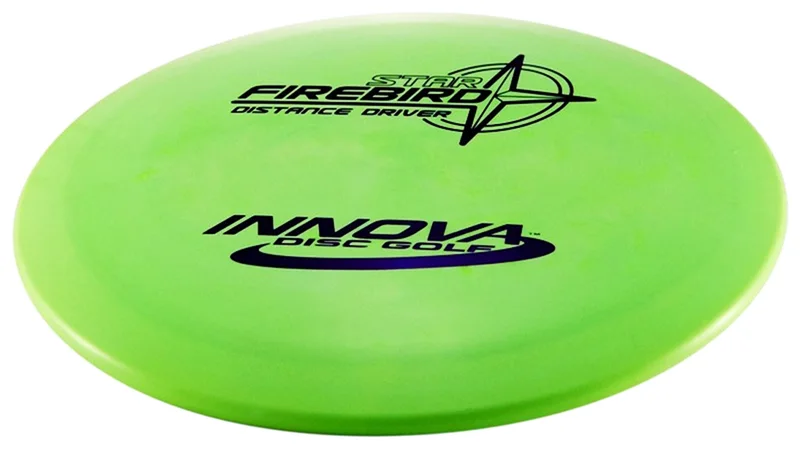
- Flex shot: an overstable disc released on anhyzer down the left side of the fairway drifts right, then its overstability curves it back left. Innova says pros use it often. The Innova Firebird, rated 9 / 3 / 0 / 4, is the kind of disc this shot wants.
- Spike hyzer: a disc thrown high on an extreme hyzer angle so that it lands almost vertically and does not skip.
A steep anhyzer with an understable disc becomes a roller once it meets the ground. Our guide on how to throw a roller covers that on purpose.
When to use each angle
Use a hyzer when the disc must finish in a predictable direction: into a landing zone that opens to the left, around an obstacle on the right side of the fairway, or on an approach shot that should stop rather than run. A stable disc on hyzer does one thing, curve toward its fade side, which is why it is the usual choice for a shot that has to land in one place.
Use an anhyzer when the hole bends the other way and you have no forehand, or when you want a long turning line without buying a more understable disc. The disc starts right of your line, so aim left of where you want it to land, and expect a stable disc to come back at the end.
Use a flat release to learn what a disc does on its own. A flat throw with a neutral midrange such as the Innova Mako3 shows you the disc's turn and fade without the angle adding to them, which makes it the fairest way to compare two discs.
How to throw a hyzer and an anhyzer
Set the angle before the throw starts, not during it. Hold the disc at the tilt you want, keep it through the reach-back and the pull, and let the arm continue on the same line after release. Innova's article on common throwing errors names off-axis torque, force applied in a different direction from the intended release angle, as one of the biggest causes of a wobbling, inconsistent release. Rolling the wrist on a hyzer release is its classic example: the disc wobbles out of the hand and loses spin and forward momentum. The fix Innova gives is the follow-through: keep the arm swinging on the line of the throw, and on a hyzer let it continue upward.
For an anhyzer, the same rule applies with the far edge raised. The disc wants to turn on this angle, so a disc that already drifts right on a flat throw will drift more; start with a stable disc and a small angle. Innova's roller article describes the extreme version, pulling the disc high across the body on a severe anhyzer and following through downward, and that is a roller rather than an air shot. For an anhyzer that stays in the air, keep the angle small and the effort smooth.
Our backhand guide covers the grip, stance and reach-back that the angle sits on top of.
A field drill for both angles
DiscField's practice suggestion, not a test method from the sources:
- Take one stable midrange to an open field with a target about as far away as you throw it comfortably.
- Throw five flat. Note where each one starts, which way it drifts and where it finishes.
- Throw five on a small hyzer, aiming a little right of the target. Expect a left finish.
- Throw five on a small anhyzer, aiming a little left. Expect a right start, and watch whether the disc comes back.
- Repeat with an understable disc and compare its hyzer flip with its anhyzer turnover.
Write down the disc, the angle and what happened. Ten throws on each angle tell you more than one good one.
Why your hyzer or anhyzer went wrong
| What you see (RHBH) | What to check | One thing to try |
|---|---|---|
| The hyzer lands far left of the target | Where you aimed | Aim right of the target and let the curve bring it back |
| The hyzer wobbles out of the hand | The wrist rolling at release (Innova's off-axis torque) | Set the angle early and follow through upward on the same line |
| The hyzer flattens and flies straight | An understable disc flipping | Use it as a hyzer flip, or pick a more stable disc for a true hyzer |
| The anhyzer keeps turning and crashes | Too much angle, or a disc too understable for it | Less angle, or a more stable disc |
| The anhyzer comes back left too early | A disc too overstable for your speed | Keep it only if you wanted a flex shot; otherwise a less stable disc |
These are things to check, not diagnoses from a single throw. Record a few throws before you change the disc.
Sources and scope
Read October 12, 2026: Innova's disc golf FAQ (bank angle definitions and the reversal for left-handed and sidearm throws), glossary of terms (hyzer flip, flex shot, spike hyzer), The Best Discs for Throwing Forehand (the clock gauge) and Common Throwing Errors Holding Back Your Game (off-axis torque, the wrist roll, the follow-through); UDisc's Hyzer In Disc Golf: Meaning, Origin, & How to Throw (Stancil Johnson and H.R. Hyzer); and Infinite Discs' Hyzer vs Anhyzer (Ted Hegemann, December 22, 2025). The Firebird rating comes from its DiscField record. The combination table, the when-to-use advice, the drill and the troubleshooting table are DiscField's editorial suggestions. DiscField has not measured release angles or flight paths.
Read next
- How to throw a hyzer flip: choose a disc and find the angle
- Understable vs overstable discs: what to choose
- How to throw a disc golf backhand: step by step for beginners
- Disc golf forehand: how to throw a sidearm for beginners
- How to throw a roller in disc golf: discs, angle and steps
- Disc golf approach shots: how to throw an upshot for beginners
- How to throw a tomahawk and thumber in disc golf