DISCFIELD / Learn
How to throw farther in disc golf: distance tips for beginners
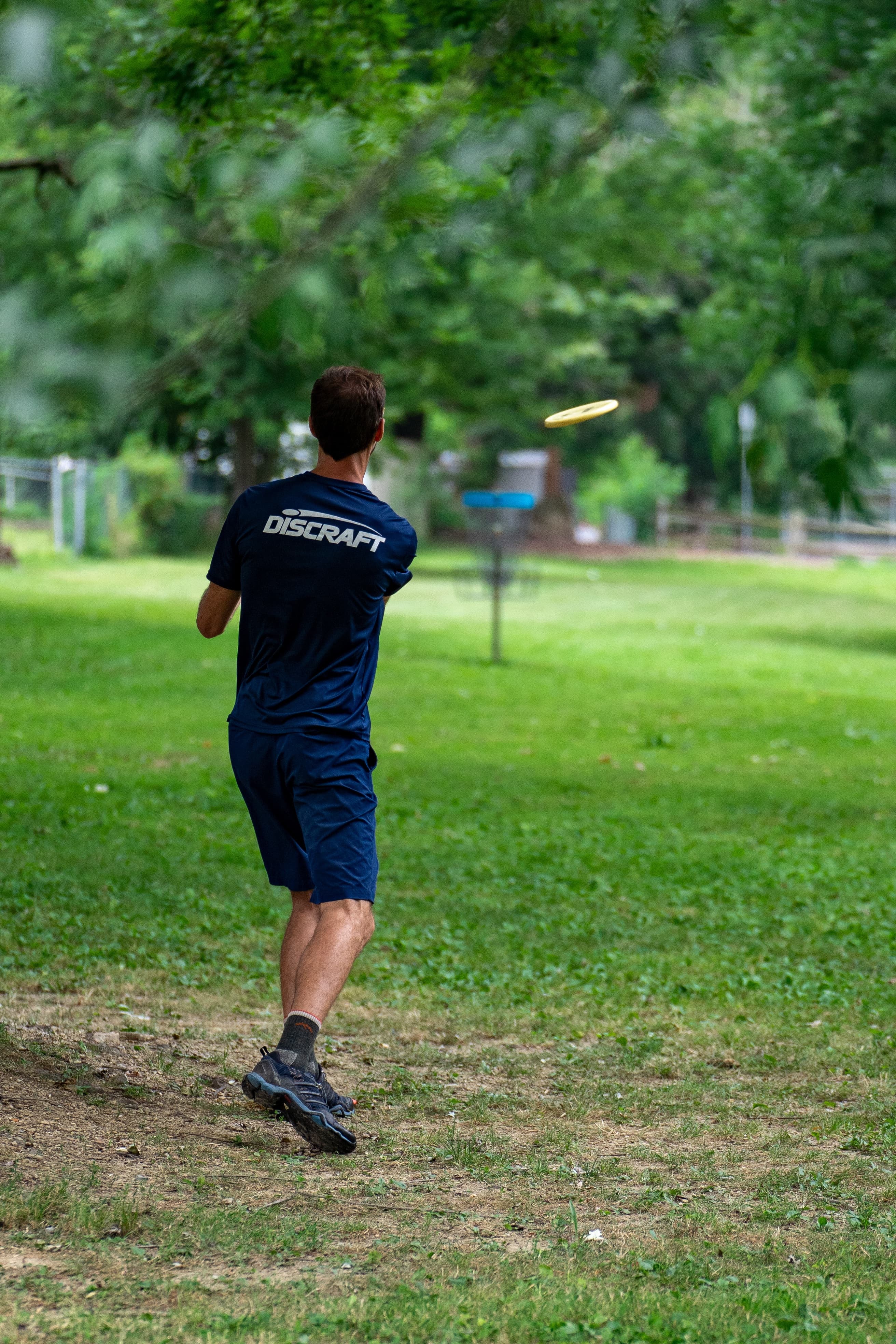
To throw farther in disc golf, throw a disc that matches your arm speed, plant your front foot before the arm pulls through, reach straight back and release the disc nose down. Innova's distance tips all point the same way: throwing harder without fixing those usually adds little distance and costs accuracy. This guide covers each fix for a right-handed backhand (RHBH). If you throw left-handed, mirror every left and right.
If you are still learning the basic standstill throw, start with our backhand guide and come back once it goes roughly where you aim.
Throw a disc your arm can get up to speed
Innova's article on common throwing errors calls throwing drivers that are too fast and overstable one of the most common beginner mistakes. A fast disc only flies farther when you throw it with enough speed and clean form. Below that, it fades early and loses distance. Innova quotes pro Gregg Barsby saying that most high-speed discs do the same thing for a new player: fade hard.
Innova's advice is to build clean form with putters and midranges, move to fairway drivers, and only then try high-speed drivers.
| Step | Example disc | Flight numbers | When to move on |
|---|---|---|---|
| Putter | Innova Aviar | 2 / 3 / 0 / 1 | Your form feels clean on short drives |
| Midrange | Innova Mako3 | 5 / 5 / 0 / 0 | The disc holds a straight line before it fades |
| Fairway driver | Innova Leopard | 6 / 5 / -2 / 1 | It goes farther than your midrange without fading early |
| Distance driver | Innova Destroyer | 12 / 5 / -1 / 3 | Only when fairway drivers no longer keep up with your arm |
The flight numbers are Innova's ratings from our disc records. The "when to move on" column is DiscField's rough guide, not an Innova rule. Our flight numbers guide explains what speed means, and our guide to choosing your first fairway driver compares several options for the third step.
Weight matters too. In its article on throwing backhands really far, Innova says lighter plastic adds distance for most players in no wind or a tailwind. It also notes that the distance world record of 1,108 feet was thrown with a 154-gram Boss. Our disc weight guide covers when a lighter copy is worth trying.
Smooth timing beats more power
Both Innova articles make the same point. Players who try to throw harder usually lose the timing between legs, hips, core and upper body, and then the extra effort adds little distance and costs accuracy. Innova's throwing-errors article says many players throw just as far at 50 percent power as at full effort. Its advice is to slow down, throw smoothly and add power only while the timing stays clean.
The same article warns against the "all arm" throw, where the lower body and core do very little. Think about turning your hips through the shot instead of pulling harder with your arm. Innova points out that much of the power in a good drive starts from the ground up.
Footwork: plant first, then throw
Innova calls throwing before the front foot has fully planted one of the most common distance leaks. If you let go while the front foot is still landing, you lose the power from your hips and back leg. Plant the front foot first (the right foot for RHBH), then push off the back leg, turn the hips, drive with the shoulder and release. Innova suggests reaching the end of your reach-back at the same moment the front foot plants.
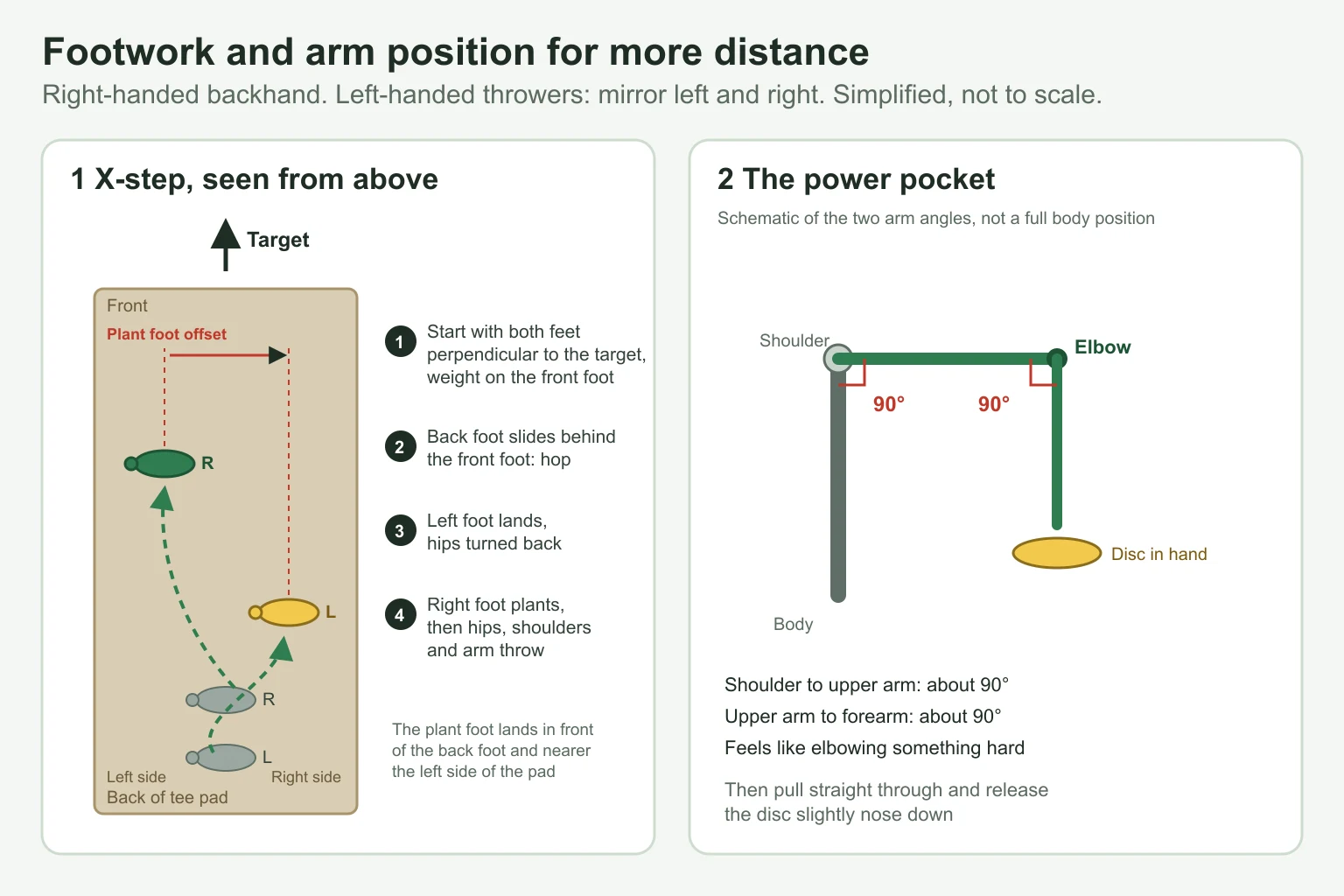
Where the feet land matters as well. Innova says the plant foot should be in front of the back foot and offset from it, with the hips pointing slightly away from the target, so your core is wound up before you turn. For RHBH, that puts the front foot nearer the left side of the tee pad and the back foot nearer the right side. If your back foot, plant foot and the target are all on one straight line, your hips cannot turn fully.
The X-step run-up
The X-step is a common way to carry momentum from the back of the tee pad into that planted position. Innova's X-step handout describes it as "a step, hop and a step" in four parts:
- Start with both feet perpendicular to the target and your weight on the front foot. Push off with the back foot, which starts to slide behind the front foot.
- Hop forward with the back foot behind the lead foot. Both feet leave the ground for a moment while your body keeps moving forward.
- The left foot lands with the hips turned back, ready to throw, while the right foot is off the ground on its way to the plant.
- The right foot plants and the throw starts: hips first, then shoulders and arm. The back heel lifts as your weight moves forward, and just after release the front foot pivots to take stress off the knee.
Learn it at walking pace in a field before you use it on a tee. If the timing falls apart, go back to a single step or the standstill throw for a while. Our backhand guide has a section on when to add footwork.
Reach back straight and find the power pocket
Rounding is another leak. Innova's throwing-errors article describes it as the disc travelling around your body instead of being pulled through in a straight line, and says it starts in the reach-back. For RHBH, rounding makes early releases pull left and late ones grip-lock far right. Innova's fix is to reach toward the back corner of the tee pad on the side opposite your throwing arm, which keeps the pull-through straighter.
A straight pull also helps you hit what Innova calls the power pocket: the moment in the throw when there is a 90-degree angle between your shoulder and upper arm and another between your upper arm and forearm. Innova suggests pretending you are elbowing something hard with your throwing arm, because that arm position is the one that transfers force well.
Release the disc nose down
Innova names nose angle as one of the biggest differences between average and advanced distance. A disc released nose up stalls and fades early. For distance shots, keep the nose slightly down relative to the flight path. The simplest way, according to Innova, is to exaggerate the nose-down angle in your hand before you start the throw, which may mean adjusting your grip. It will probably feel strange at first. Our grips guide shows the power grip and fan grip.
Watch your follow-through as well. Innova links wobble, which it calls off-axis torque, to rolling the wrist at release, and says the wobble costs spin and forward speed. Keep the arm moving on the same line as the throw after you let go.
Pick a line before you throw
Innova's distance article suggests picturing the flight you want before every drive and picking checkpoints in the sky that the disc should pass through. Throwing as hard as you can with no plan does not add distance consistently. It also gives you a fairer way to judge a throw. If you hit your line and a hidden branch stops the disc, it was still a good throw.
Wind changes both the disc and the angle. Innova suggests a faster, more overstable disc into a headwind and a less stable disc with a tailwind, and generally not showing the bottom of the disc to the wind. Our guide to disc golf in the wind goes into more detail.
Common reasons you are not throwing farther
| What you see | Likely cause | Try this |
|---|---|---|
| A fast driver dives left early (RHBH) | The disc is too fast or overstable for your arm speed | Throw a fairway driver or midrange instead |
| The disc climbs, stalls and drops | Nose-up release | Exaggerate the nose-down angle in your grip |
| More effort gives no extra distance | Timing breaks down, or the throw is all arm | Throw at a smooth, steady pace and turn the hips through |
| Releases go far left or far right | Rounding in the reach-back | Reach toward the back corner of the pad on the side opposite your throwing arm |
| The run-up feels powerful but the disc goes nowhere | You release before the front foot plants | Plant first, with the reach-back at its end as the foot lands |
| The disc wobbles out of your hand | Off-axis torque from a rolled wrist | Follow through on the same line as the throw |
How to practice for distance
Practice in an open field with a few discs you know, not on a busy course. Change one thing at a time, such as the nose angle, the plant or the disc, and compare where several throws land. Our practice routine includes a block for controlled drives you can use for this. When the extra distance shows up in a field, a good next step is our guide to approach shots, because a longer drive usually leaves an upshot to the basket.
Make sure the field is clear ahead of you and to both sides before you throw, and stop if a run-up starts to hurt your knee or shoulder.
Sources and scope
Sources checked October 9, 2026: Innova's How to Throw Backhands... Really Far (February 2026; flight path, plant timing, staggered feet, power pocket, wind, timing, nose angle, disc and weight choice); Innova's Common Throwing Errors Holding Back Your Game (May 2026; off-axis torque, rounding, power vs technique, all-arm throws, nose angle, discs that are too fast); and Innova's X-step handout. Flight numbers come from DiscField's disc records, which cite the manufacturers. The steps describe one common way to learn the throw, not the only correct form. DiscField has not measured throwing distances or tested these discs.