DISCFIELD / Learn
How to throw a tomahawk and thumber in disc golf

Tomahawks and thumbers are the two common overhead throws in disc golf. You hold the disc on its edge beside your head and throw it overhand, much like an outfielder throwing a baseball back to the infield. In the air the disc turns upside down and drops back to the ground, so it can get up and over a tree or a tall bush that blocks a backhand or forehand.
The two throws differ in the grip. A tomahawk uses your forehand grip with the flight plate facing you. A thumber has your thumb tucked inside the rim with the flight plate facing away. For a right-handed thrower, a tomahawk pans out from right to left and finishes left, and a thumber does the opposite and finishes right. Left-handed throwers should mirror every direction in this guide.
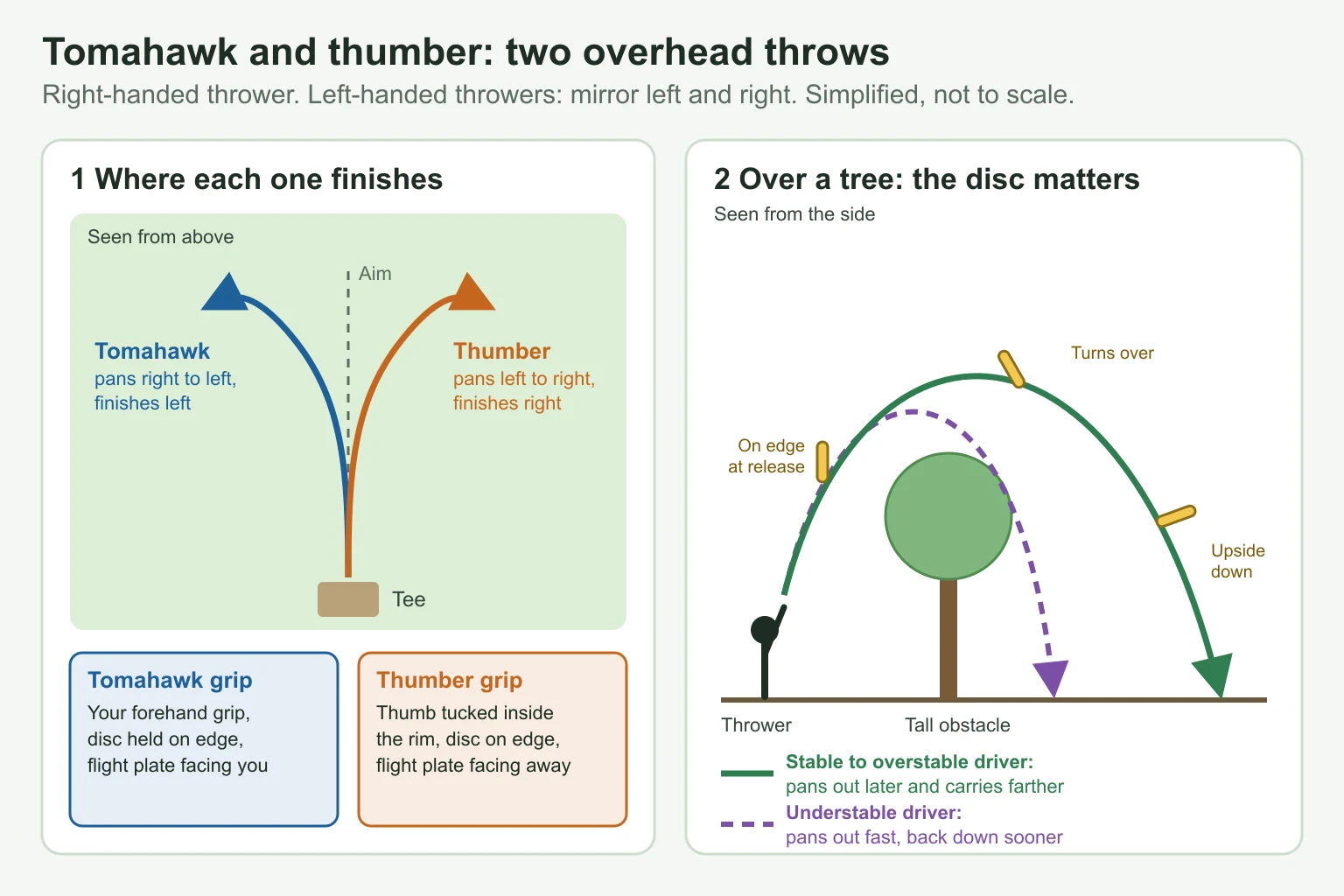
Tomahawk vs thumber at a glance
| Tomahawk | Thumber | |
|---|---|---|
| Grip | Your normal forehand grip, disc on edge | Thumb inside the rim, rim resting on the middle finger, index finger on the flight plate |
| Flight plate at release | Facing you | Facing away from you |
| Where it finishes (right-handed) | Pans right to left, ends left | Pans left to right, ends right |
| Other names | Sometimes called a hammer | Named for the thumb grip |
| Good to learn first if | You already throw forehand | Your thumb fits comfortably under the rim of your discs |
Ultiworld Disc Golf's utility shot guide describes the grips, the "corkscrew" flight with the flight plate facing the ground and the pan direction of each throw. It also notes that thumbers are somewhat more common than tomahawks. The last row is DiscField's suggestion. Both throws are worth learning, because each one bends the opposite way to the other.
When an overhead is the right shot
An overhead throw solves a specific problem: there is more room above you than in front of you. Ultiworld lists four common situations:
- Getting out of the rough when a backhand or forehand air shot has no clear line.
- Going up and over a tree, a tall bush or a low ceiling that has room above it.
- Controlled skip shots, when an overhead is thrown low and hard.
- Tunnel fairways, narrow corridors where there is more vertical space than horizontal space.
Infinite Discs' overhead disc roundup adds that the overhead is also used as a shortcut over a tight fairway and says it is more popular with experienced players than with beginners. It is a utility shot. You do not need it to start playing, and most of your throws will still be backhands and forehands.
How the overhead compares with the other ways around an obstacle, as DiscField reads the sources:
| The obstacle | Shot to consider | Why |
|---|---|---|
| Low branches, open ground under them | Roller | It stays under the canopy and rolls along the ground |
| A tree or bush in front, open sky above | Tomahawk or thumber | It goes over the top and comes down behind |
| Trees on both sides, a narrow gap up the middle | Tomahawk or thumber | The disc travels on edge through a tall, narrow window |
| Room to curve around one side | Hyzer or anhyzer | A backhand or forehand on an angle keeps more distance and control |
Overhead grips
For a thumber, Ultiworld says to hold the disc vertically with the flight plate facing away from you, tuck your thumb into the rim, let the edge of the rim rest on your middle finger, and keep your index finger on the flight plate. That index finger adds grip strength and helps you adjust the release angle. Infinite Discs describes the same hold as the thumb against the inner rim with the index finger pressing on the outside.
For a tomahawk, use the same grip you use for forehand throws: index and middle finger along the inside of the rim, thumb on top of the flight plate. Hold the disc vertically with the flight plate facing you. Our grips guide shows the forehand grips, and the forehand guide covers the wrist snap that both throws share.
Rim width matters most for the thumber. Infinite Discs notes that some players cannot fit their thumb comfortably under a very thick rim, so a fairway driver with a narrower rim can be easier to grip than a wide distance driver.
How to throw a tomahawk or thumber, step by step
The arm motion is nearly the same for both throws. The steps below follow Ultiworld's guide.
- Grip and aim. Hold the disc on edge in the tomahawk or thumber grip and face your target. Pick a line over the obstacle, not at it.
- Walk up smoothly. A controlled walk or run-up, like one for a forehand, is enough. Ultiworld suggests an outfielder's crow hop if you want more momentum.
- Shift your weight from the back leg to the front leg. Ultiworld says the momentum from your lower body goes into the disc and takes stress off your shoulder and elbow.
- Bring the disc back to your ear, or to the side or back of your head. Keeping it close lets more of your body into the throw. Ultiworld warns that throwing with the disc held out away from your body puts undue stress on the shoulder.
- Stay smooth, then accelerate late. Keep the motion slow and controlled until just before release. The disc leaves your hand above your head, with the most speed at that point.
- Follow through toward your target. A well-thrown overhead should finish more or less in front of you, with some drift left or right from the disc's stability and the wind.
Start with short, soft throws in an open field. The motion is new for your shoulder, and Ultiworld's advice about using your legs and keeping the disc near your head is aimed at protecting it.
Which disc to use for overhead throws
Overhead throws flip the usual logic of disc stability. On a backhand, an overstable disc gives a short, hard fade. Thrown overhead, a stable to overstable driver turns over more slowly and pans out in a wider arc, and that wider arc is what carries the disc farther.
- Ultiworld says stable to overstable fairway drivers and lower-speed drivers are typically preferred, because they take longer to pan out, pan more predictably and gain more distance. Understable drivers in the same speed range can be just as useful: they flip and pan out faster, so they get up over an obstacle and back down quickly. The author's own tomahawk disc in that article was a beat-up Innova Roadrunner, an understable fairway driver.
- Infinite Discs nominates only very overstable discs: the Axiom Fireball, Innova Firebird, Discraft Flick, Latitude 64 Stiletto and Latitude 64 XXX. Its pick is the Flick, which it calls a common first thumber and tomahawk disc.
- Innova's own Firebird page calls the Firebird a favorite of sidearm and overhead throwers. In a pro review on the same page, Chris Sprague says he uses it a lot for overhand shots because its stability is predictable.
Overstable drivers in the DiscField catalog
To turn that advice into a short list, DiscField filtered its own disc records. Of the 156 disc pages on the site, 59 are fairway or distance drivers rated speed 6 to 10, the fairway and lower-speed range Ultiworld describes. Ten of those have a turn rating of 0 or higher and a fade rating of 3 or more on the manufacturer's numbers:
| Disc | Type | Flight numbers | Note |
|---|---|---|---|
| Innova Firebird | Fairway driver | 9 / 3 / 0 / 4 | Named by Infinite Discs; Innova calls it an overhead favorite |
| Axiom Fireball | Fairway driver | 9 / 3.5 / 0 / 3.5 | Named by Infinite Discs |
| Dynamic Discs Felon | Fairway driver | 9 / 3 / 0.5 / 4 | Like the Firebird, a touch more turn-resistant |
| Discraft Predator | Fairway driver | 9 / 4 / 1 / 4 | The most turn-resistant on this list |
| Discmania Splice | Fairway driver | 9 / 3 / 0 / 4 | Same rating profile as the Firebird |
| Discraft Raptor | Fairway driver | 9 / 4 / 0 / 3 | A little less fade |
| Kastaplast Stål | Fairway driver | 9 / 4 / 0 / 3 | A little less fade |
| MVP Resistor | Fairway driver | 6.5 / 4 / 0 / 3.5 | The slowest on this list |
| Discmania PD | Distance driver | 10 / 4 / 0 / 3 | The only distance driver on this list |
| Discraft Anax | Fairway driver | 10 / 6 / 0 / 3 | Much more glide than the rest |
The filter is DiscField's, built from what the sources say about overhead discs. Flight numbers are manufacturer ratings for a backhand throw, not measurements of overhead flight, and DiscField has not thrown these discs overhead. Treat the table as candidates to try rather than a ranking. Our flight numbers guide explains the four ratings, and the guide to understable vs overstable discs explains what turn and fade mean in practice.
If you already carry an overstable utility driver for headwinds or hard fades, try that one overhead first. You do not need a new disc to find out whether the shot works for you.
Common overhead problems
| What you see | Likely cause | Try this |
|---|---|---|
| The disc flips and drops sooner than you wanted | The disc is understable for the shot | Use a more stable driver when you need distance |
| You cannot get a solid thumber grip | The rim is too thick for your thumb | Try a fairway driver with a narrower rim |
| Your shoulder or elbow feels the throw | All arm, or the disc held out away from your body | Use your legs, shift your weight and keep the disc near your head |
| The disc finishes well off the line | Stability and wind push an overhead left or right | Learn how far each disc drifts and aim off accordingly |
Ultiworld also points out that an overhead can be accurate once you know your discs, but where it ends up depends on the ground it lands on. Note how each disc behaves after landing on the surfaces you usually play.
Practice and safety
Learn overhead throws in an open field before you use them in a round. Take two discs of different stability, throw a few tomahawks and thumbers with each and note where each one lands. Then add a short overhead block to your practice routine.
An overhead climbs high and can land in places you cannot see from the tee. Check that nobody is near the landing area, and on a blind shot use a spotter or wait, as our disc golf etiquette guide explains.
Sources and scope
Sources read October 17, 2026: Ultiworld Disc Golf's Tuesday Tips: Utility Shots – Thumbers & Tomahawks by Alex Colucci (September 2017; grips, footwork, arm motion, flight direction, uses and disc choice); Infinite Discs' Best Disc Golf Overhead Discs (grips, uses, nominated discs and the thick-rim note); and Innova's Firebird page (overhead note and Chris Sprague's review). Flight numbers come from DiscField's disc records, which cite the manufacturers. The catalog filter (fairway and distance drivers, speed 6 to 10, turn 0 or higher, fade 3 or more) was run on DiscField's 156 disc records on October 17, 2026. DiscField has not tested these discs or measured overhead flights.
Read next
- How to throw a roller in disc golf: discs, angle and steps
- Disc golf forehand: how to throw a sidearm for beginners
- Understable vs overstable discs: what to choose
- Disc golf grips: how to hold a disc for backhand, forehand and putting
- Hyzer vs anhyzer: disc golf release angles explained
- A 30-minute disc golf practice routine for beginners