DISCFIELD / Buying guides
Distance drivers: when you need one and which to choose

A distance driver is the fastest kind of disc golf disc, with the widest and sharpest rim. UDisc rates them at speed 9 to 15 and says most players should not throw one for shots under 300 feet. Until you throw a fairway driver straight past about 300 feet, a fairway driver flies as far for you, and often farther. When you are ready, start with a speed 10 to 12 disc that has some rated turn, in a lighter weight, and give it one job your fairway driver cannot do.
Further down, 12 distance drivers from our disc records are sorted by what their makers say they are for.
What is a distance driver?
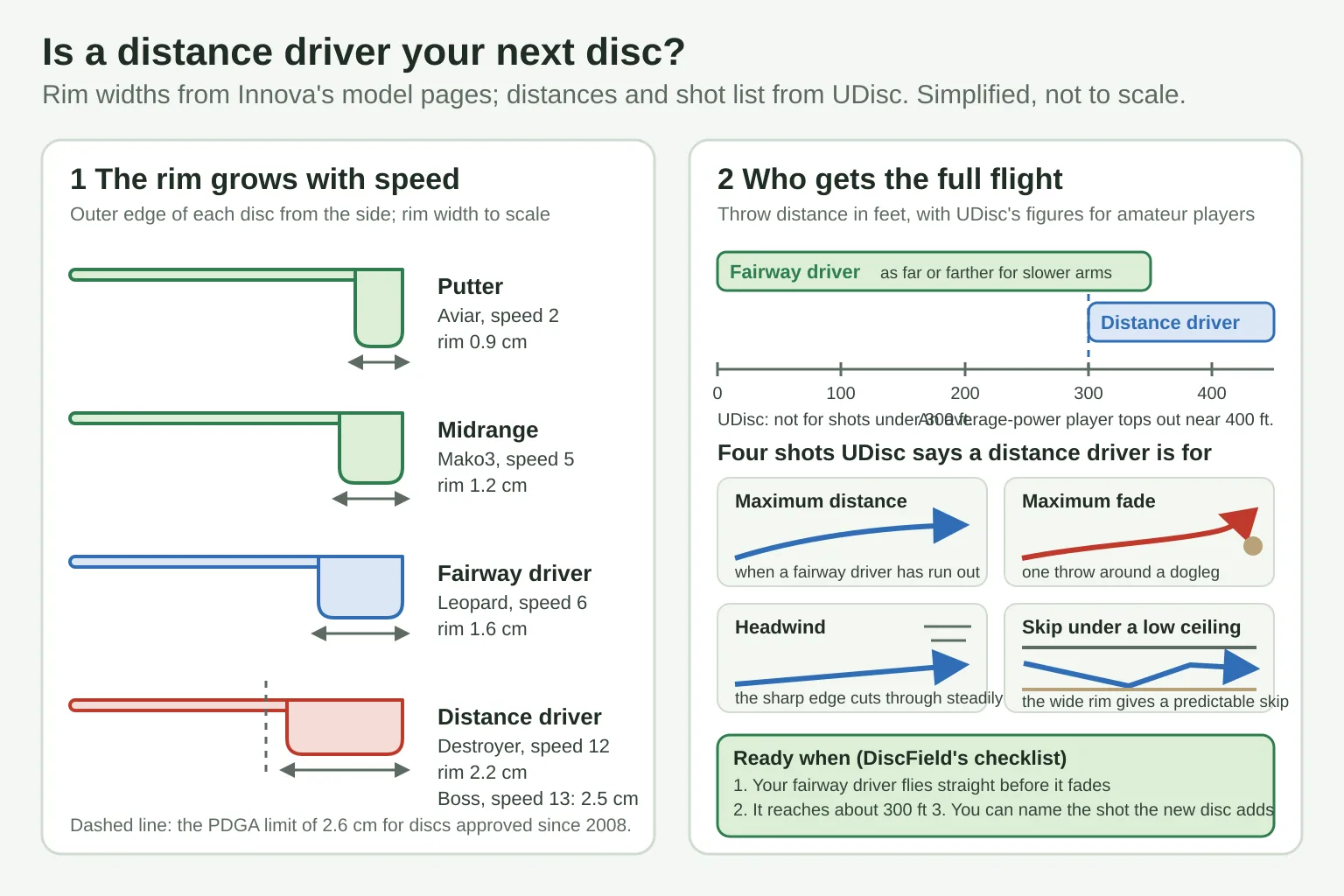
UDisc's explainer on how and when to throw distance drivers describes them as discs with wide, shallow, sharp rims and a flat, aerodynamic shape, rated from speed 9 up to 15. The rim is the part you feel first. In our Innova records the Aviar putter has a 0.9 cm rim, the Mako3 midrange 1.2 cm, the Leopard fairway driver 1.6 cm, and the distance drivers run from 2.0 cm (Orc) to 2.5 cm (Boss). The PDGA's technical standards cap the rim at 2.6 cm for discs approved since 2008, and Innova's flight ratings page says its speed 14 drivers have that maximum legal wing width.
Speed is the catch. The same Innova page says higher speed discs need more throwing power to fly as rated, and that Innova does not usually recommend them for beginners. A wide rim also changes how you hold the disc, which the grip section below covers. Our flight numbers guide explains the four ratings. Brands rate on their own scales, so a Discraft 12 and an Innova 12 are not the same promise.
Makers draw the line between fairway and distance drivers in different places. Discraft lists its speed 9 Heat and Undertaker as distance drivers, while DiscField groups speed 9 discs with fairway drivers. This guide covers the speed 10 and faster discs in our records.
Fairway driver vs distance driver
UDisc's companion article on fairway drivers says most amateurs throw them near or just above 300 feet, and that for a player with slower arm speed a fairway driver flies just as far as a distance driver, if not farther. The distance driver article adds that an average-power player generally maxes out around 400 feet with one.
| Fairway driver | Distance driver | |
|---|---|---|
| Speed rating | About 6 to 9 | About 10 to 14 (UDisc counts 9 to 15) |
| Rim width in our Innova records | 1.6 to 1.9 cm | 2.0 to 2.5 cm |
| Who gets the full flight | Most players who throw a midrange well | Players who already throw a fairway driver straight past about 300 feet |
| Shots it adds | Longer straight lines and controlled curves | Maximum distance, a long bend, a headwind line or a skip |
The speed bands are DiscField's grouping of manufacturer ratings. The rim widths come from the Innova model pages cited on each disc record.
If your fairway driver fades early and lands short, a faster disc lands shorter still. Innova's advice, which our guide to throwing farther goes through in detail, is to build form with putters and midranges, move to fairway drivers, and only then try high speed drivers.
Are you ready for a distance driver?
Three signs, drawn from the UDisc and Innova articles above:
- Your fairway driver flies straight before it fades. A driver that dives left straight out of the hand (right-handed backhand) is already too much disc.
- You throw that fairway driver around 300 feet to a landing area you can predict. UDisc's 300-foot line is where a distance driver starts to make sense.
- You can name the shot: a long open hole, a dogleg that needs a hard finish, a headwind drive or a skip under low branches. If the only reason is that it should go farther, it probably will not yet.
If one of those is missing, a lighter fairway driver or more field work with the discs you own usually adds more distance than a new disc. Our disc weight guide explains when a lighter copy helps.
When a distance driver helps
UDisc names four situations where the disc earns its place:
- Maximum distance, when a fairway driver has run out and you need a faster disc.
- Maximum fade, to bend around a tree line or dogleg in one throw.
- Wind. The sharper edge cuts through a heavy headwind more predictably than a midrange or fairway driver. Innova's flight ratings page agrees that faster discs cut into the wind with less effort, and adds that a slower disc may go farther with a tailwind. Our wind guide covers that choice.
- Maximum skip, for a sharp angle or a low ceiling, where the wide rim gives a predictable skip.
Which distance driver to try first
Start with the slowest distance driver that does the job, with some rated turn. Innova's Flight Numbers Made Simple says discs rated -2 to -5 turn are generally easier for newcomers to throw and get a full flight from. Each disc below has a DiscField record with the maker's ratings and source.
| Disc | Flight numbers | What the maker says it does |
|---|---|---|
| Innova Gorgon | 10 / 6 / -2 / 1 | Distance-driver speed without a strong finish; Innova says GStar copies can show more turn |
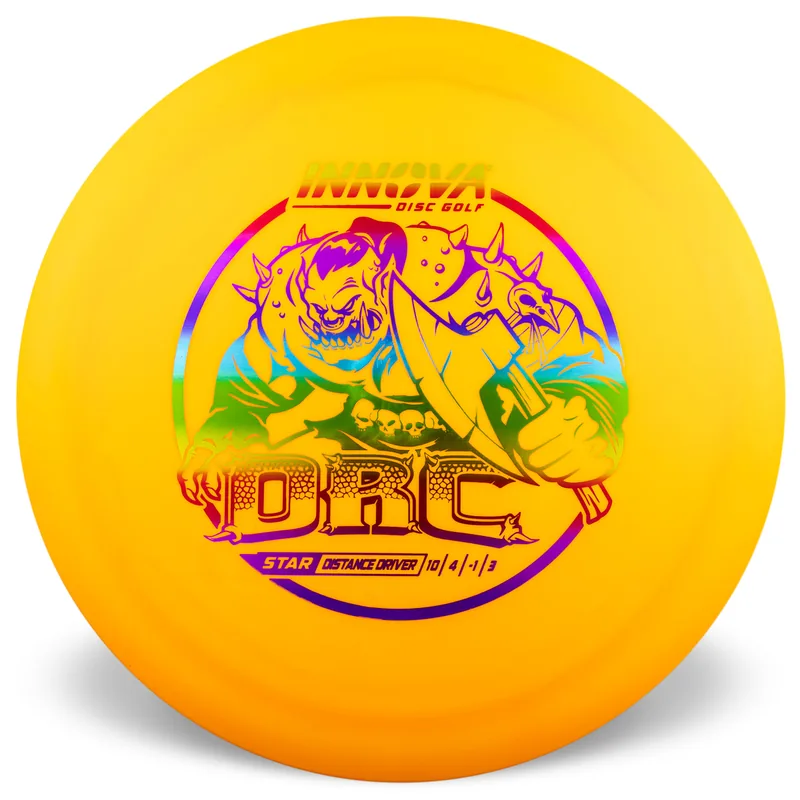
| Innova Orc | 10 / 4 / -1 / 3 | A straight go-to driver with dependable fade; lighter weights keep it manageable for beginners |
| Discraft Thrasher | 12 / 5 / -3 / 2 | Big distance for slower arms on turnover and anhyzer lines; finishes on a slow hyzer |
| Innova Tern | 12 / 6 / -3 / 2 | More rated turn and glide than the Destroyer; the Champion version is rated -2 turn |
These four are the distance drivers whose makers mention beginners or slower arms, or that carry a rated turn of -2 or lower. The Gorgon and Orc keep you at speed 10 with a 2.0 to 2.1 cm rim. The Thrasher and Tern are faster and turn more, so they suit a player who already throws a turning fairway driver such as the Valkyrie.
Three more drivers in our records fit the same group. Innova lists novice players who want more distance among the best uses of the Beast (10 / 5 / -2 / 2). Latitude 64 calls the Sapphire (10 / 6 / -2 / 1.5) a natural step up from its Diamond for players who want more distance, and Discraft calls the Avenger SS (10 / 5 / -3 / 1) a distance driver for the rest of us.
| Disc | Flight numbers | What the maker says it does |
|---|---|---|
| Innova Wraith | 11 / 5 / -1 / 3 | A step below the Destroyer in speed with a similar turn and fade rating |
| Discmania PD | 10 / 4 / 0 / 3 | Power and control in one disc, pitched at advanced and pro-level players |
| Innova Destroyer | 12 / 5 / -1 / 3 | A power driver; Innova does not recommend it for beginners |
| Discmania DD3 | 12 / 5 / -1 / 3 | Advanced players' go-to; at slower speeds it acts overstable for headwinds and forehands |
| Discraft Force | 12 / 5 / 0 / 3 | Discraft's fastest overstable driver, for experienced players who throw hard |
| Innova Boss | 13 / 5 / -1 / 3 | A 2.5 cm rim for an established driving game; Champion copies are rated 13 / 5 / 0 / 3 |
| Discraft Nuke | 13 / 5 / -1 / 3 | Maximum distance for moderate to expert players |
| Innova Firestorm | 14 / 4 / -1 / 3 | Low power drives, long forehands and spike hyzers; Champion plastic only |
These eight are power drivers: little or no rated turn and a fade of 3. For a player who cannot yet get a speed 10 disc up to speed, they fade early and land short of a fairway driver. The grouping is DiscField's own sorting of the manufacturer ratings and descriptions, with the limits noted on each record.
Other drivers in our records with the same power-driver shape include the Prodigy D2 (12 / 5 / 0 / 3), which Prodigy designs for strong throwers, and the Latitude 64 Ballista Pro (14 / 4 / 0 / 3), which Latitude 64 says is best suited to advanced players and power throwers who want extra stability.
To see two of these side by side, open them in Compare, or search the full catalog in the Flight Chart.
Weight and plastic
Innova's article on why you should throw lightweight discs says lighter plastic takes less arm speed to get up to cruising velocity, and that heavy discs tend to hyzer out early when you cannot generate enough speed. Several of the discs above come in light runs. Innova lists the Wraith and Boss in Blizzard plastic at 130 to 159 g, the Tern in StarLite at 130 to 159 g, and the Orc in DX from 150 g. The PDGA's weight limit is 8.3 g per centimeter of diameter, which is why a 21.1 cm driver such as the DD3 tops out at 175.1 g.
Plastic can change the rating as well as the feel. Innova rates the Champion Boss at 0 turn against -1 for the general Boss, the Champion Tern at -2 against -3, and says GStar Gorgons can turn more than the chart. Check the plastic and marked weight on the listing, and compare copies of the same plastic when you use flight numbers.
How to throw a distance driver
UDisc suggests a power grip: thumb on top and the other fingers wrapped inside the rim. It says the grip takes more torque to release the disc properly and belongs on throws for power, not touch shots. Our grips guide shows the power grip next to the fan grip.
Keep the nose slightly down and the effort smooth. Innova's distance advice, summarized in our guide to throwing farther, is that extra effort without clean timing adds little distance, and a nose-up release stalls and fades early.
A simple field comparison, which is DiscField's suggestion rather than a test method from either source:
- Throw your fairway driver five times at one target with the same comfortable effort.
- Throw the distance driver five times at the same target with the same effort.
- Compare the two landing areas, not the single best throw. Note the wind.
- Repeat on another day before deciding.
If the distance driver's landing area is shorter or wider than the fairway driver's, it stays in the bag for now. If it is longer and about as tight, give it a job in Bag Check, such as the drive on one long open hole, and keep the fairway driver for everything else.
Sources and scope
Read October 12, 2026: UDisc's Disc Golf Discs Explained: How & When To Throw Distance Drivers (rim shape, the speed 9 to 15 range, the 300 and 400 foot figures, the four situations and the power grip) and How & When To Throw Fairway Drivers (distances for amateurs, slower arms); Innova's Flight Ratings System, Flight Numbers Made Simple and Why You Should Throw Lightweight Discs; and the PDGA's Technical Standards (rim width and weight limits). Flight numbers, rim widths, weights and disc descriptions come from the manufacturer pages cited on each linked DiscField disc record, checked between September 28 and October 17, 2026. The two groups are DiscField's own sorting. DiscField has not flight-tested these discs or measured throwing distances.