DISCFIELD / Buying guides
Midrange discs: how to choose the right one for your bag

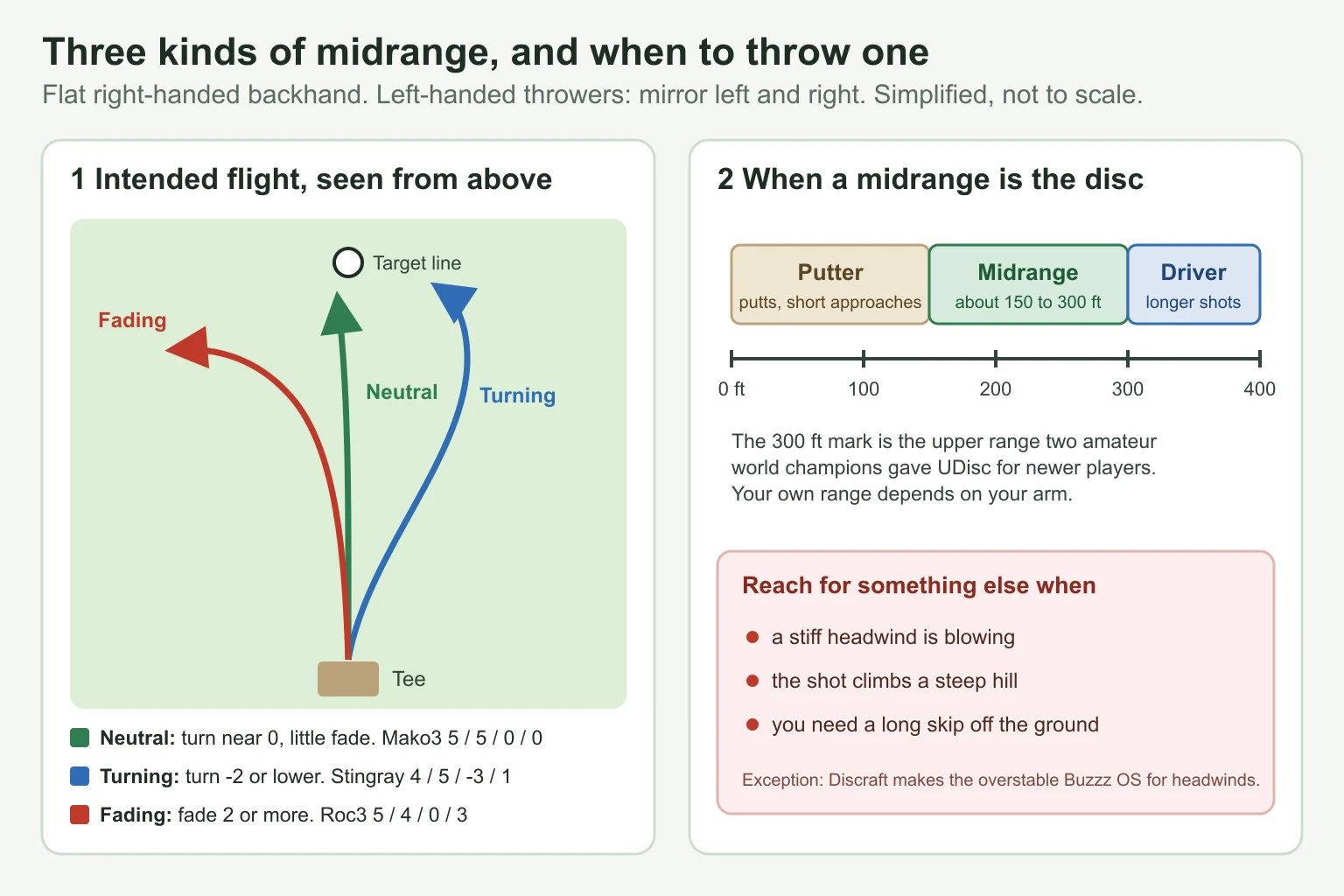
A midrange disc is the slower, wider disc that sits between a putter and a driver. Most midranges are rated speed 4 to 6, and newer players use them for tee shots and approaches up to about 300 feet. To choose your first one, pick a neutral midrange with turn near 0 and little fade, such as the Innova Mako3, Discraft Buzzz or Axiom Hex, in a weight you can throw comfortably. Add a second midrange only when you can name a shot that turns or fades in a way your first one does not.
Further down, 19 midranges from our disc records are sorted by how they fly: neutral, turning or fading.
What is a midrange disc?
UDisc's explainer on how and when to throw midranges calls the midrange the happy medium between a putter and a driver. Midranges are the widest discs on the market, and their rims are narrow and usually rounded, so most hands, including children's, can get a good grip on them. The same article says midranges run from speed 2 to 6 on the common 1 to 15 scale, although almost all of them are rated 4 to 6.
Low speed and plenty of glide mean a smooth, easy throw with a midrange can still go a long way. That is one reason UDisc says new players are often advised to start with just a putter and a midrange. Our beginner guide and first-bag guide build on that idea.
Flight numbers are each manufacturer's own rating. Brands do not use one shared scale, so a 5 / 5 / -1 / 1 from Axiom and the same numbers from Dynamic Discs are not a promise of identical flights. Our flight numbers guide explains what speed, glide, turn and fade describe.
When to throw a midrange
UDisc asked two amateur world champions, AJ Carey and Erikah Weir, when newer players should reach for a midrange. They gave about 300 feet and in as the range. A midrange also fits two in-between cases. If a driver feels like too much disc at 350 feet, throw a midrange. If a putter seems too little for a 150-foot shot, a midrange is the usual answer there too.
That range makes the midrange the disc for many short tee shots and longer approach shots. Plenty of courses have holes around 300 feet or shorter.
Carey also named three times to leave the midrange in the bag: a stiff headwind, a steep uphill shot, and a shot that needs a long skip. One exception is a midrange built for wind. Discraft makes the overstable Buzzz OS as a complement to the regular Buzzz and says to reach for it into a headwind. Our wind guide covers that choice in more detail.
How to choose your first midrange
Start with a neutral midrange: turn close to 0 and fade of 0 to about 1.5. These discs fly fairly straight on a flat release and finish gently, which makes it easier to see what your own release angle is doing. Every disc below has its own DiscField record with the manufacturer's ratings and source.
| Disc | Flight numbers | What the maker or our record says it does |
|---|---|---|
| Innova Mako3 | 5 / 5 / 0 / 0 | Neutral, very little fade; our pick for learning one main throwing disc |
| Discmania MD3 | 5 / 5 / 0 / 1 | Discmania calls it a workhorse midrange found in beginner and pro bags |
| Innova Jay | 5 / 4 / 0 / 1 | Everyday mid with a micro-bead rim, so feel matters when comparing |
| Axiom Hex | 5 / 5 / -1 / 1 | Everyday fairway shots with a little turn and a gentle finish |
| Dynamic Discs Truth | 5 / 5 / -1 / 1 | Mild turn and fade for ordinary throwing lines |
| Discraft Buzzz | 5 / 4 / -1 / 1 | One of the sport's most popular midranges, for controlled everyday shots |
| Latitude 64 Fuse | 5 / 6 / -1 / 0 | Some turn and very little fade, for gentle turning lines |
| MVP Reactor | 5 / 5 / -0.5 / 1.5 | Small turn and a moderate finish, at the stable end of this group |
Two more Latitude 64 midranges belong in this group. Latitude 64 says the Compass (5 / 5 / 0 / 1) holds the angle it is released on, and says the Claymore (5 / 5 / -1 / 1) is a good first midrange and a useful option for learning release angles.
The Mako3, Hex and Buzzz can do a very similar job in a recreational bag. Pick the one that feels good in your hand and that you can find in a weight you like. If you already own one of them, keep throwing it before buying another. Our comparisons of Mako3 vs Buzzz and Hex vs Mako3 go through the close calls.
Then pick a weight. Infinite Discs' midrange guide says most midranges come in about 160 to 180 grams and that lighter ones tend to be easier for beginners. Our disc weight guide explains when a lighter disc helps and when it can struggle in wind.
Turning midranges for turnovers, hyzer flips and rollers
An understable midrange has a turn rating of -2 or lower. On a flat backhand from a right-handed player, it drifts right before it finishes, which makes it useful for a gentle turnover line, a hyzer flip or a roller.
| Disc | Flight numbers | What the maker or our record says it does |
|---|---|---|
| Discraft Comet | 4 / 5 / -2 / 1 | A slower mid for touch shots and learning to shape a turn |
| Discraft Buzzz SS | 5 / 4 / -2 / 1 | The Buzzz family's turning version, with a gentle finish |
| MVP Detour | 5 / 5 / -2 / 1 | Controlled turn with a modest finish |
| Innova Stingray | 4 / 5 / -3 / 1 | A slow mid for gentle curves without moving up to a driver |
| MVP Uplink | 5 / 5 / -3 / 0.5 | Strong turn and very little fade, for touch lines and hyzer-flip practice |
| Innova Rollo | 5 / 6 / -4 / 1 | Innova designed it for rollers and big turning shots |
The Rollo is a specialist. Innova's Rollo page lists it as a best choice for roller shots and sweeping turnovers, and it will turn hard on a throw where a neutral mid would fly straight, so it makes a poor default disc. The Buzzz vs Buzzz SS guide shows how much one point of turn changes inside one family.
Two more turning mids are in our records. Discraft says the Meteor (5 / 5 / -3 / 1) gives steady, controlled turnovers even at slower speeds, and Westside says the Tursas (5 / 5 / -2 / 1) should let you throw a midrange anhyzer while you are still learning the game.
Fading midranges for approaches and finishing shots
An overstable midrange has a fade rating of about 2 or more and little or no turn. It holds a straighter start and then hooks left at the end for a right-handed backhand. That finish helps on approaches where you want the disc to curve into a landing area, on forehands, and, in the case of the Buzzz OS, into a headwind.
| Disc | Flight numbers | What the maker or our record says it does |
|---|---|---|
| MVP Matrix | 5 / 4 / -1 / 2 | MVP designed it to resist turning over, with a long straight flight and a late fade |
| Dynamic Discs EMac Truth | 5 / 5 / 0 / 2 | A more stable version of the Truth, for stable approaches and holding lines |
| Innova Shark | 4 / 4 / 0 / 2 | A slower mid with a noticeable finish |
| Innova Roc3 | 5 / 4 / 0 / 3 | Controlled shots with a strong finish into the landing area |
| Discraft Buzzz OS | 5 / 4 / 0 / 3 | Discraft's pick for headwinds, hard finishes and forehands |
Axiom's Pyro (5 / 4 / 0 / 2.5) also belongs here. Axiom calls it its first overstable midrange and says it has enough stability for consistent flights in strong winds.
Extra fade does not make a disc more accurate. If your neutral midrange already finishes left for you, a fading mid mostly repeats that shot. Our guide to understable vs overstable discs explains how throwing speed changes how much a disc turns before it fades.
How many midranges do you need?
One is enough to start. A second earns its place when it does a different job. Our records suggest a simple pair: a neutral disc such as the Mako3 for everyday lines, plus a fading disc such as the Roc3 for approaches that need a firm finish. A turning mid like the Stingray or Buzzz SS can come later, once you know you want a right-curving shot without picking up a driver.
Two midranges that sit next to each other in the tables above usually overlap. Before you buy a second one, write down the shot it should add in Bag Check, or put the two discs side by side in Compare to see how their ratings differ.
How to try a new midrange in the field
Field work means throwing the same shot over and over in an open area instead of playing a round. Weir told UDisc it is how you learn how much power a shot needs and what different release angles do to the disc. A simple session:
- Hold the disc in a fan grip. Carey spreads the bottom three fingers under the flight plate and tucks his index finger slightly into and under the rim. Our grips guide shows the fan grip.
- Throw at about 60 to 70 percent power, as Carey suggests, and aim for a flat release.
- Watch where the disc starts, which way it drifts and how hard it finishes.
- Throw your current midrange on the same line and compare the two landing areas.
- Repeat on another day before deciding the new disc really flies differently for you.
Treat what you see as a practice note. Plastic, weight and wear all change how one copy of a disc flies. Our practice routine has more ideas for a short session.
Sources and scope
Read October 11, 2026: UDisc's Disc Golf Discs Explained: How & When To Throw Midranges (published August 2020; disc shape, the 2 to 6 speed range, distances, AJ Carey's grip, power and when-not-to-throw advice, Erikah Weir on field work) and Infinite Discs' Midranges: A Complete Guide (typical 160 to 180 gram weights). Innova's Rollo page was also reread October 11, 2026. The flight numbers and disc descriptions come from the manufacturer pages cited on each linked DiscField disc record, checked between September 8 and October 17, 2026. The neutral, turning and fading groups are DiscField's own sorting of those ratings. DiscField has not flight-tested these discs.
Read next
- Best disc golf discs for beginners: a simple 2–3 disc bag
- Mako3 vs Buzzz: flight numbers and which midrange to choose
- Hex vs Mako3: flight numbers and which midrange to choose
- Understable vs overstable discs: what to choose
- Disc golf approach shots: how to throw an upshot for beginners
- Disc golf disc weight guide: which weight should you choose?