DISCFIELD / Buying guides
Best discs for slow arm speed: what to throw under 300 feet
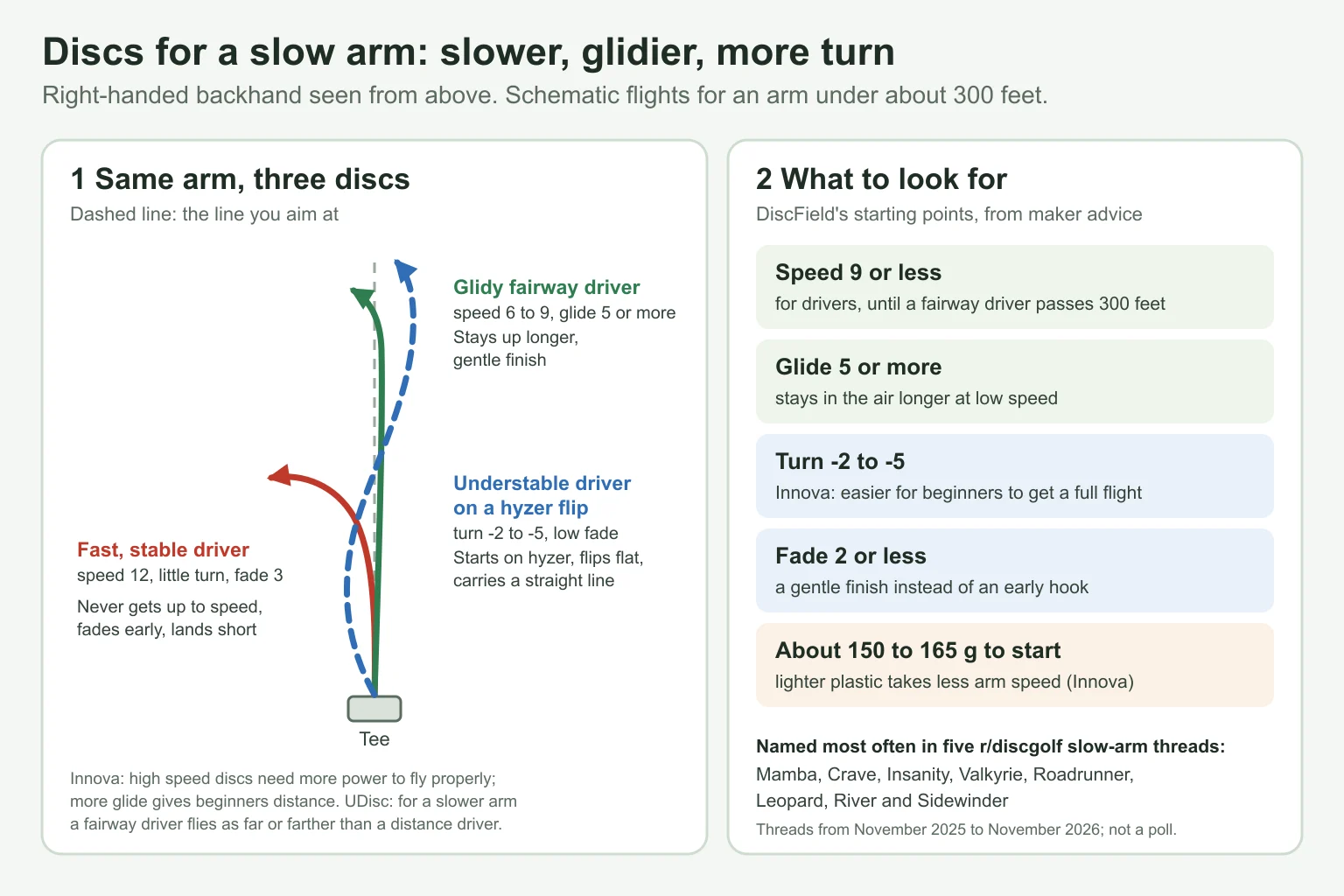
If your drives land under about 300 feet, slower discs will probably fly farther for you than fast ones. Look for drivers rated speed 9 or less, with high glide, some turn and a gentle fade, and buy them at around 150 to 165 g. Throw them on a hyzer flip. The Leopard, Crave and River are good first fairway drivers. When those feel easy, the Valkyrie, Insanity and Heat are the next step up.
We also read the five biggest threads from the past year on r/discgolf where players with slower arms asked what to throw. Together they had about 1,100 comments, and the same handful of discs came up in every one. The full list is further down.
What counts as a slow arm?
There is no official cutoff. This guide uses about 300 feet, the same line our distance driver guide uses for when a faster disc starts to make sense. UDisc's article on fairway drivers says most amateurs throw them at distances near or just above 300 feet. If your best drives land between 200 and 300 feet, you are in good company.
In an r/discgolf thread called "Reality Check - Distance", the top replies point out that the people who post about disc golf every day are better than the average player, and that many players top out around 300 to 330 feet until they do serious form work.
Why a slower disc flies farther for you
Speed is the first flight number. Innova's Flight Numbers Made Simple says a higher speed number requires more power to fly as designed. Its flight ratings page adds that high speed discs are not recommended for beginners, and that beginners who want more distance should choose discs with more glide.
A fast, stable driver thrown below its speed does not turn and glide as it should. It fades early and lands short and left (right-handed backhand). UDisc's fairway driver article says that for a player with slower arm speed a fairway driver flies just as far as a distance driver, if not farther. Our flight numbers guide explains all four ratings.
What to look for in the flight numbers
These starting points are DiscField's, built from the maker advice above. Brands rate on their own scales, so treat them as a guide.
| Flight number | Look for | Why |
|---|---|---|
| Speed | 9 or less for drivers | You can get the disc up to the speed it was designed for |
| Glide | 5 or more | The disc stays in the air longer at low speed |
| Turn | -2 to -5 | Innova says discs rated -2 to -5 are easier for beginners to throw and get a full flight from |
| Fade | 2 or less | A gentle finish instead of an early hook |
An understable disc, one with more turn than fade, is the usual answer. The one exception players keep making is the Mamba, a speed 11 disc with a lot of turn. More on that below.
What players with slower arms recommend
We read five r/discgolf threads posted between November 2025 and November 2026: Distance drivers for slower arms?, People who can't throw 300 ft: what do you like to throw?, 9 or 10 speed driver for someone with average arm strength, Understable fairway driver for noodle arms and Noodle arms, which understable discs opened up your game?. These eight discs were named most often, and each one came up in all five threads.
| Disc | Flight numbers | What the maker or our record says | How players in the threads use it |
|---|---|---|---|
| Innova Mamba | 11 / 6 / -5 / 1 | Innova designs it for maximum distance with minimal effort | Their longest throws, mostly in light or Halo copies; a top-voted reply adds: not in a headwind |
| Axiom Crave | 6.5 / 5 / -1 / 1 | Controlled lines without a large finishing hook | An accurate everyday driver; several call it their controlled distance disc |
| Axiom Insanity | 9 / 5 / -2 / 1.5 | A turning speed 9 driver | The fastest disc some 280 to 320 foot throwers carry |
| Innova Valkyrie | 9 / 4 / -2 / 2 | Innova suggests it for a first distance-driver role | Light Star and DX copies for long straight lines |
| Innova Roadrunner | 9 / 5 / -4 / 1 | A lot of rated turn and little fade | Turning lines, often named together with the Mamba and Sidewinder |
| Innova Leopard | 6 / 5 / -2 / 1 | Our first fairway driver pick | Light DX copies, or a Leopard, Leopard3 and Teebird set for a 300-foot arm |
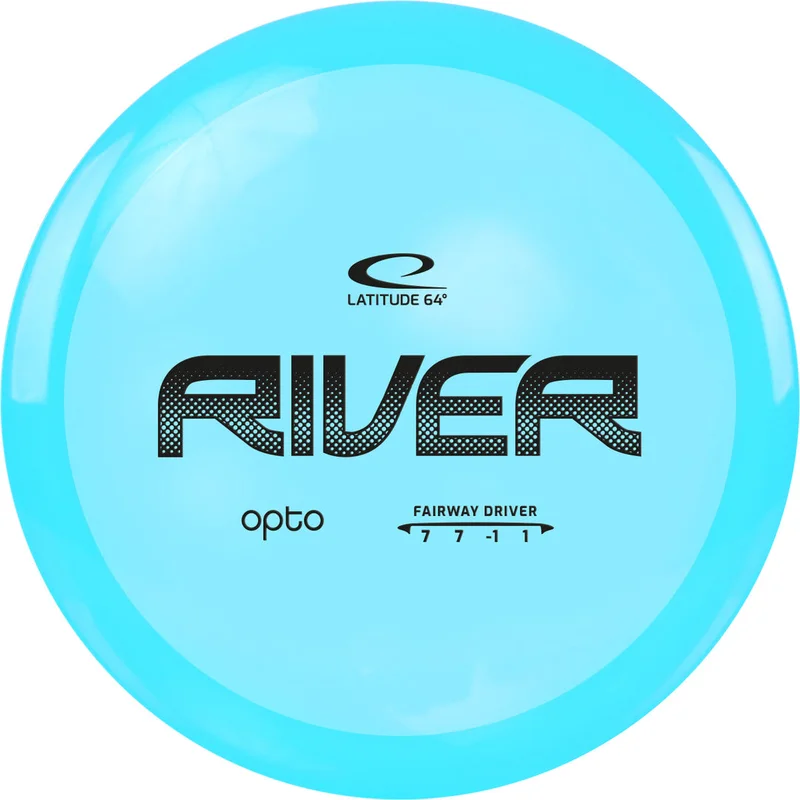
| Latitude 64 River | 7 / 7 / -1 / 1 | High rated glide with modest turn and fade | "Best consistent distance" for one player who had just broken 300 feet |
| Innova Sidewinder | 9 / 5 / -3 / 1 | A turning speed 9 driver | Paired with the Mamba for turning lines |
The disc counts are ours: we counted the comments that name each disc. That is a sample of what players suggest, not a poll or a test. A few comments named a disc to avoid, most often the Destroyer, which Innova itself does not recommend for beginners. As the top-voted reply in the first thread put it, "A faster disc isn't going to get you magic distance."
Other discs that came up in all five threads include the Discraft Heat (9 / 6 / -3 / 1), which Discraft says gives control, glide and distance at slower arm speeds, the Latitude 64 Diamond (8 / 6 / -3 / 1), the Discmania Essence (8 / 6 / -2 / 1), the Innova Leopard3 (7 / 5 / -2 / 1) and the Discraft Avenger SS (10 / 5 / -3 / 1).
A word on the Mamba
The Mamba breaks the speed 9 rule, and players still name it more than any other disc. Its -5 turn is the reason: a slow arm can still get it to turn and glide. The same threads add warnings. Copies differ a lot between plastics, weights and runs: some players call their light Mamba touchy, while others say theirs flies far less flippy than -5. Several keep a heavier or Champion copy for wind, and the most-voted Mamba reply says to leave it in the bag in a headwind. Innova lists it in light StarLite plastic at 139 to 159 g and in Star from 160 g. If you try one, buy a light copy and keep it for open holes and tailwinds.
A simple bag for a slow arm
You do not need every disc above. One disc per row is enough to start (each record has its flight numbers), and our first disc golf bag guide covers the two or three discs to buy first.
| Slot | Start with | When you need it |
|---|---|---|
| Putter | Innova Aviar or Axiom Proxy | Putts and short approaches, where arm speed matters least |
| Midrange | Innova Mako3, Axiom Hex or MVP Detour | Straight shots and approaches |
| Fairway driver | Innova Leopard, Axiom Crave or Latitude 64 River | Your main tee shot |
| Longer driver | Discraft Heat, Axiom Insanity or Innova Valkyrie | Once the fairway driver flies straight before it fades |
Open two of them side by side in Compare, or put the discs you already own into Bag Check to see which slots you have covered.
Weight and plastic
Innova's article on throwing lightweight discs says lighter plastic takes less arm speed to get up to cruising velocity, and that heavy discs tend to hyzer out early when you can't generate enough speed. Our disc weight guide suggests about 150 to 165 g for a first fairway driver. Players in the threads went both ways: some buy as light as they can find, while others settled on about 162 to 168 g. Heavier copies hold their line better in wind, so keep one heavier driver if your course is often windy.
Plastic changes the flight too. Innova rates some premium Champion copies with less turn than the base model, and a beaten-in disc turns more, as our used discs guide explains. If a disc fades early for you, try the same mold in a lighter weight or a more worn copy before buying a different one.
Throw it on a hyzer flip
Understable discs reward a hyzer flip. Release the disc with the outside edge tilted down. As it turns, it rolls up to flat and flies a long straight line before a gentle finish. Hyzer flips come up in 52 comments across the five threads. For many of these players, a light understable driver on a hyzer flip is how they get close to 300 feet.
Better form adds distance whichever disc you throw. Our guide to throwing farther covers the plant, the X-step and a nose-down release.
Do you need to throw farther?
In a thread asking 900-rated players who max out under 300 feet what made the difference, the top answers were putting and the scramble game: getting up and down after a bad drive, and not missing short putts. Our guides to putting and approach shots cover both.
Sources and scope
Read November 20, 2026: UDisc's How & When To Throw Fairway Drivers (amateur distances, slower arms), Innova's Flight Numbers Made Simple (speed and power, the -2 to -5 turn advice), Flight Ratings System (high speed discs, glide and turn for beginners) and Why You Should Throw Lightweight Discs. Flight numbers, weights and maker descriptions come from the manufacturer pages cited on each linked DiscField disc record.
The player recommendations come from the five r/discgolf threads linked above, read in full on November 20, 2026 through the Arctic Shift archive of Reddit, with the "Reality Check - Distance" and 900-rated threads for context. We counted the comments that name each disc and read the most-voted replies. A Reddit thread is a sample of keen players, not a survey, and DiscField has not flight-tested these discs or measured throwing distances.
Read next
- Distance drivers: when you need one and which to choose
- How to throw farther in disc golf: distance tips for beginners
- Disc weight guide for disc golf: which weight should you choose?
- How to throw a hyzer flip: choose a disc and find the angle
- Understable vs overstable discs: what to choose
- Choosing your first fairway driver